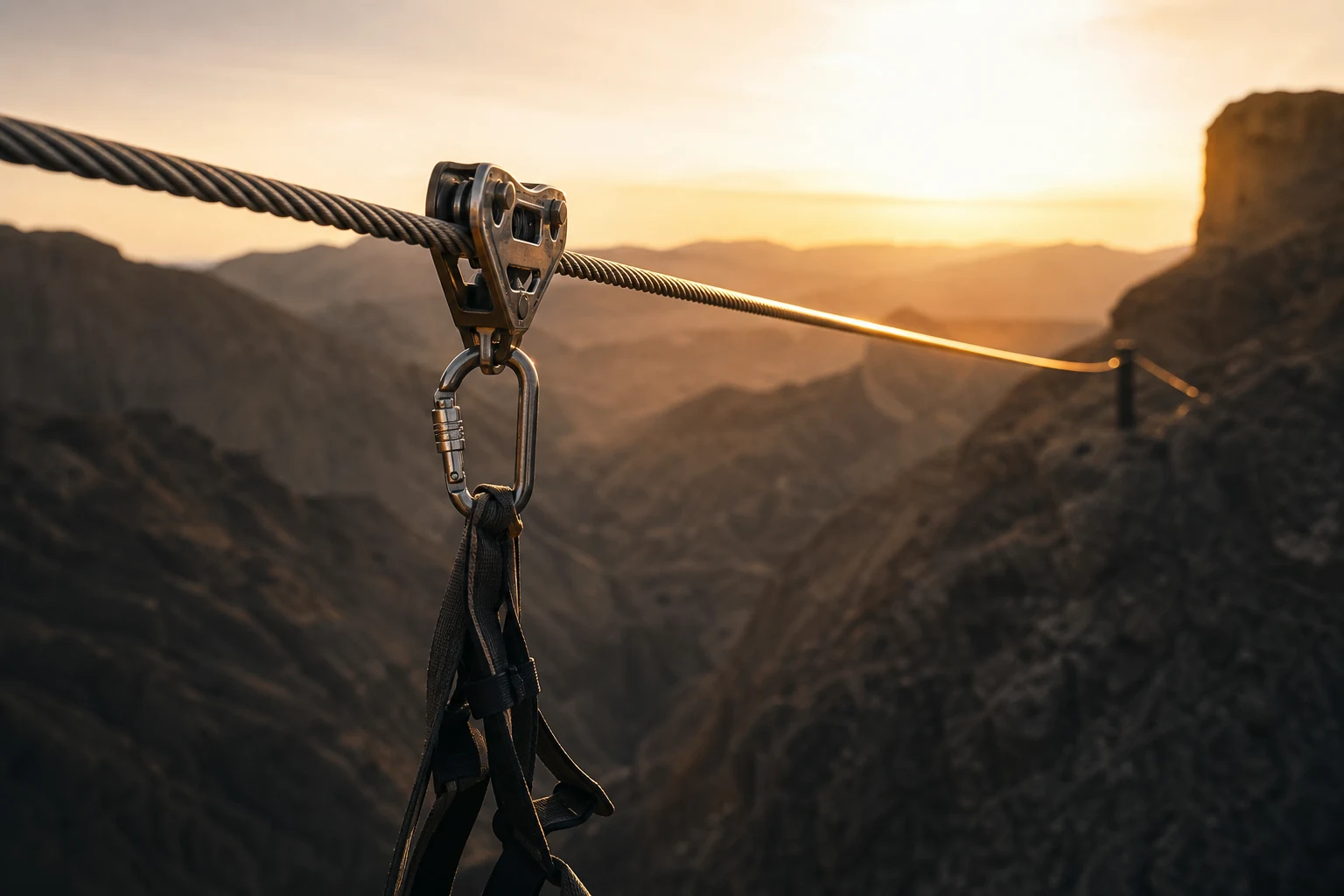
Zip Line Accident Claims in Las Vegas: Your Legal Rights
In This Article
Two hundred feet above a Boulder City canyon, a guide clips a rider's harness onto a steel trolley and lets gravity do the rest — the same rush that draws hundreds of thousands of visitors a year to Clark County's canyon zip line courses and to the twin lines strung above the Fremont Street Experience downtown. Most rides end with nothing worse than a sore grip and a great video. When a cable frays or a harness buckle fails, though, zip line accident claims in Las Vegas raise a legal question most visitors never expect to research: how does Nevada actually regulate a ride that carries you across a canyon on a wire? At Thomas Boley Attorney At Law, we represent injured riders and their families throughout Las Vegas, Henderson, Summerlin, North Las Vegas, and the rest of Clark County, and this guide explains how Nevada's amusement ride law applies, who can be held responsible, and what a signed waiver actually does — and does not — protect.
- NRS 455B.010 defines a covered "amusement ride" as a device that carries passengers "over a fixed or restricted route" primarily for their amusement — a steel zip line cable is about as literal a fit for that language as Nevada's amusement ride statute gets.
- NRS 455B.020 requires the operator to take all measures reasonably necessary to protect passenger safety in constructing, maintaining, operating, and supervising the line.
- NRS 455B.070(3) limits assumption of risk to dangers that are open and obvious to a reasonable rider age 13 or older — a frayed cable, an unlatched carabiner, or an undertrained guide is not a risk a rider signs away just by buying a ticket.
- NRS 455B.090 requires a written incident report at a designated station, or within 120 days if injuries are too severe to report immediately, and the operator must keep that report on file for at least 3 years.
- Liability can extend beyond the tour operator to a harness or trolley manufacturer, the canyon land-lease holder, or an outside inspection and maintenance contractor.
- Nevada's modified comparative negligence rule (NRS 41.141) bars recovery only if you are more than 50% at fault, and the standard personal injury statute of limitations (NRS 11.190) gives you two years to file suit.
Zip Line Accident Claims in Las Vegas: How Nevada's Amusement Ride Law Applies
Free case review
Injured or Facing Charges in Las Vegas?
Thomas Boley offers free consultations — no fees unless we win your case.
Clark County's zip lines fall into two very different settings, and both draw huge crowds. Downtown, the SlotZilla lines send riders flying above the packed pedestrian mall of the Fremont Street Experience in full view of thousands of onlookers below. Outside the valley, canyon adventure courses near Boulder City send riders across open desert terrain hundreds of feet above the ground, often as part of a multi-line tour with several launch platforms. Both setups share the same basic legal DNA: a rider is clipped to a moving trolley on a fixed steel cable and released, with essentially no ability to control speed, stop, or steer once the line is running. That total dependence on someone else's equipment and judgment is exactly the situation Nevada's amusement ride statute was written to address, and it is why zip line accident claims in Las Vegas usually start with a single question — did the operator meet the safety duty the law actually imposes on it, or did it cut a corner that put a paying rider at risk?
How Zip Line Accidents Happen in Las Vegas and Clark County
Most zip line injuries trace back to a small set of recurring failures, and Nevada's extreme summer heat makes several of them worse:
- Equipment failure: A frayed or improperly tensioned cable, a worn trolley wheel, or a harness buckle skipped during a scheduled inspection.
- Improper clipping-in: A guide who attaches a rider's carabiner to the wrong point or rushes a launch during a busy rotation.
- Braking system failure: A primary or backup brake that does not engage in time, causing a hard impact at the landing platform.
- Platform hazards: Unstable stairs, wet decking, or an unsecured railing at a launch or landing tower.
- Weather and heat: Extreme desert heat can affect cable tension and harness webbing, and wind gusts can swing a rider into a tower or rock face.
- Weight or medical screening errors: An operator who ignores posted weight limits or clears a rider who should have been turned away.
- Collision with another rider or structure: Improper spacing on the same line, or a failure to clear the landing zone before the next launch.
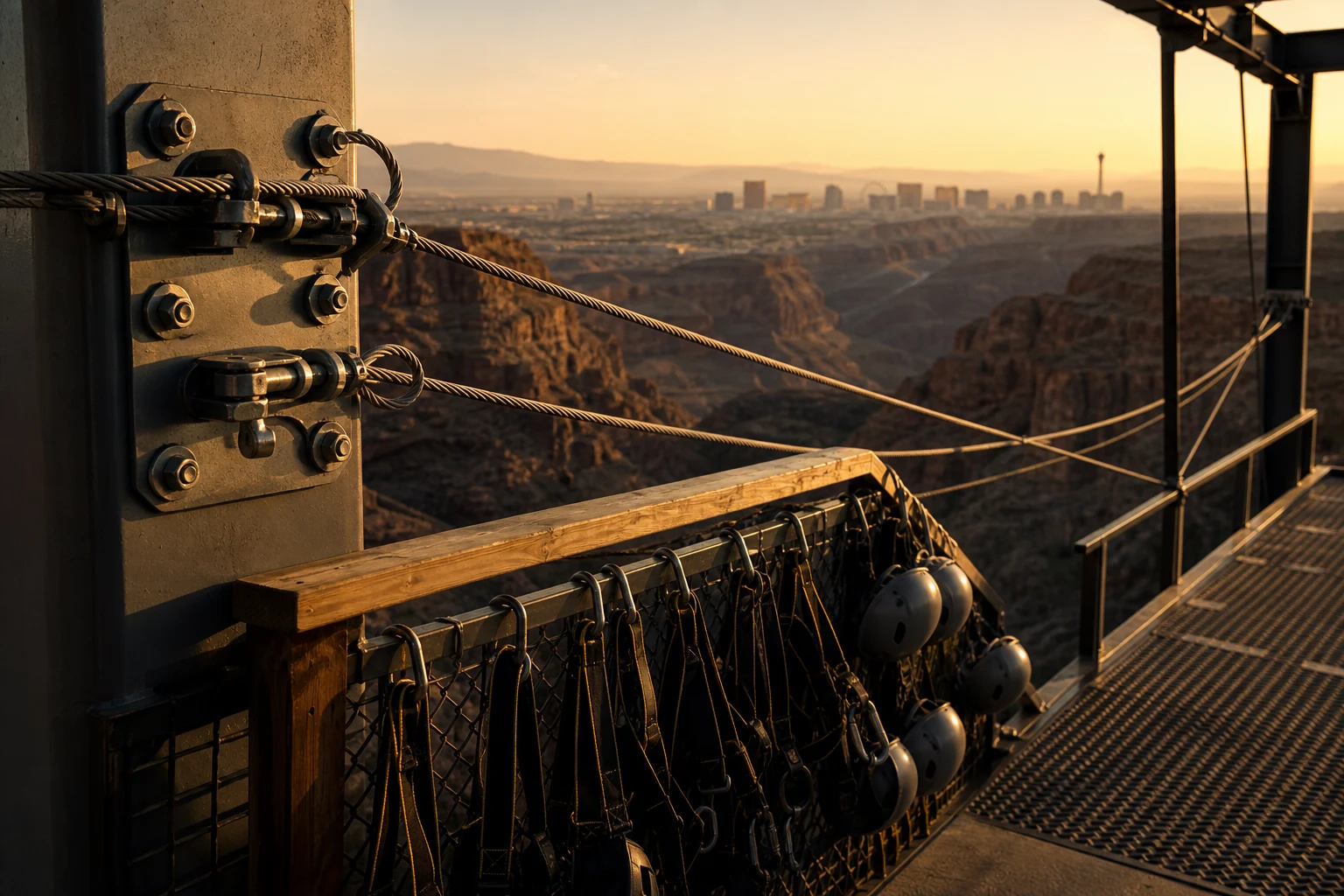
NRS 455B: Nevada's Amusement Ride Safety Law and Zip Lines
Nevada regulates amusement rides through a compact but specific statute, and a zip line fits its language unusually well. NRS 455B.010 defines an "amusement ride" as a mechanical or aquatic device that carries passengers "over a fixed or restricted route" primarily for their amusement — language that describes a cable-based ride about as directly as any attraction the statute reaches. NRS 455B.020 does the real legal work: it requires an operator — defined broadly as anyone who "owns, leases, manages or operates" a facility with amusement rides — to take all measures reasonably necessary to ensure passenger safety in constructing, maintaining, operating, and supervising the ride. A skipped cable inspection, an ignored maintenance alert, or an undertrained guide is not just careless under this statute — it is evidence the operator's statutory duty was violated. The same chapter requires posted signage at launch platforms explaining passenger responsibilities and the reporting-station location under NRS 455B.030, and it requires riders to follow posted instructions under NRS 455B.050 and NRS 455B.060.
Nevada law also requires an injured rider to document the incident. Under NRS 455B.090, a passenger hurt on a covered ride must file a written report at a staffed reporting station the operator is required to maintain, unless the injury is too severe to allow it — in which case the report is still due "as soon as practicable, but in no event later than 120 days after the incident." The operator must keep that report on file for at least 3 years and make it available to the injured rider or their attorney. Filing that report, and keeping your own copy, creates a contemporaneous record that is far harder for an insurer to dispute months later.
Zip Line Waivers in Nevada: Assumption of Risk vs. Operator Negligence
Every zip line tour requires riders to sign a waiver before they ever reach the platform, and most riders assume that signature ends their legal options if something goes wrong. Nevada law does not actually work that way. NRS 455B.070(3) provides that a passenger age 13 or older is deemed to assume the inherent risks of an amusement ride only to the extent those risks are "open and obvious to the reasonable person." The ordinary sensation of height, speed, and wind on a zip line is that kind of open and obvious risk. A frayed cable that should have been retired, a carabiner clipped to the wrong anchor point, an unmaintained braking system, or a guide who rushed a safety check are not risks a rider agrees to just by signing a form — they are the operator's own negligence, and Nevada courts generally will not let a waiver excuse a business for that. Courts also construe any ambiguity in a waiver against the company that drafted it.
Who Can Be Held Liable After a Zip Line Accident
A zip line tour usually involves more potential defendants than riders expect:
- The tour operator: Carries the core NRS 455B duty to build, maintain, and supervise the ride safely, plus the premises liability duty owed to a paying guest under NRS 41.130.
- Guides and staff: A guide who improperly clips in a rider or clears an unsafe launch can create liability for the operator under ordinary negligence principles.
- Equipment manufacturers: If a harness, carabiner, or braking component failed due to a design or manufacturing defect, the manufacturer can face a separate product liability claim.
- Inspection and maintenance contractors: Courses that outsource cable tensioning or equipment servicing can create independent liability if a contractor's inspection missed a defect it should have caught.
- The land-lease holder: Canyon courses are often built on leased land, and the underlying property owner can share responsibility for hazards tied to the land itself, such as an unstable tower foundation.
Common Injuries From Zip Line Accidents in Las Vegas
Zip line injuries range from minor to catastrophic, depending on the cause and height involved:
- Fall injuries: Fractures, spinal injuries, and traumatic brain injuries from a harness or cable failure.
- Collision injuries: Fractures and soft-tissue trauma from a hard impact with a platform, tower, or rock face.
- Rope burn and lacerations: Deep abrasions from an uncontrolled slide or a malfunctioning trolley.
- Shoulder and harness-strap injuries: Dislocations from an improperly fitted or overtightened harness.
- Heat-related emergencies: Heat exhaustion or heat stroke from extended waits on an exposed platform.
- Wrongful death: The most severe cable, braking, or harness failures can be fatal on high canyon courses.
Damages You Can Recover After a Zip Line Accident
If negligence caused your accident, Nevada law may entitle you to recover:
- Medical expenses: Emergency transport out of a remote canyon course, hospitalization, surgery, and future care related to your injury.
- Lost wages and earning capacity: Income lost during recovery and any long-term reduction in your ability to work.
- Pain and suffering: Compensation for physical pain, emotional distress, and diminished quality of life.
- Scarring and disfigurement: Additional compensation for visible injuries from lacerations or rope burns.
- Wrongful death damages: If a loved one was killed in a zip line accident, survivors may recover funeral expenses, lost financial support, and loss of companionship under NRS 41.085.
- Get medical attention immediately, even for an injury that feels minor — a remote canyon location can delay treatment, so a full evaluation still matters once you reach care.
- Go to the designated injury-reporting station required by NRS 455B.030 and file the written report required by NRS 455B.090; keep a copy for yourself.
- Photograph your harness, the cable, the launch or landing platform, and your injuries before conditions change or equipment is serviced.
- Get the names and contact information of your guide, other staff present, and any fellow riders who witnessed what happened.
- Keep your ticket, waiver copy, and any confirmation emails as proof of your booking and the date.
- Do not sign anything further from the operator or its insurer, and avoid giving a recorded statement, before speaking with an attorney.
- Contact a Las Vegas personal injury attorney promptly — the 120-day report deadline and equipment condition both benefit from early action.
Statute of Limitations for Zip Line Accident Claims in Nevada
Under NRS 11.190, you generally have two years from the date of your injury to file a personal injury lawsuit in Nevada. A minor injured on a zip line generally has their own claim tolled until two years after their 18th birthday under NRS 11.250, though a parent's related claims run on the standard two-year clock. Missing the applicable deadline can permanently bar your claim, so do not wait to get legal advice, particularly since cable and harness equipment gets serviced, replaced, or rotated out of use over time.
- Can I sue if I signed a waiver before my zip line ride? Often, yes. Nevada law limits assumption of risk to open and obvious inherent dangers; a waiver generally cannot excuse an operator's own negligence, such as a maintenance failure or improper clip-in.
- Does Nevada actually regulate zip lines? Yes. Zip lines generally fall under NRS Chapter 455B, Nevada's amusement ride safety law, which requires operators to take all measures reasonably necessary to protect rider safety.
- Who can I sue after a zip line accident — the tour company or the equipment maker? It depends on the cause. The tour operator is responsible for maintenance, supervision, and staff training; the original equipment manufacturer can be separately liable if a defective harness, trolley, or braking component caused the harm.
- What if I was partly at fault for my own accident? Under Nevada's comparative negligence rule, you can still recover as long as your own fault does not exceed 50 percent; your damages are reduced by your share of fault.
- How long do I have to file a zip line accident claim in Nevada? Generally two years from the date of injury under NRS 11.190, with a longer tolled window for a minor's own claim under NRS 11.250.
Speak With a Las Vegas Zip Line Accident Attorney
Thomas Boley has represented injured visitors and Las Vegas locals for more than 18 years, including claims arising from Strip-area and canyon attractions where sorting out an operator's duty under Nevada's amusement ride statute determines whether a claim succeeds.
Call (702) 435-3333 for a free consultation, or contact Thomas Boley online to discuss a zip line accident in Las Vegas, Henderson, Summerlin, North Las Vegas, or elsewhere in Clark County. Our full personal injury practice handles Strip and Clark County attraction injuries of every kind, and our guides to High Roller accident claims and comparative negligence in Nevada cover closely related issues. This article is informational only and is not legal advice. Every case is unique.
About the Author
Thomas Boley is a Nevada licensed attorney specializing in personal injury law and criminal defense. Since 2008, Thomas has represented thousands of clients in Las Vegas and Clark County, recovering millions of dollars in compensation for injury victims. He is a member of the State Bar of Nevada, the Clark County Bar Association, and the Nevada Justice Association.
Need Legal Help? Contact Thomas Boley for a free consultation: (702) 435-3333