High Roller Accident Claims in Las Vegas: Your Legal Rights
In This Article
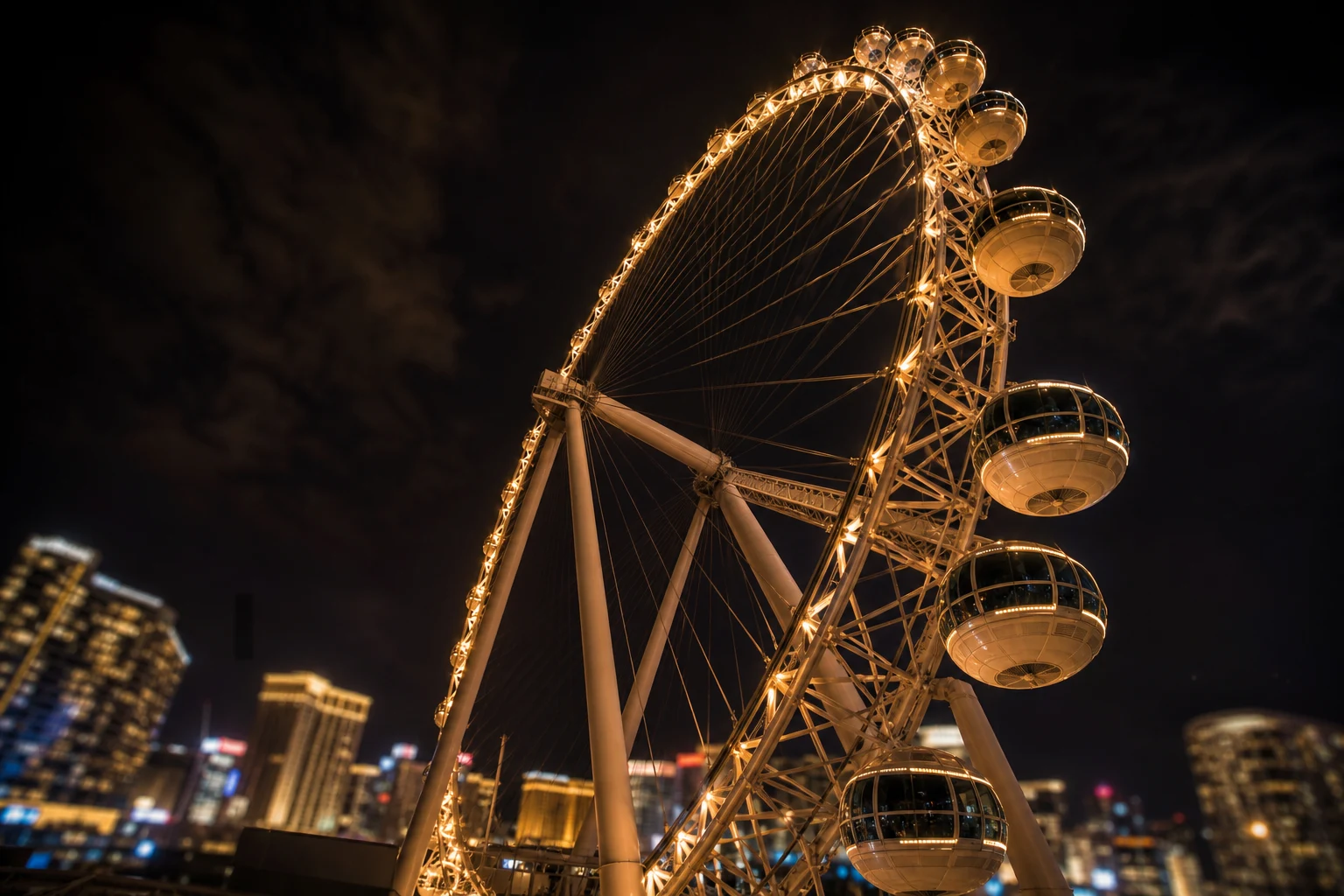
Halfway through the 30-minute rotation, 550 feet above the LINQ Promenade, a glass gondola pod on the world's tallest observation wheel grinds to a stop and the doors won't open. For most riders trapped above the Strip skyline, it's an unnerving story to tell later. For a smaller number, a hard jolt, a restraint bar that won't release, or a fall while boarding a pod that never fully stops turns a bucket-list photo op into a real injury. High Roller accident claims in Las Vegas sit at the intersection of two areas of law most visitors never think about — Nevada's amusement ride statute and ordinary premises liability — and which one actually controls can decide whether an injured rider has a case at all. At Thomas Boley Attorney At Law, we help injured guests and locals throughout Las Vegas, Henderson, Summerlin, North Las Vegas, and the rest of Clark County sort out who is actually responsible after getting hurt on the High Roller or a similar observation attraction.
- NRS 455B.020 requires an amusement ride operator to take all measures reasonably necessary to ensure passenger safety while constructing, maintaining, operating, and supervising a ride like the High Roller.
- NRS 455B.070(3) only lets an operator point to assumption of risk for dangers that are open and obvious to a reasonable person — a mechanical malfunction, a maintenance failure, or an operator's mistake is not an inherent, assumed risk.
- NRS 455B.090 requires an injured rider to file a written incident report at a designated station; if injuries are too severe to report right away, the deadline is 120 days, and the operator must keep the report on file for at least 3 years.
- More than one party can potentially be liable: the ride operator and premises owner, the ride's original manufacturer or a parts supplier if a mechanical defect caused the harm, and an outside maintenance contractor if inspection or repair work was outsourced.
- Nevada does not run a dedicated state inspection agency for fixed amusement rides the way some states do — day-to-day safety oversight leans heavily on the operator's own compliance with NRS 455B and local permitting rather than a routine state inspector.
- Nevada's modified comparative negligence rule, NRS 41.141, bars recovery only if an injured rider is more than 50% at fault, and otherwise reduces the award by the rider's own percentage of fault.
- Nevada's 2-year personal injury statute of limitations, NRS 11.190, applies to a High Roller or observation wheel accident claim the same as any other injury case.
High Roller Accident Claims in Las Vegas: How Nevada Law Applies
Free case review
Injured or Facing Charges in Las Vegas?
Thomas Boley offers free consultations — no fees unless we win your case.
High Roller accident claims in Las Vegas rarely turn on a single, tidy legal theory, because the wheel itself sits at the intersection of two different duties of care. As a paying guest on private resort property along the LINQ Promenade, an injured rider is a legal invitee, owed the highest duty of care Nevada premises liability law provides — the property owner and operator must inspect for hazards, fix or warn about what they find, and keep the walkways, boarding platforms, and queue areas reasonably safe. Layered on top of that ordinary premises duty is a second, ride-specific one: Nevada's amusement ride statute, NRS Chapter 455B, which applies to any "mechanical or aquatic device which carries passengers over a fixed or restricted route primarily for the passengers' amusement" — language that covers a 550-foot observation wheel just as clearly as it covers a roller coaster. Untangling which duty was breached, and by whom, is usually the first real work in evaluating a claim.
How Accidents Happen on the Las Vegas High Roller and Similar Attractions
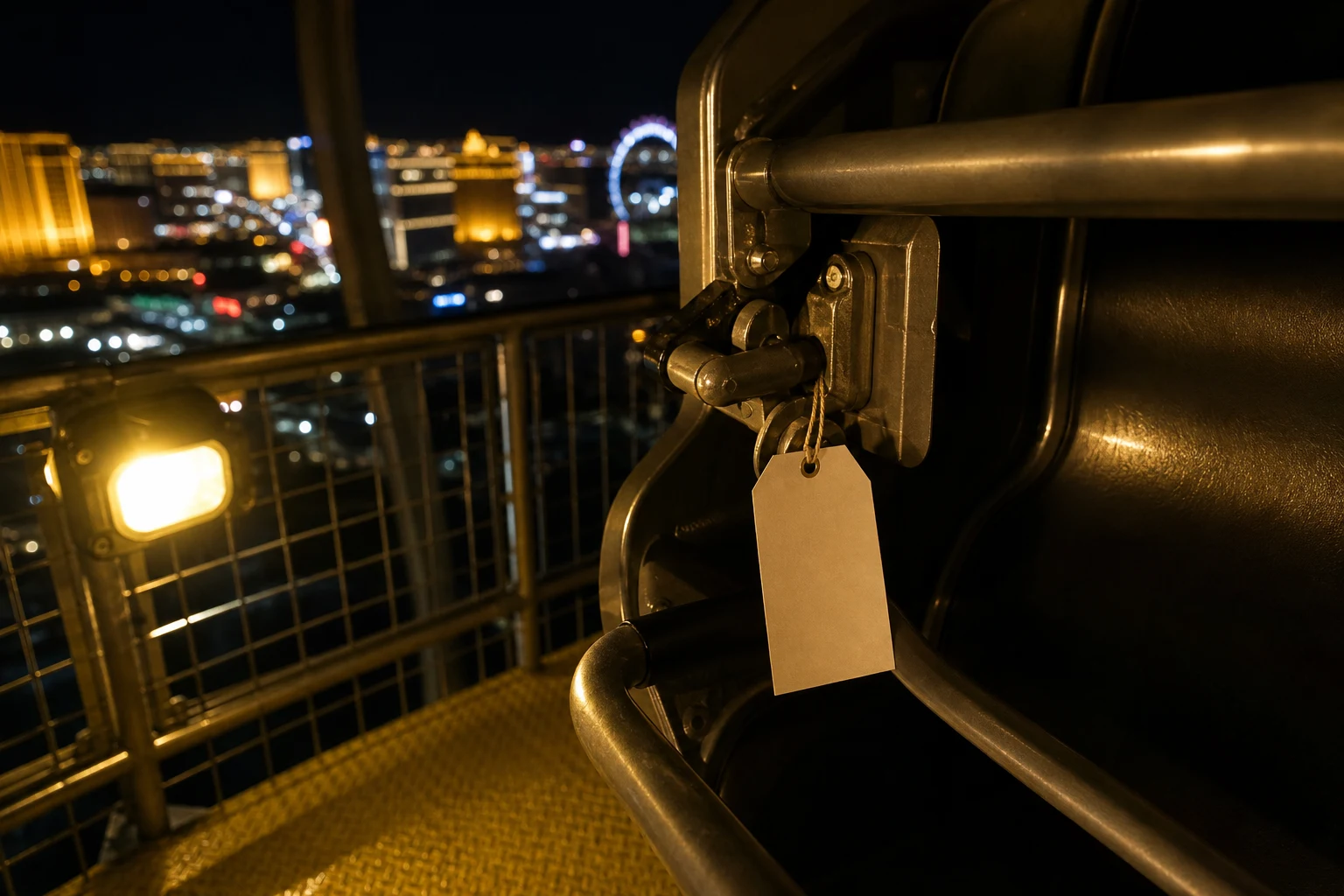
Injuries on the High Roller and comparable Las Vegas observation attractions tend to fall into a handful of recurring patterns rather than one obvious cause. A pod can stall mid-rotation because of an electrical, network, or drive-motor fault, trapping riders at height for an extended period and turning a medical condition like a panic attack, a cardiac event, or heat exhaustion in a glass-walled pod into a genuine emergency if staff are slow to respond. A gondola can tilt or fail to level correctly as it approaches the loading platform, throwing riders against a wall or door before anyone can brace. A restraint bar or door latch can fail to lock, or can be defective from the manufacturer, leaving a rider exposed at a point in the rotation where a fall would be catastrophic. Because the wheel loads continuously at a slow crawl rather than stopping fully for each group, as our guide to amusement park and attraction injuries in Las Vegas explains happens at other Strip-area rides, a rider can be struck or knocked off balance by a moving pod door while boarding or exiting, especially an older guest, a child, or someone with a mobility issue. And because the wheel is one stop along a larger promenade built around the same hotel and resort injuries we see throughout Las Vegas — wet ramps, uneven pavers, inadequate lighting at night — a slip-and-fall on the approach to the platform is just as common as anything involving the ride mechanism itself.
NRS 455B: Nevada's Amusement Ride Safety Law Explained
Nevada addresses amusement ride safety through a compact but specific statute, NRS 455B.020, which requires an operator — defined broadly as any person who "owns, leases, manages or operates" a facility with amusement rides — to "take all measures reasonably necessary to ensure the safety of the passengers in constructing, maintaining, operating and supervising an amusement ride." That single sentence does most of the legal work in a High Roller injury claim: it creates an affirmative, ride-specific duty that exists independent of ordinary negligence law, and a failure to meet it — a skipped inspection, an ignored maintenance alert, an undertrained attendant — is itself evidence the statute was violated. The same chapter requires an operator to post signs at entrances, exits, and boarding points explaining passenger responsibilities and the location of the station for reporting an injury under NRS 455B.030, and it requires passengers themselves to heed posted warnings and avoid the specific list of prohibited conduct set out in NRS 455B.050 and NRS 455B.060, such as disabling a restraint device or purposefully boarding or exiting outside the time and place an attendant directs.
One part of the statute surprises almost every injured rider we talk to: Nevada law does not just encourage an injury report — it requires one. Under NRS 455B.090, a passenger who is hurt on a ride "shall make a written report concerning the details of the incident" at a staffed reporting station the operator is required to maintain, unless the injuries are too severe to allow it. If severe injuries make immediate reporting impossible, the report must still be filed "as soon as practicable, but in no event later than 120 days after the incident." The operator, in turn, must keep that report on file for at least 3 years and make it available for inspection by the injured person or their attorney. Skipping this step doesn't necessarily end a claim, but filing it — and keeping a copy — creates a contemporaneous record that is far harder for an insurer to dispute months later.
Assumption of Risk vs. Operator Negligence: Where Nevada Law Draws the Line
Every High Roller ticket comes with warnings and, typically, waiver language a guest agrees to before boarding, and the operator's first move after a claim is filed is almost always to point to that waiver and to NRS 455B.070(3), which says a passenger age 13 or older is deemed to "assume the inherent risks of an amusement ride to the extent that those risks are open and obvious to the reasonable person." That defense has a hard limit built into its own language: it only reaches risks that are inherent and obvious — the ordinary sensation of height, motion, or an enclosed pod. A mechanical malfunction, a software or network fault that traps a pod mid-rotation, a restraint bar that fails to latch, negligent maintenance, or an undertrained attendant who mishandles a boarding accident are not risks a reasonable rider signs up for just by buying a ticket, and a waiver generally cannot be used to sign away a claim based on the operator's own negligence under Nevada law. In practice, that means the real fight in most High Roller accident claims in Las Vegas is not whether a waiver exists — it almost always does — but whether what actually happened was an open, obvious risk of riding a giant wheel, or a failure the operator was specifically obligated to prevent under NRS 455B.020.
Who Can Be Held Liable After a High Roller or Observation Wheel Accident
Because a modern observation wheel is a manufactured mechanical structure operated by a resort but frequently built, maintained, or serviced by outside specialists, more than one party can end up sharing responsibility for a single incident. The ride operator and the resort that owns the promenade carry the core NRS 455B and premises liability duties described above. If the actual cause traces back to a defective part — a restraint mechanism, a door sensor, a drive motor — the manufacturer or a parts supplier can face a separate Nevada product liability claim, independent of anything the operator did wrong on the day of the incident. Where inspection, maintenance, or repair work was contracted out rather than handled in-house, the maintenance company itself can be a defendant if its inspection missed or ignored a defect it should have caught. It's a structure similar to what we see with other mechanized Strip transit and attractions — our guide to Las Vegas monorail accident claims walks through the same multi-defendant analysis for a different mechanical people-mover. And Nevada's modified comparative negligence rule, NRS 41.141, still applies on the other side of the ledger: if an injured rider ignored a posted safety instruction or violated one of the prohibited-conduct rules in NRS 455B.050, an insurer will argue for a reduction in — or complete denial of — any recovery based on that rider's own share of fault.
- Get medical attention first, even if an injury seems minor — heat exhaustion, a cardiac event, or a soft-tissue injury from a jolt can worsen quickly.
- Go to the designated injury-reporting station required by NRS 455B.030 and file the written report required by NRS 455B.090; ask for a copy before you leave.
- Note the exact pod number, boarding time, and approximate time and location on the rotation where the incident happened.
- Photograph the restraint bar, door, platform surface, and any posted warning signs before conditions change.
- Get names and contact information for other riders in your pod and any witnesses on the platform.
- Do not sign anything beyond what is necessary for medical treatment, and avoid giving a recorded statement to the operator's insurer before speaking with an attorney.
- Contact a Las Vegas personal injury attorney promptly — the 120-day report deadline and the 2-year filing deadline under NRS 11.190 both benefit from an early start.
- Can I sue if I was hurt on the High Roller in Las Vegas? Potentially, yes. If the injury resulted from a mechanical malfunction, negligent maintenance, an untrained attendant, or a hazard on the boarding platform — rather than an open and obvious inherent risk of riding — Nevada law allows a claim against the operator, and possibly the manufacturer or a maintenance contractor.
- Does the waiver I agreed to when I bought my ticket stop me from suing? Generally, no, not for the operator's own negligence. NRS 455B.070(3) limits assumed risk to open and obvious inherent dangers — a waiver typically cannot erase a claim based on a mechanical defect or the operator's failure to meet its NRS 455B.020 safety duty.
- What if the ride just stalled and I wasn't physically touched? A stall or extended stop at height can still support a claim if it caused a medical emergency, a panic-related injury, or significant harm from prolonged exposure to heat or confinement, especially if staff response was delayed.
- How long do I have to report an injury versus file a lawsuit? A written incident report is generally required at the time of the injury, or within 120 days if you were too injured to report immediately, under NRS 455B.090. A lawsuit itself must generally be filed within 2 years under NRS 11.190.
- Who is actually responsible — the ride operator or the manufacturer? It depends on the cause. The operator is responsible for maintenance, supervision, and premises safety; the original manufacturer or a parts supplier can be separately liable if a defective component caused the harm.
Speak With a Las Vegas High Roller Accident Attorney
Thomas Boley has represented injured visitors and Las Vegas locals for more than 18 years, including claims arising from Strip-area attractions where sorting out the operator's duty under Nevada's amusement ride statute, and separating it from an ordinary and obvious risk of the ride itself, determines whether a claim succeeds.
Call (702) 435-3333 for a free consultation, or contact Thomas Boley online to discuss a High Roller, observation wheel, or other attraction injury in Las Vegas, Henderson, Summerlin, North Las Vegas, or elsewhere in Clark County. Bring any incident report, photographs, and medical records you have. Our slip and fall practice and our full personal injury practice handle every stage of an attraction-related injury claim. This article is informational only and is not legal advice. Every case is unique.
About the Author
Thomas Boley is a Nevada licensed attorney specializing in personal injury law and criminal defense. Since 2008, Thomas has represented thousands of clients in Las Vegas and Clark County, recovering millions of dollars in compensation for injury victims. He is a member of the State Bar of Nevada, the Clark County Bar Association, and the Nevada Justice Association.
Need Legal Help? Contact Thomas Boley for a free consultation: (702) 435-3333