Truck Accidents in Las Vegas: What You Need to Know to Get Full Compensation
In This Article
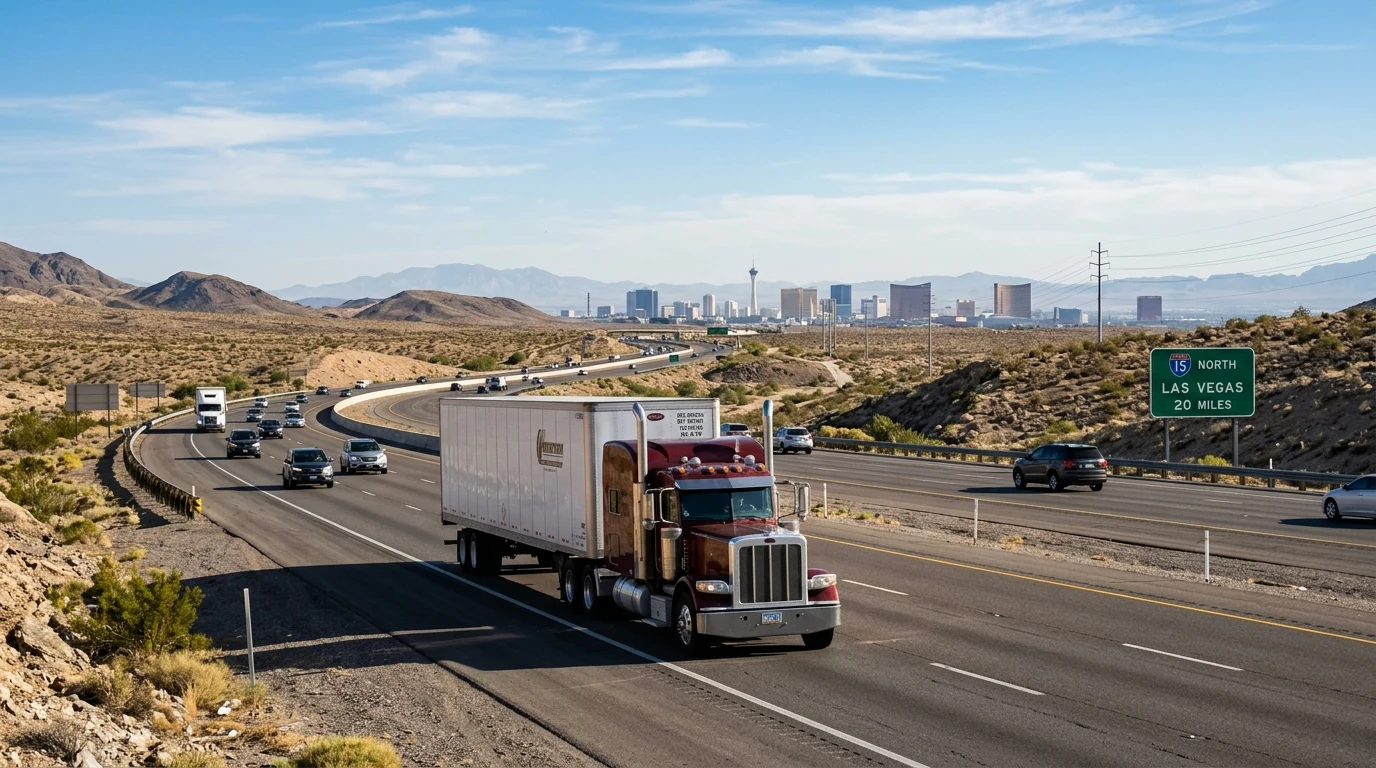
Las Vegas sits at the crossroads of some of the most heavily traveled commercial trucking corridors in the American West. Interstate 15 — connecting Southern California to Utah through the heart of Clark County — carries an enormous volume of 18-wheelers and commercial freight vehicles every single day. Add the constant deliveries to Strip hotels, the distribution centers along the 215 Beltway, and construction traffic feeding the valley's relentless growth, and you have a recipe for frequent, catastrophic truck accidents. When a fully loaded commercial semi-truck weighing up to 80,000 pounds collides with a passenger vehicle, the results are devastating. If you or a loved one was injured in a truck accident in Las Vegas, Henderson, or anywhere in Clark County, the Law Offices of Thomas Boley can help you pursue the full compensation you deserve — on a contingency fee basis, with no upfront cost.
How Truck Accidents Differ from Regular Car Accidents
Truck accident cases are fundamentally more complex than standard passenger vehicle crashes — and typically involve far higher stakes. Key differences include:
Free case review
Injured or Facing Charges in Las Vegas?
Thomas Boley offers free consultations — no fees unless we win your case.
Multiple liable parties: A passenger car accident usually involves one negligent driver. A truck accident may involve the driver, the trucking company (carrier), the cargo shipper or loader, the truck manufacturer, a maintenance contractor, or all of the above — each with separate insurance policies and legal teams.
Federal regulations: Commercial trucking is governed not just by Nevada law but by Federal Motor Carrier Safety Administration (FMCSA) regulations, which mandate driver hours-of-service limits, vehicle inspection requirements, drug and alcohol testing, electronic logging device (ELD) requirements, and minimum insurance levels. Violations of FMCSA rules are often central to proving liability.
Massive insurance policies: Under FMCSA regulations, interstate commercial carriers must carry a minimum of $750,000 in liability insurance — and most large carriers carry $1 million or more. This means higher potential compensation, but also aggressive defense teams whose job is to minimize your recovery.
Evidence disappears fast: Trucking companies have rapid-response teams that dispatch to accident scenes immediately to protect the company's interests. Electronic logs, black box data (ECM), and driver records can be altered or destroyed if legal holds are not issued promptly. Immediate attorney involvement is critical.
We cover the surrounding issues in more depth in what to Do After a Car Accident in Las Vegas and in uber and Lyft Accidents in Las Vegas.
Common Causes of Truck Accidents in Las Vegas
Our investigation of truck accident cases in Clark County consistently reveals several recurring causes:
Driver fatigue: Despite FMCSA hours-of-service rules (49 C.F.R. § 395.3) limiting commercial drivers to 11 hours of driving within a 14-hour window after 10 consecutive off-duty hours, driver fatigue remains the leading cause of truck accidents. Pressure from carriers to make delivery windows often pushes drivers to violate these limits. ELD data, driver logs, and fuel and toll records can reveal when rules were broken.
Distracted driving: Texting, GPS use, and radio operation are major distractions for truck drivers. Nevada law (NRS 484B.165) prohibits all handheld device use while driving. FMCSA regulations go further, banning texting while operating a commercial motor vehicle under 49 C.F.R. § 392.82.
Speeding and aggressive driving: Heavy vehicles require far greater stopping distances. A fully loaded 18-wheeler traveling at 65 mph on I-15 needs approximately 525 feet to stop — nearly two football fields. Speeding or aggressive lane changes dramatically increase both the likelihood of a crash and its severity.
Improper cargo loading: Unbalanced or overweight loads cause rollovers, jackknifing, and tire blowouts. Under FMCSA rules and Nevada law, cargo must be properly secured and within federal weight limits. If a third-party loader caused a shift in cargo that contributed to your crash, that company is also a liable defendant.
Truck maintenance failures: Brake failures, blown tires, and defective lighting are common factors in Nevada truck crashes. Federal regulations (49 C.F.R. Part 396) require carriers to maintain systematic inspection, repair, and maintenance programs. When maintenance records show known defects that weren't repaired, that evidence is powerful proof of negligence.
Impairment: FMCSA regulations (49 C.F.R. § 382) require pre-employment, random, post-accident, and reasonable-suspicion drug and alcohol testing for commercial drivers. A positive post-accident test — or evidence of a carrier that failed to conduct required testing — significantly strengthens a negligence claim.
Who Can Be Held Liable in a Las Vegas Truck Accident?
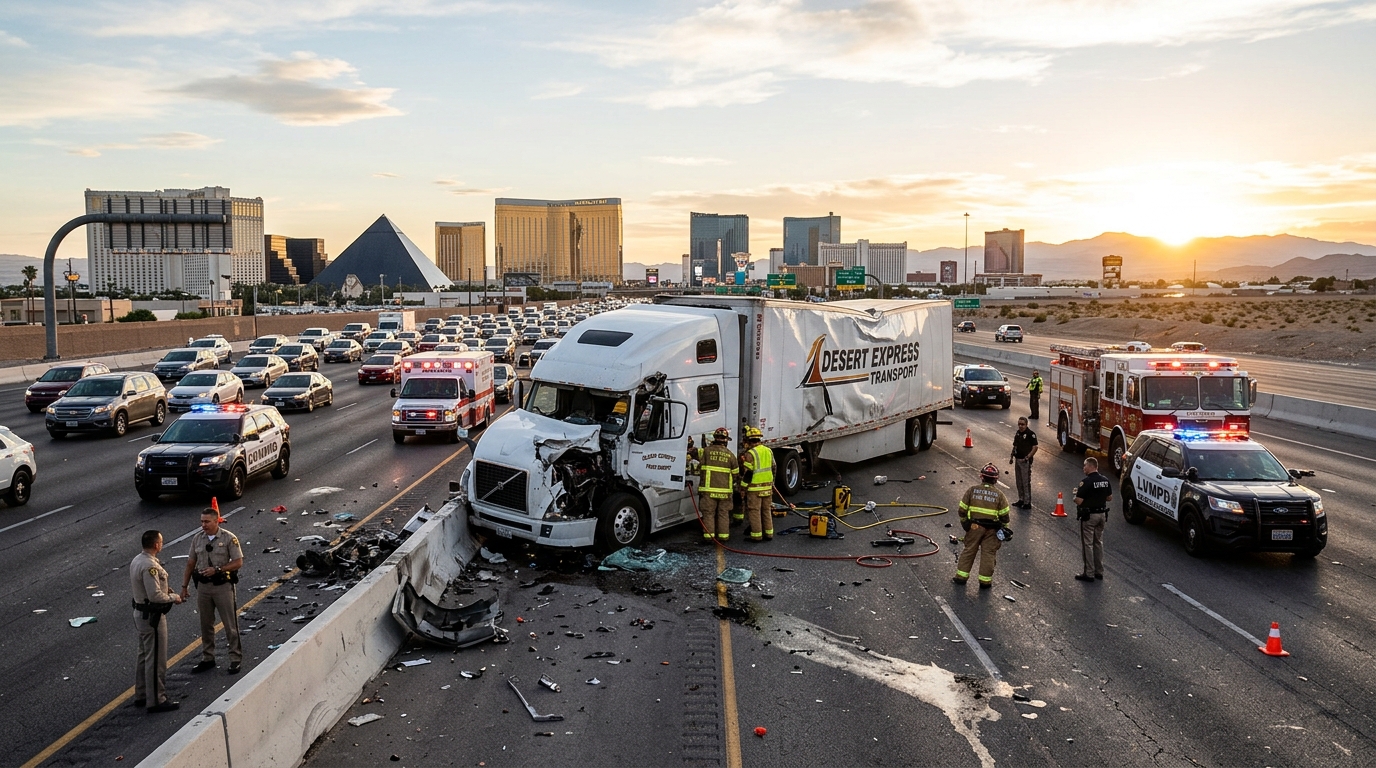
One of the most important things a truck accident attorney does is identify every potentially liable party — not just the driver who was behind the wheel at the moment of impact:
The truck driver: Liable for negligent operation — speeding, distraction, fatigue, intoxication, or failure to yield. Their personal assets and auto insurance are the first layer of recovery, though rarely sufficient given injury severity.
The trucking company (carrier): Under the doctrine of respondeat superior, carriers are vicariously liable for the negligent acts of their employee-drivers committed within the scope of employment. Carriers can also be independently liable for negligent hiring (failing to check a driver's MVR history), negligent training, and negligent entrustment (allowing a driver with a poor safety record to operate a loaded rig). Under FMCSA's Graves Amendment exceptions (49 U.S.C. § 30106), carriers that own the truck can be held liable regardless of independent-contractor agreements.
The cargo shipper or loader: If improper loading — overloaded pallets, unsecured freight, or hazardous material mishandling — contributed to the crash, the company that loaded the truck shares liability. This is especially common in warehouse distribution crashes near the Las Vegas 215 Beltway industrial corridors.
The truck or parts manufacturer: Defective brakes, tire failures, steering defects, or faulty electronic control modules can give rise to a products liability claim against the manufacturer under Nevada strict liability law (see Allison v. Merck & Co., 110 Nev. 762 (1994)). These claims run parallel to — not instead of — negligence claims.
A maintenance contractor: Many carriers outsource truck inspections and maintenance. If a third-party shop failed to identify or repair a known defect, they are independently liable for resulting crashes.
Injuries in Commercial Truck Accidents
The physics of a truck accident produce catastrophic injuries at much higher rates than passenger-vehicle crashes. Our clients have suffered:
Wrongful death: Fatality rates in large truck crashes are dramatically higher than in passenger vehicle collisions. Nevada's wrongful death statute (NRS 41.085) allows surviving spouses, children, and parents to recover funeral costs, loss of financial support, and loss of companionship.
Traumatic brain injury: Violent deceleration — even without direct head contact — causes diffuse axonal injury, contusions, and hemorrhage. TBI resulting from truck accidents is a leading cause of permanent disability and lifetime lost income claims in Clark County civil litigation.
Spinal cord injuries and paralysis: Compression fractures, herniated discs, and cord transections require immediate surgical intervention and often result in permanent mobility limitations. Lifetime care costs for complete spinal cord injuries routinely exceed $5 million.
Crush injuries and amputations: When a passenger vehicle is pinned under a truck — a common "underride" crash pattern — crush injuries to the lower extremities can necessitate amputation. Truck underride guards (required by FHWA standards) that fail to meet federal specifications are an independent basis for products liability.
Internal organ injuries: Steering wheel impact, seatbelt compression, and blunt trauma routinely cause liver lacerations, splenic ruptures, and internal bleeding — all of which may not be immediately apparent at the scene.
What to Do After a Truck Accident in Las Vegas
1. Call 911. Nevada law requires reporting any accident involving injury or property damage above $750. A detailed police report documents the truck's DOT number, carrier name, driver license information, cargo manifest, and road conditions — all critical to your claim.
2. Seek emergency medical care immediately. Accept ambulance transport if offered. Internal injuries are common in truck crashes and may not be symptomatic at the scene. Any delay in seeking care will be used by the carrier's insurer to minimize your claim.
3. Photograph everything. If physically able: photograph the truck's DOT numbers and license plates, trailer markings, your vehicle from multiple angles, skid marks, road conditions, and any visible injuries. This evidence is often the only record of scene conditions before trucks are moved.
4. Get witness information. Bystanders, other drivers, and passing commercial vehicles (whose dash cameras may have captured the crash) are critical witnesses. Nevada's trucking corridors — especially I-15 near the I-215 interchange — are heavily trafficked by other commercial drivers with dash cam systems.
5. Contact an attorney before speaking to the carrier's insurer. The carrier's rapid-response team and insurance adjuster will contact you within hours of the accident. Their goal is to obtain statements minimizing liability and settle for as little as possible. An attorney can issue immediate evidence preservation letters — including a litigation hold for ELD data, driver logs, black box (ECM) data, inspection records, and dispatch communications — before that data is overwritten or destroyed.
Damages You Can Recover in a Nevada Truck Accident Case
Nevada allows truck accident victims to recover the full spectrum of economic and non-economic losses:
Economic damages: All past and future medical expenses (emergency care, surgery, hospitalization, physical therapy, home health aides, adaptive equipment, future surgeries); lost wages from missed work; loss of future earning capacity; vehicle repair or replacement; home modification costs; and all other out-of-pocket accident-related expenses.
Non-economic damages: Physical pain and suffering; emotional distress and PTSD; loss of enjoyment of life; disfigurement; and loss of consortium. Nevada imposes no cap on non-economic damages in personal injury cases.
Punitive damages: When a carrier knowingly allowed a fatigued driver to operate, concealed maintenance defects, or engaged in other conduct showing "oppression, fraud, or malice" under NRS 42.005, punitive damages may be available. These can multiply a verdict substantially in egregious cases.
Nevada Statute of Limitations for Truck Accident Claims
You have two years from the date of your accident to file a personal injury lawsuit in Nevada (NRS 11.190). For wrongful death claims, the clock runs from the date of death. While two years may seem adequate, truck accident cases require immediate investigation — ELD and black box data are automatically overwritten by many systems within 30 days unless a legal hold is in place. Waiting even a few weeks can permanently destroy critical evidence.
Why Choose Thomas Boley for Your Las Vegas Truck Accident Case
Truck accident litigation requires resources, expertise, and speed that general practice attorneys cannot match. Our office handles truck accident cases on a contingency fee basis — no upfront fees, no costs unless we recover. We work with accident reconstruction specialists, commercial trucking safety experts, and life care planners to build the strongest possible case. We issue immediate evidence preservation letters, obtain FMCSA safety records and crash histories for the carrier, and negotiate aggressively before filing suit — with full trial readiness in Clark County District Court if the carrier refuses fair compensation.
Call (702) 435-3333 for a free consultation. We handle personal injury and criminal defense throughout Las Vegas, Henderson, Summerlin, North Las Vegas, and all of Clark County — on a no win, no pay basis.
Frequently Asked Questions
Q: The truck driver's company is claiming the driver was an independent contractor — does that mean they're not liable?
A: Not necessarily. Under the FMCSA's Graves Amendment (49 U.S.C. § 30106), motor carriers cannot escape liability simply by labeling drivers as independent contractors. If the carrier had operational control over the driver, held the operating authority, or owned the trailer, they remain liable. Courts routinely pierce independent-contractor labels in trucking cases.
Q: What is ELD data and why does it matter?
A: An Electronic Logging Device (ELD) records a commercial truck's movement, speed, engine hours, and the driver's hours-of-service status in real time. It cannot be manually altered like paper logs. ELD data often proves that a driver had been on the road far longer than allowed — directly linking fatigue to the crash. This data is often overwritten within 30 days, so immediate legal holds are critical.
Q: How long does a truck accident case take to resolve?
A: Cases with clear liability and documented injuries can settle in 9–18 months. Complex cases — especially those with catastrophic injuries, multiple defendants, or disputed liability — may require 2–3 years, including litigation. We move as efficiently as the facts allow while ensuring your recovery is maximized.
Q: The truck driver's insurer offered a quick settlement — should I accept it?
A: Almost never without attorney review. Early offers from carrier insurers are designed to close the claim before your full injuries are known and before an attorney can identify all liable parties. Once you sign a release, you cannot seek additional compensation — even if you need surgery months later.
Q: Can I still recover if I was partially at fault for the truck accident?
A: Yes. Nevada's modified comparative negligence rule (NRS 41.141) allows you to recover as long as you were less than 51% at fault. Your recovery is reduced by your percentage of fault — so if you were 20% responsible, you receive 80% of your total damages. An attorney can work to minimize any fault attributed to you.
About the Author
Thomas Boley is a Nevada licensed attorney specializing in personal injury law and criminal defense. Since 2008, Thomas has represented thousands of clients in Las Vegas and Clark County, recovering millions of dollars in compensation for injury victims. He is a member of the State Bar of Nevada, the Clark County Bar Association, and the Nevada Justice Association.
Need Legal Help? Contact Thomas Boley for a free consultation: (702) 435-3333