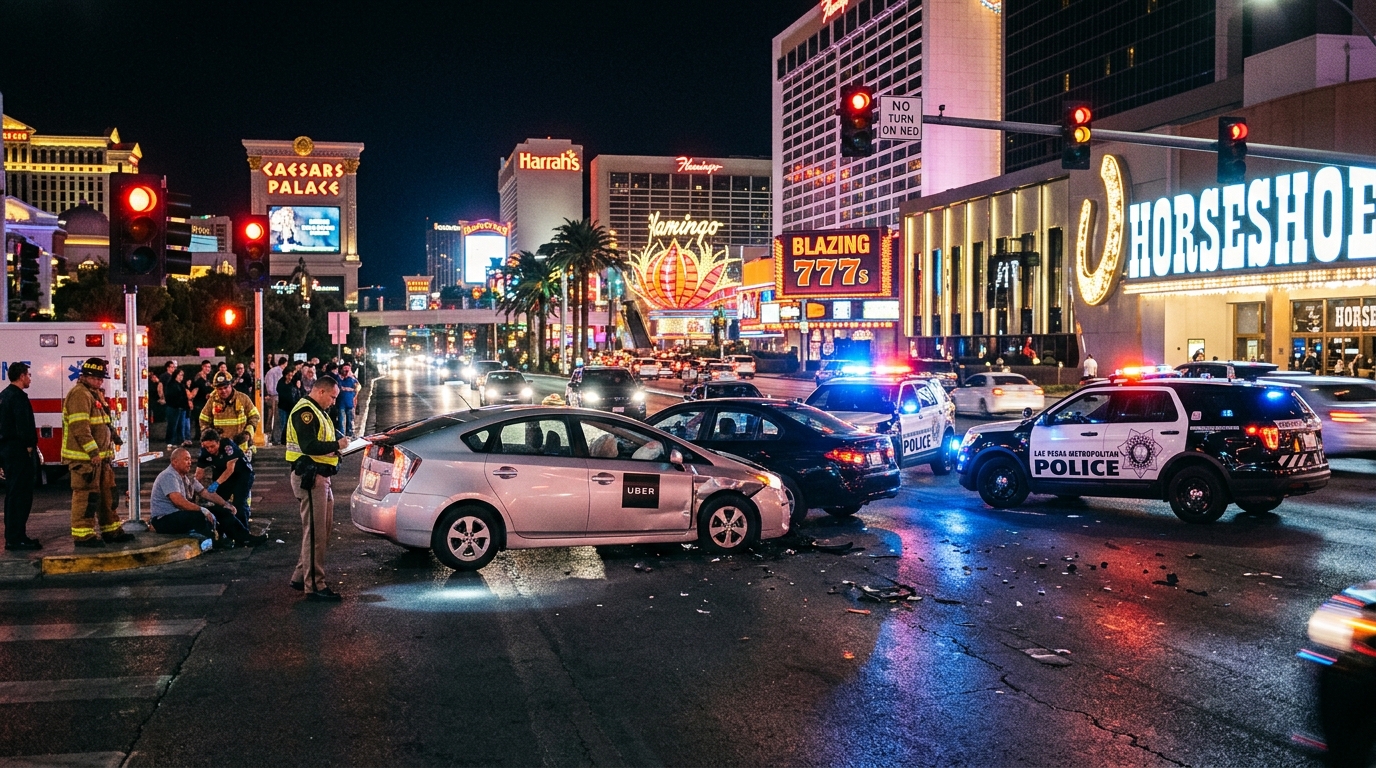
Uber and Lyft Accidents in Las Vegas: Who Pays and How to Get Compensation
In This Article
Las Vegas is one of the most rideshare-dependent cities in America. With millions of tourists moving between the Strip, Harry Reid International Airport, downtown casinos, and entertainment venues every year, Uber and Lyft vehicles are everywhere on Las Vegas roads. That density means rideshare accidents are increasingly common — and the insurance and liability rules that apply are fundamentally different from ordinary car crashes. At the Law Offices of Thomas Boley, we help rideshare accident victims throughout Las Vegas, Henderson, Summerlin, and Clark County navigate these complex claims and recover full compensation.
Why Rideshare Accidents Are More Complicated Than Regular Car Crashes
In a standard two-car accident in Nevada, you deal with two insurance policies. In a rideshare crash, up to three or four insurance layers may apply — the driver's personal auto policy, Uber or Lyft's commercial liability coverage, and potentially an underinsured motorist (UIM) layer. Which policy applies depends entirely on what the driver was doing at the exact moment of the crash. Uber and Lyft divide their coverage into three distinct \"periods,\" each with different limits and rules.
Free case review
Injured or Facing Charges in Las Vegas?
Thomas Boley offers free consultations — no fees unless we win your case.
For a deeper dive, read what to Do After a Car Accident in Las Vegas and motorcycle Accident Injuries.
Understanding Uber and Lyft's Three Coverage Periods
Period 0 — App Off: The driver is operating their vehicle for personal use. Only their personal auto insurance applies. Uber and Lyft provide zero coverage. If the driver causes your accident while their app is off, you pursue their personal insurer.
Period 1 — App On, No Ride Accepted: The driver has the rideshare app open and is available for trips but has not yet matched with a passenger. This is the most dangerous gap in coverage. Uber and Lyft provide contingent liability coverage of $50,000 per person / $100,000 per accident / $25,000 property damage — but only if the driver's personal policy denies the claim. Many personal auto policies exclude rideshare driving, creating real coverage gaps for victims.
Period 2 — Ride Accepted, En Route to Pickup: From the moment the driver accepts a trip until they pick up the passenger. Uber and Lyft's full $1 million commercial liability policy is active. This applies both to occupants of other vehicles and to injured bystanders.
Period 3 — Passenger On Board: From passenger pickup through drop-off. The full $1 million commercial liability policy remains in effect. If you are the passenger injured during a ride, this coverage applies to injuries caused by the Uber/Lyft driver.
Who Can Be Injured in a Rideshare Accident?
Rideshare accident victims fall into several categories, each with different legal footing:
Passengers in the rideshare vehicle — You are covered under the platform's $1 million policy during Periods 2 and 3. You cannot be found contributorily negligent as a passenger (unless you distracted the driver in an extraordinary way). This is typically the strongest position.
Occupants of another vehicle — If an Uber or Lyft driver rear-ends your car, sideswiped you in a lane change, or ran a red light, their Period 1/2/3 coverage applies depending on their app status. You pursue the rideshare insurer (Lyft uses Aviva/James River; Uber uses Allstate/James River depending on the period and state).
Pedestrians and cyclists — Las Vegas has high foot traffic on and near the Strip. If a rideshare vehicle strikes you in a crosswalk or bike lane, the same coverage tiers apply. Nevada's comparative negligence rules (NRS 41.141) still apply — if you were jaywalking, your recovery may be reduced but not eliminated.
Rideshare drivers injured by another driver — If you are a driver for Uber or Lyft and another motorist hits you while you have a passenger, Uber's uninsured/underinsured motorist (UIM) coverage of up to $1 million may apply on top of the at-fault driver's policy.
Common Causes of Rideshare Accidents in Las Vegas
From our experience representing crash victims throughout Clark County, the most common causes of Uber and Lyft accidents in Las Vegas include:
Distracted driving: Rideshare drivers constantly check their app for navigation, new ride requests, and passenger ratings. The Las Vegas Strip — with its heavy foot traffic, jaywalking pedestrians, and abrupt turn signals — is particularly unforgiving of any distraction.
Fatigue: Many rideshare drivers work long shifts, especially during Friday and Saturday nights when demand surges. Nevada and federal guidelines set hours-of-service limits for commercial drivers, but gig workers often lack oversight. Fatigued driving causes reaction-time failures nearly identical to alcohol impairment.
Sudden stops and drop-off hazards: Passengers directing drivers to stop abruptly in traffic, on Las Vegas Boulevard, or in no-stopping zones create rear-end and door-opening hazards for cyclists and motorcyclists.
Unfamiliar roads: Tourists-turned-rideshare-drivers may rely entirely on GPS navigation, causing last-minute lane changes, missed turns corrected dangerously, and failure to yield at Nevada-specific intersections.

Steps to Take After a Rideshare Accident in Las Vegas
1. Call 911 immediately. A police report is essential for rideshare claims. The report documents the accident scene, names all parties, and records the driver's rideshare app status — a critical fact for determining which insurance layer applies.
2. Screenshot the app. If you are a passenger, immediately screenshot the ride details in the Uber or Lyft app — your trip ID, driver name and photo, route, and timestamp. This data can be subpoenaed but having your own copy is faster.
3. Document everything at the scene. Photograph all vehicles, their positions, license plates, visible damage, road conditions, and any injuries. Note whether the rideshare driver's phone was mounted on the dash (required by Nevada law for hands-free use) or in their hand.
4. Get witness information. Las Vegas always has bystanders. Even if they don't stop, note descriptions of any witnesses — security cameras at casinos, hotels, and intersections often capture accidents and can be subpoenaed if you act quickly.
5. Seek medical care the same day. Nevada courts and insurers scrutinize gaps between the accident and first medical treatment. Even if you feel only minor pain, go to an urgent care or ER. Soft tissue injuries, concussions, and internal bleeding often have delayed presentations.
6. Do not speak to Uber/Lyft's insurer without counsel. Uber's commercial liability insurer (Allstate or James River) will contact you quickly with a recorded statement request. Anything you say can reduce or eliminate your recovery. Always have an attorney present first.
Suing Uber or Lyft Directly — Can You?
Uber and Lyft classify their drivers as independent contractors, not employees — a classification they have aggressively defended in Nevada courts. This matters because under Nevada law, an employer is generally liable for an employee's negligence (respondeat superior) but not an independent contractor's. However, this does not mean Uber and Lyft are completely shielded. Several legal theories can still support direct claims:
Negligent hiring or retention: If Uber or Lyft knew or should have known that a driver had a dangerous driving record, prior DUI convictions, or fraudulent background check data, they may be directly liable for putting that driver on the road.
Negligent entrustment: Allowing a demonstrably unsafe driver to use their platform can constitute negligent entrustment under Nevada law.
Platform defects: If the app's interface (navigation prompts, alert sounds, ride-acceptance interruptions) foreseeably distracted the driver, a product liability argument against the platform may exist. This is an emerging area of litigation nationally.
Nevada Rideshare Laws and Regulations
Nevada regulates transportation network companies (TNCs) like Uber and Lyft under NRS Chapter 706. TNCs must maintain the insurance minimums described above, conduct background checks on all drivers, and ensure drivers carry proof of TNC insurance. Nevada also requires hands-free device usage while driving (NRS 484B.165), making handheld phone use by a rideshare driver strong evidence of negligence per se.
The statute of limitations for personal injury claims in Nevada is two years from the date of the accident (NRS 11.190). However, if a government entity is involved (for example, a Clark County bus or Metro Police vehicle), the deadline to file a notice of claim is just 90 days. For rideshare claims, the two-year window applies, but acting quickly is still important — witness memories fade, cameras overwrite footage, and app data may not be preserved indefinitely.
How Thomas Boley Handles Rideshare Accident Cases
Our firm handles rideshare accident cases on a contingency fee basis — you pay nothing unless we recover compensation for you. We immediately send preservation letters to Uber/Lyft and their insurers demanding retention of all app data, driver records, and telematics. We work with accident reconstruction experts and medical professionals to document your injuries and build a case that cannot be easily minimized by a corporate claims adjuster. Thomas Boley has represented clients against Uber's insurers, Lyft's insurers, and at-fault third parties simultaneously in complex multi-vehicle crashes on the Las Vegas Strip and surrounding highways.
Call (702) 435-3333 for a free, no-obligation consultation. We handle personal injury and criminal defense throughout Las Vegas, Henderson, Summerlin, North Las Vegas, and all of Clark County — on a no win, no pay basis.
Frequently Asked Questions
Q: I was a passenger in an Uber and got hurt — can I sue the driver?
A: Yes. As a passenger, you have a claim against the at-fault driver (whether that's your Uber driver or another motorist), and Uber's $1 million commercial policy is in effect during your ride. You do not share fault as a passenger simply by being in the car.
Q: The Uber driver was in Period 1 (app on, no passenger) — do I still have coverage?
A: Yes, but it's limited. Uber/Lyft provide $50K/$100K/$25K in contingent coverage during Period 1, and only if the driver's personal policy denies the claim. This gap makes Period 1 crashes legally more complex — attorney involvement is especially important.
Q: How long do I have to file a rideshare accident claim in Nevada?
A: Two years from the accident date under NRS 11.190. But don't wait — evidence disappears and insurance companies start building their defense immediately. Contact an attorney within days of the crash.
Q: What if the Uber driver had no insurance of their own?
A: Uber and Lyft's commercial policies are primary in Periods 2 and 3. You are not dependent on the driver having personal coverage when the platform policy applies.
Q: Can I get compensation for an injury that didn't appear until days after the crash?
A: Yes. Delayed-onset injuries like whiplash, disc herniations, and concussions are well-recognized in Nevada personal injury law. The key is to see a doctor as soon as symptoms appear and document the connection to the crash. Our attorneys can help build that medical timeline.
About the Author
Thomas Boley is a Nevada licensed attorney specializing in personal injury law and criminal defense. Since 2008, Thomas has represented thousands of clients in Las Vegas and Clark County, recovering millions of dollars in compensation for injury victims. He is a member of the State Bar of Nevada, the Clark County Bar Association, and the Nevada Justice Association.
Need Legal Help? Contact Thomas Boley for a free consultation: (702) 435-3333