T-Bone Accident Injuries in Las Vegas: Rights and Compensation
In This Article
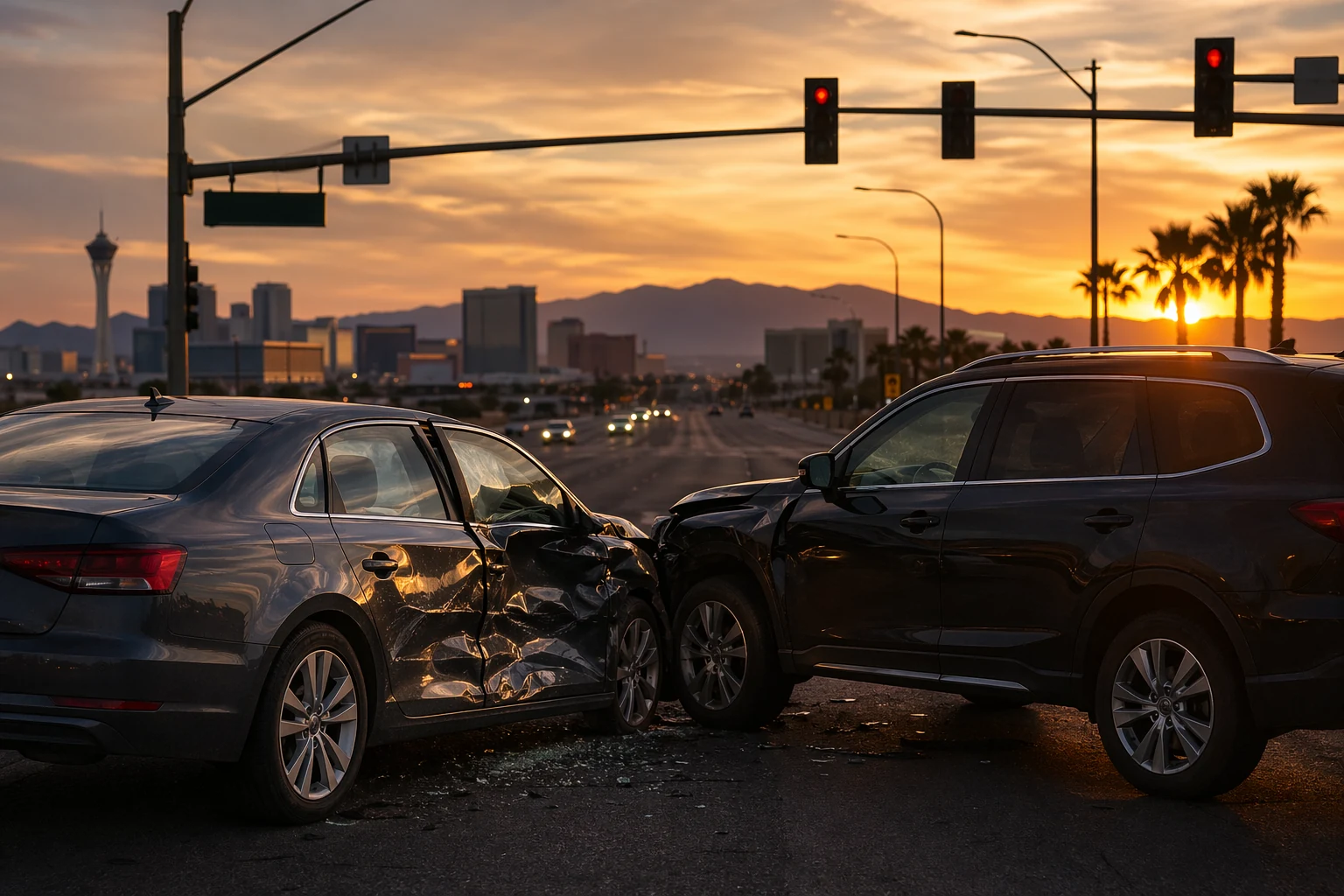
T-bone accidents — also called broadside or side-impact collisions — are among the most dangerous types of crashes on Las Vegas roads. These collisions happen when the front of one vehicle strikes the side of another, almost always at an intersection or in a parking lot. Because the side of a vehicle offers far less structural protection than the front or rear, occupants on the impact side face an elevated risk of catastrophic and life-changing injuries. Unlike head-on or rear-end collisions, where crumple zones and airbag systems absorb much of the impact force, a T-bone strike delivers energy directly through the door panel and window glass — often just inches from the driver or passenger. If you or a family member has been hurt in a T-bone accident in Las Vegas, understanding your legal options is the first step toward recovering the compensation you deserve.
Why T-Bone Accidents Are So Common in Las Vegas
Las Vegas has one of the highest rates of intersection-related accidents in Nevada — and the design of the city itself is a major contributing factor. The Las Vegas Valley is built on a wide grid system with high-speed arterial roads connecting residential neighborhoods, commercial districts, and the resort corridor. Busy corridors like Tropicana Avenue, Flamingo Road, Charleston Boulevard, Sahara Avenue, and the intersections surrounding the Las Vegas Strip see tens of thousands of vehicles daily. Many of these intersections are large, multi-lane crossings where vehicles travel at 45 mph or faster. According to the Nevada Department of Transportation, Clark County consistently leads the state in intersection crash fatalities. Red-light running, left-turn misjudgments, distracted driving, and impaired motorists all contribute to the frequency of broadside collisions throughout Henderson, Summerlin, North Las Vegas, Spring Valley, Enterprise, Paradise, and the broader Las Vegas Valley.
Free case review
Injured or Facing Charges in Las Vegas?
Thomas Boley offers free consultations — no fees unless we win your case.
Common Causes of T-Bone Collisions in Las Vegas
Understanding the cause of a T-bone accident is critical for establishing liability and building a strong injury claim. The most common causes of broadside collisions in the Las Vegas area include:
- Running red lights or stop signs: This is the single most common cause of T-bone accidents. A driver who enters an intersection against a red signal strikes a vehicle lawfully crossing with a green light. Las Vegas Metropolitan Police Department data consistently identifies red-light violations as a leading factor in fatal intersection crashes.
- Failing to yield on left turns: Left-turn accidents are extremely common at Las Vegas intersections without protected left-turn arrows. A driver turning left must yield to oncoming traffic, and misjudging the speed or distance of an approaching vehicle often results in a broadside collision.
- Distracted driving: Texting, adjusting GPS navigation, eating, or interacting with passengers diverts attention from traffic signals and cross traffic. Even a two-second glance away from the road at 40 mph covers more than 115 feet — enough to miss a signal change entirely. For more on this problem, see our guide to distracted driving accidents in Las Vegas.
- Speeding through yellow lights: Drivers who accelerate to 'beat the yellow' often enter intersections after the light has turned red, striking vehicles that have begun to cross on their green signal.
- Impaired driving: Alcohol and drug impairment slow reaction times, impair judgment, and reduce a driver's ability to process intersection signals and cross traffic. Las Vegas — with its 24-hour entertainment culture — sees a disproportionate share of impaired-driving intersection crashes, particularly on weekend nights. See also: drunk driving accident claims.
- Obstructed visibility: Large vehicles, overgrown landscaping, construction equipment, or poorly placed signage near intersections can block a driver's view of cross traffic, leading to collisions that might otherwise have been avoided.
- Malfunctioning traffic signals: A traffic light that is dark, stuck, or cycling incorrectly can create confusion about right-of-way. When signal malfunctions contribute to a crash, the government entity responsible for maintaining the signal may share liability.
- Failure to stop at stop signs in residential areas: Many T-bone accidents in Henderson, Summerlin, and Spring Valley neighborhoods happen at residential stop-sign intersections where one driver rolls through without stopping.
Why T-Bone Accidents Cause Such Severe Injuries
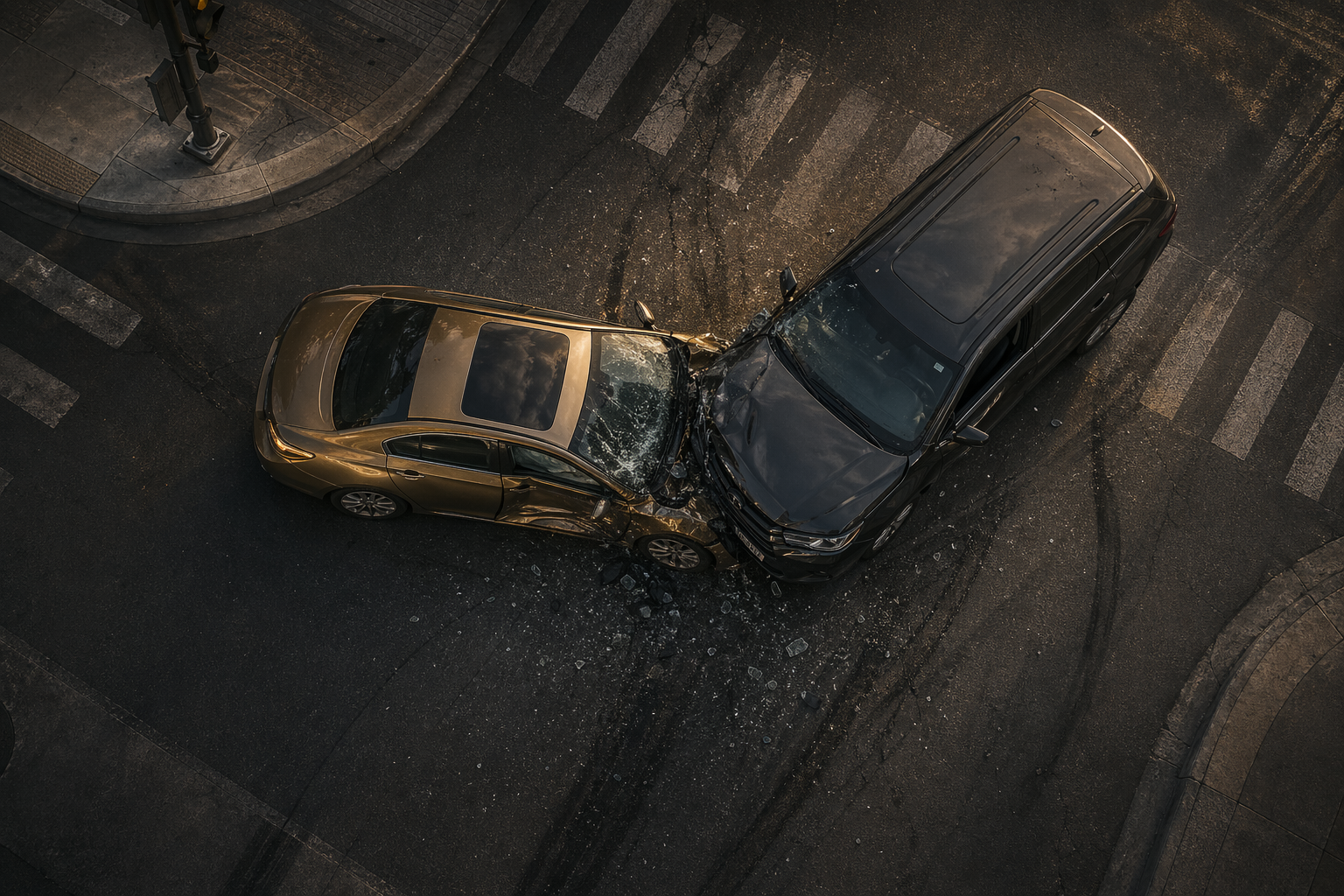
The physics of a side-impact collision make T-bone accidents uniquely dangerous. In a frontal crash, the engine compartment, hood, and front crumple zones absorb a significant portion of the impact energy before it reaches the passenger cabin. In a rear-end collision, the trunk and rear structure provide a similar buffer. But in a T-bone collision, the only barrier between the striking vehicle and the occupant is the door panel, side window glass, and — in newer vehicles — a side curtain airbag. That is a fraction of the protective distance available in front or rear impacts. When a vehicle traveling at 40 or 50 mph strikes the driver's door directly, the force is transferred almost instantly to the occupant's body. The driver or passenger on the impact side can be pushed laterally into the center console, opposite door, or other occupants. Head contact with the window, B-pillar, or intruding door panel is common and frequently causes traumatic brain injuries.
Common Injuries in T-Bone and Intersection Accidents
The injuries sustained in T-bone collisions are often severe and may require extensive medical treatment, surgery, and long-term rehabilitation. The most common injuries we see in Las Vegas intersection accident cases include:
- Traumatic brain injuries (TBI): Head contact with the door frame, window, or B-pillar can cause concussions, contusions, or severe TBI. Even without direct head contact, the violent lateral acceleration can cause diffuse axonal injury. See our detailed guide on traumatic brain injury claims.
- Spinal cord injuries and paralysis: The lateral force of a T-bone collision can fracture vertebrae, herniate discs, or damage the spinal cord itself. Partial or complete paralysis is possible in high-speed broadside crashes. Learn more about spinal cord injury claims.
- Broken ribs and pelvic fractures: The ribs and pelvis are directly exposed to side-impact forces. Multiple rib fractures can puncture lungs or damage internal organs, while pelvic fractures often require surgical repair and months of recovery.
- Internal organ damage: The spleen, liver, and kidneys are vulnerable to blunt-force trauma from lateral impacts. Internal bleeding can be life-threatening and may not be immediately apparent after the crash.
- Shoulder, arm, and wrist fractures: Occupants on the struck side often have their arm against the door or armrest at the moment of impact, resulting in fractures of the shoulder, humerus, forearm, or wrist.
- Whiplash and soft tissue injuries: The lateral whipping motion in a T-bone accident differs from the front-to-back motion in a rear-end crash, but it can cause equally serious cervical spine and soft tissue injuries. See: whiplash and soft tissue injury claims.
- Lacerations from broken glass: Side windows shatter on impact, sending glass fragments into the passenger compartment and causing facial and upper body lacerations.
- Crush injuries: In high-speed T-bone collisions, the door and side panel can intrude into the passenger compartment, trapping and crushing occupants' lower extremities.
Passengers and Children Face Elevated Risk
Rear-seat passengers — including children in car seats — positioned on the struck side of a vehicle are particularly vulnerable in T-bone accidents. Unlike the driver, who may see the approaching vehicle and brace for impact, rear-seat occupants often have no warning. Children in rear-facing car seats on the impact side are exposed to direct force transfer through the door panel. Parents involved in intersection accidents should always have children evaluated by a pediatric emergency physician, even if they appear uninjured immediately after the crash.
Proving Fault in a Las Vegas T-Bone Accident
Determining who had the right of way is the central question in most T-bone accident cases. Nevada follows a modified comparative negligence rule under NRS 41.130, which means you can recover damages as long as your share of fault is less than 50 percent. However, your compensation will be reduced by your percentage of fault. For example, if you are found 20 percent at fault and your damages total $500,000, your recovery would be $400,000. To understand more about how Nevada's fault system works, see our guide to personal injury claims in Nevada.
Key evidence used to prove fault in T-bone accident cases includes:
- Traffic camera and surveillance footage: Many Las Vegas intersections have red-light cameras or nearby business surveillance systems that capture the crash sequence. This footage is often the strongest evidence of who ran the light or failed to yield.
- Police accident reports: The responding officer's report typically documents witness statements, signal status, skid marks, and the officer's determination of fault. While not binding in a civil case, it carries significant weight.
- Witness testimony: Other drivers, pedestrians, and nearby business employees who saw the collision can provide critical testimony about signal status and driver behavior.
- Accident reconstruction: In complex or disputed-fault cases, expert accident reconstructionists analyze vehicle damage patterns, debris fields, speed calculations, and electronic data recorder (black box) information to determine exactly how the collision occurred.
- Cell phone records: If distracted driving is suspected, cell phone records can establish whether the at-fault driver was texting, browsing, or on a call at the time of the crash.
- Vehicle event data recorders: Modern vehicles record pre-crash data including speed, brake application, throttle position, and steering angle. This data can conclusively establish whether a driver attempted to stop before entering the intersection.
What Compensation Is Available After a T-Bone Accident?
Nevada law allows T-bone accident victims to pursue both economic and non-economic damages. The full range of compensation available in a Las Vegas intersection accident claim includes:
- Current and future medical expenses — emergency care, surgery, hospitalization, rehabilitation, prescription medications, and ongoing treatment
- Lost wages — income lost during recovery, including salary, hourly wages, bonuses, and commissions
- Loss of future earning capacity — if your injuries prevent you from returning to your former occupation or reduce your ability to work
- Pain and suffering — physical pain, discomfort, and the impact on daily life activities
- Emotional distress — anxiety, depression, PTSD, and sleep disturbances caused by the accident
- Loss of enjoyment of life — inability to participate in hobbies, sports, social activities, or family events you previously enjoyed
- Property damage — vehicle repair or replacement costs, personal belongings damaged in the crash
- Wrongful death damages — if a loved one was killed in a T-bone accident, surviving family members may pursue a wrongful death claim for funeral expenses, lost financial support, and loss of companionship
For a detailed breakdown of all damage types, see our guide to personal injury damages and compensation in Nevada.
Steps to Take After a T-Bone Accident in Las Vegas
The actions you take in the hours and days after a T-bone accident can significantly affect your ability to recover compensation. Follow these steps to protect your health and your legal rights:
- Call 911 and report the accident: A police report documents the scene and provides an official record of the collision. Nevada law requires reporting accidents that involve injury, death, or significant property damage.
- Seek immediate medical attention: Even if you feel fine, some injuries — including internal bleeding, concussions, and soft tissue damage — may not produce symptoms for hours or days. A medical evaluation creates a documented link between the accident and your injuries.
- Document the scene: If you are physically able, photograph the intersection, traffic signals, vehicle damage, debris, skid marks, and your visible injuries. Note the signal status if you can recall it.
- Exchange information: Get the other driver's name, insurance information, license plate number, and contact details. Collect contact information from any witnesses.
- Do not admit fault: Do not apologize or make statements about who caused the accident. Nevada's comparative negligence system means even a partial admission can reduce your recovery.
- Notify your insurance company: Report the accident to your insurer, but do not provide a recorded statement to the other driver's insurance company without consulting an attorney first. For more on insurer tactics, see: insurance company tactics in personal injury cases.
- Contact an experienced personal injury attorney: An attorney can preserve critical evidence, handle insurance communications, and begin building your case while you focus on recovery.
Dangerous Intersections in Las Vegas for T-Bone Accidents
While T-bone collisions can happen at any intersection, certain Las Vegas area locations have a particularly high incidence of broadside crashes due to traffic volume, speed, and design factors. Some of the most dangerous intersections include Tropicana Avenue and Las Vegas Boulevard, Flamingo Road and Paradise Road, Charleston Boulevard and Rancho Drive, Sahara Avenue and Decatur Boulevard, Eastern Avenue and Warm Springs Road in Henderson, Lake Mead Boulevard and North 5th Street in North Las Vegas, and the multiple high-speed intersections along the 215 Beltway frontage roads in Summerlin and Enterprise. If your accident occurred at any of these locations, nearby surveillance cameras and traffic monitoring systems may have captured footage that proves who was at fault.
Nevada's Statute of Limitations for Intersection Accident Claims
Under NRS 11.190, you generally have two years from the date of the accident to file a personal injury lawsuit in Nevada. If a government vehicle or a malfunctioning government-maintained traffic signal contributed to your crash, the deadline may be shorter and additional notice requirements apply. Do not wait to consult an attorney — critical evidence like traffic camera footage can be overwritten within days or weeks if it is not formally preserved.
How Thomas Boley Fights for T-Bone Accident Victims
At Thomas Boley Attorney At Law, we have represented victims of intersection and T-bone accidents throughout the Las Vegas Valley for over 18 years. Our approach to T-bone accident cases includes:
- Immediately preserving traffic camera footage, surveillance video, and electronic data recorder information before it is overwritten or destroyed
- Conducting a thorough investigation of the intersection, including signal timing, visibility, and roadway design
- Working with accident reconstruction experts to establish exactly how the collision occurred and who was at fault
- Calculating the full value of your claim — including future medical costs, lost earning capacity, and long-term pain and suffering — not just the initial medical bills
- Aggressively negotiating with insurance companies and taking cases to trial when insurers refuse to offer fair compensation
We handle T-bone accident cases on a contingency fee basis, which means you pay nothing unless we win your case.
Contact Thomas Boley for a Free Consultation
If you have been injured in a T-bone or intersection accident in Las Vegas, Henderson, North Las Vegas, Summerlin, Spring Valley, Paradise, Enterprise, Sunrise Manor, or anywhere in Clark County, contact Thomas Boley Attorney At Law today at (702) 435-3333 for a free, confidential consultation. We will review your case, explain your rights under Nevada law, and fight to recover the full compensation you deserve. This article is for informational purposes only and does not constitute legal advice. Every case is unique. Contact Thomas Boley Attorney At Law for a free consultation specific to your situation.
About the Author
Thomas Boley is a Nevada licensed attorney specializing in personal injury law and criminal defense. Since 2008, Thomas has represented thousands of clients in Las Vegas and Clark County, recovering millions of dollars in compensation for injury victims. He is a member of the State Bar of Nevada, the Clark County Bar Association, and the Nevada Justice Association.
Need Legal Help? Contact Thomas Boley for a free consultation: (702) 435-3333