Distracted Driving Accidents in Las Vegas: Your Rights and Legal Options
In This Article
In 2023, the Nevada Department of Transportation reported that distracted driving contributed to thousands of crashes across the state — and Las Vegas, with its dense traffic, constant tourist activity, and sprawling highway network, is one of the most dangerous places in the country for inattentive drivers. If you or a loved one was injured by a driver who was texting, scrolling, eating, or otherwise not paying attention, Nevada law gives you powerful tools to pursue full compensation.
At Thomas Boley Attorney At Law, we represent car accident victims throughout Clark County — from the I-15 and US-95 corridors to the Las Vegas Strip, Henderson, Summerlin, and North Las Vegas. We work on contingency, meaning you pay nothing unless we win.
What Is Distracted Driving Under Nevada Law?
Free case review
Injured or Facing Charges in Las Vegas?
Thomas Boley offers free consultations — no fees unless we win your case.
Nevada law defines distracted driving broadly, but the most legally significant category involves handheld electronic devices. Under NRS 484B.165, it is illegal for any driver in Nevada to use a handheld wireless communications device to talk, text, browse, or engage with apps while driving. This includes holding your phone to your ear, composing a text message at a red light, or scrolling social media while moving.
The penalty for a first offense is a fine of up to $50. Second and subsequent offenses increase to up to $100 or $250, depending on circumstances. While these fines are modest, a traffic citation for distracted driving is powerful evidence in a personal injury lawsuit — it demonstrates that the at-fault driver violated Nevada traffic law, establishing negligence per se.
Distracted driving extends well beyond cell phone use. Courts and insurers also recognize these behaviors as distracted driving that can create liability:
- Eating or drinking while driving
- Adjusting the GPS, radio, or infotainment system
- Reaching for items in the back seat
- Grooming — applying makeup, shaving, or styling hair
- Reading maps, documents, or paper materials
- Intense conversations with passengers that divert visual attention
- Daydreaming or being lost in thought (cognitive distraction)
For more background, see our guides on what to Do After a Car Accident in Las Vegas and the Basic Elements of a Car Accident Tort in Nevada.
Why Distracted Driving Is So Dangerous in Las Vegas
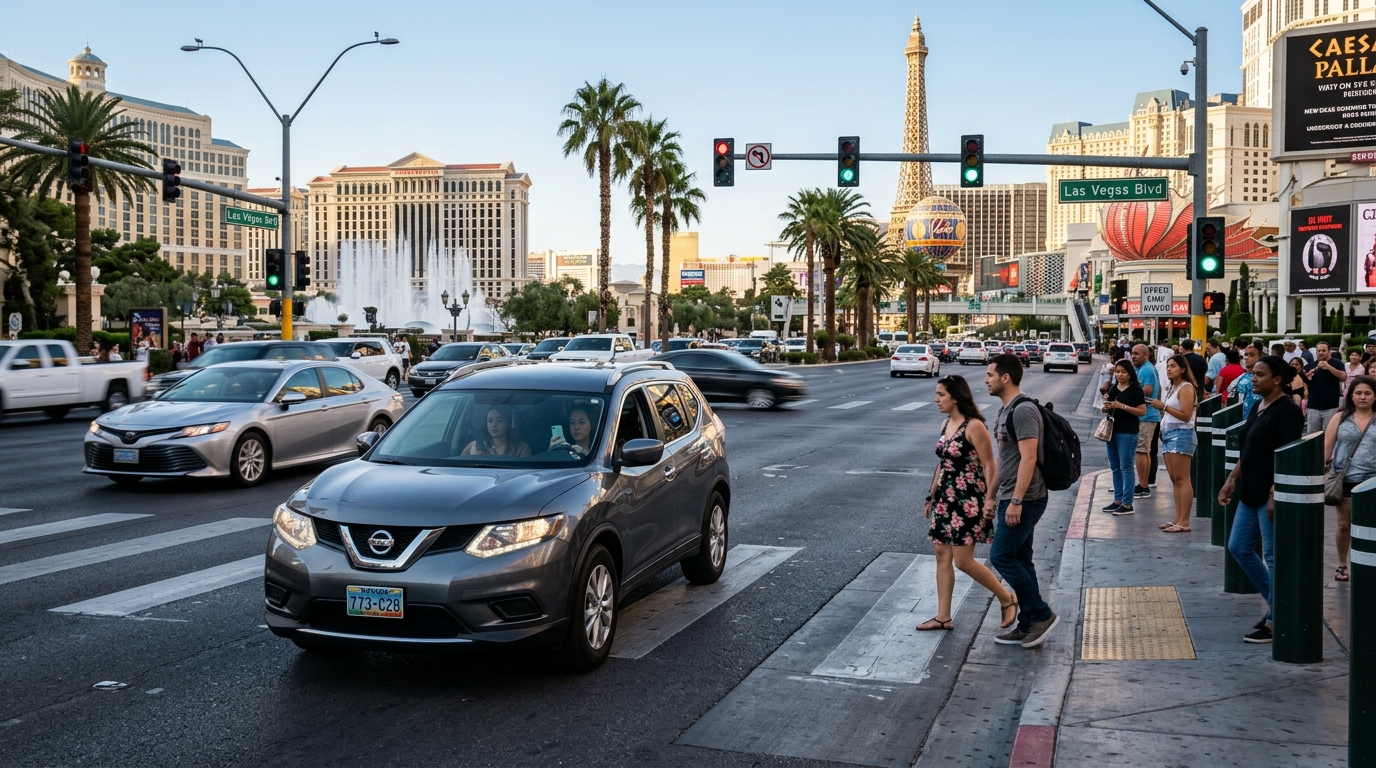
Las Vegas presents a uniquely hazardous driving environment. The Strip — Las Vegas Boulevard from the Mandalay Bay area north to the Stratosphere — is among the most pedestrian-dense roadways in the United States. Tourists unfamiliar with local traffic patterns, rideshare drivers navigating unfamiliar hotel drop-off zones, and commercial drivers on I-15 all share the same roads. Add to this the allure of billboard advertising, neon signage, and the general visual stimulation of the city, and you have a recipe for distracted driving incidents.
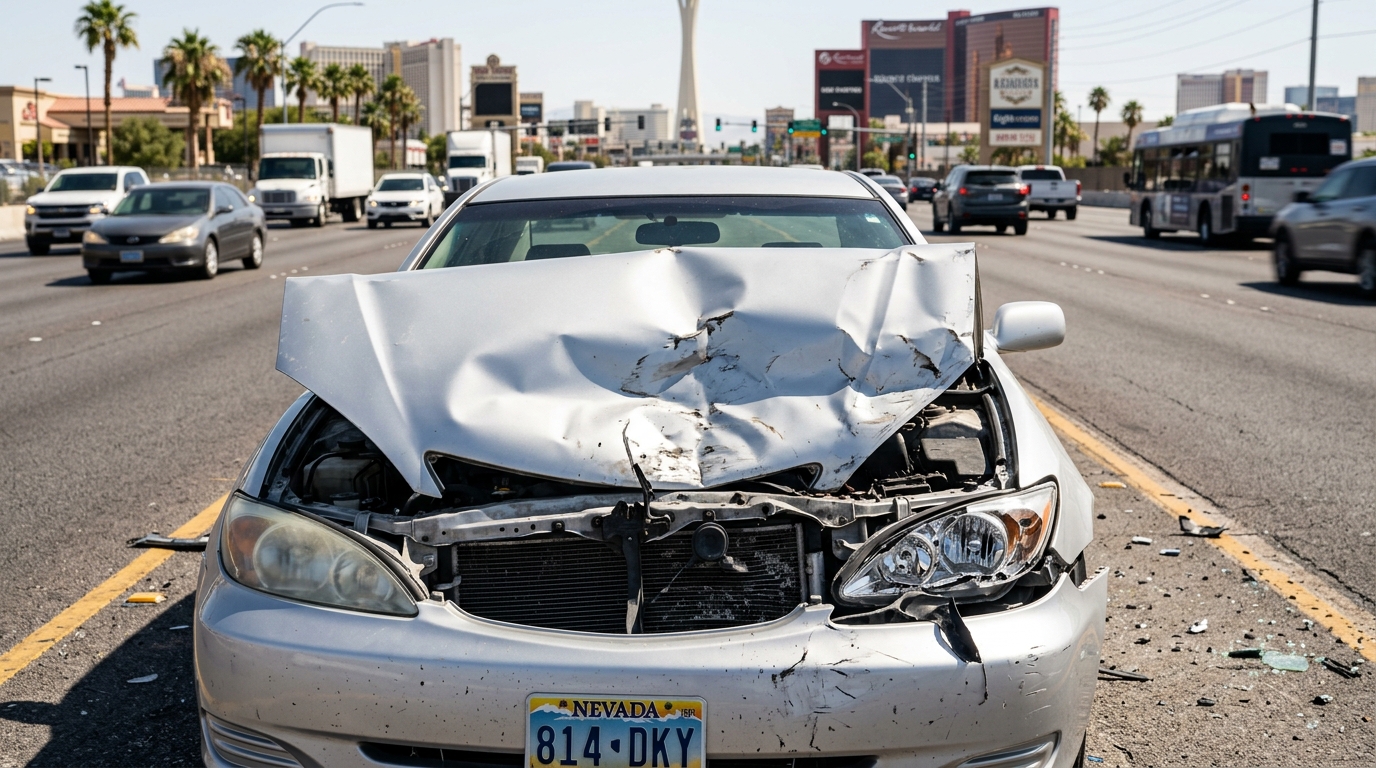
The Las Vegas Beltway (I-215), US-95, and I-15 are high-speed corridors where distracted driving at 65–75 mph can have catastrophic consequences. A driver who takes their eyes off the road for just 5 seconds at 55 mph covers the length of a football field — blind. At Las Vegas highway speeds, that distance can mean the difference between a near miss and a fatal crash.
Proving Distracted Driving in a Nevada Personal Injury Case
One of the most critical — and challenging — elements of a distracted driving case is proving that the other driver was actually distracted at the moment of the crash. Unlike DUI cases, where blood alcohol content provides objective evidence, distraction is often invisible. This is why working with an experienced Las Vegas personal injury attorney from the earliest stages of your case matters so much.
Evidence used to establish distracted driving typically includes:
- Cell phone records and carrier data. Your attorney can subpoena the at-fault driver's carrier to obtain call logs, text timestamps, and data usage records. If the driver sent a text at 2:14 PM and the crash happened at 2:14 PM, that is powerful evidence. Courts in Clark County regularly admit this type of evidence in personal injury trials.
- App usage and GPS data. Modern smartphones log app activity with timestamps. If a driver was actively scrolling Instagram or using Google Maps at the moment of impact, that data can be recovered and used as evidence.
- Witness statements. Bystanders, other drivers, and passengers sometimes observe the distracted driver before impact. Eyewitness testimony describing a driver staring at their phone, eating, or not watching the road is admissible and persuasive.
- Dashcam and surveillance footage. Las Vegas has an extensive network of traffic cameras, and many businesses along major corridors run external surveillance cameras. Your attorney can move quickly to preserve this footage before it is overwritten — typically within 30 to 72 hours of the incident.
- Event data recorders (EDR/black boxes). Most vehicles manufactured after 2012 contain an event data recorder that captures speed, braking behavior, steering inputs, and throttle position in the seconds before a crash. This data can show whether the driver attempted to brake before impact, which combined with other evidence helps establish what they were paying attention to.
- Social media and messaging apps. In some cases, a driver's social media activity — a post, a story, a reaction — can be timestamped and correlated with the accident time, providing independent confirmation of distraction.
- Admissions at the scene or to police. Some drivers voluntarily admit to having been on their phone when speaking to responding officers from the Las Vegas Metropolitan Police Department (LVMPD) or Henderson Police Department. These statements are captured in the accident report and are admissible in civil proceedings.
Negligence Per Se: How a Traffic Violation Strengthens Your Case
In Nevada, when a driver violates a traffic statute and that violation causes harm to another person, the legal doctrine of negligence per se may apply. Under this doctrine, the plaintiff does not need to prove that the driver failed to act as a reasonable person would — the violation of the statute itself establishes the breach of the duty of care.
This is particularly significant in distracted driving cases where a police officer cited the at-fault driver for a cell phone violation under NRS 484B.165. That citation, combined with your accident reconstruction evidence, creates a strong foundation for your personal injury claim. Nevada courts have consistently recognized negligence per se in cases where statutory traffic violations directly caused the plaintiff's injuries.
What Damages Can You Recover After a Distracted Driving Accident?
Nevada's personal injury law allows injured accident victims to recover both economic and non-economic damages. In cases involving egregious conduct — such as a driver who was streaming video while traveling at highway speed — punitive damages may also be available.
Economic damages are objectively calculable losses:
- Emergency room treatment, hospitalization, surgery, and ongoing medical care
- Physical therapy, rehabilitation, and chiropractic treatment
- Prescription medications and medical devices
- Future medical expenses if your injuries require long-term treatment
- Lost wages for time missed from work during recovery
- Reduced earning capacity if your injuries permanently impair your ability to work
- Property damage — repair or replacement of your vehicle and personal belongings
Non-economic damages compensate for personal losses that do not carry a price tag:
- Pain and suffering — both physical pain and the ongoing discomfort of living with injuries
- Emotional distress and psychological trauma, including anxiety, depression, and PTSD
- Loss of enjoyment of life — hobbies, activities, and experiences you can no longer pursue
- Loss of consortium — the impact on your relationship with your spouse or partner
- Scarring, disfigurement, and permanent disability
Nevada does not cap non-economic damages in personal injury cases (unlike in medical malpractice cases). This means that in severe cases involving catastrophic injuries, significant pain and suffering awards are possible.
Nevada's Modified Comparative Fault Rule
Insurance companies defending distracted drivers often argue that the victim was also at fault for the accident — perhaps by following too closely, failing to yield, or making a sudden lane change. Nevada uses a modified comparative fault system under NRS 41.141. Under this rule, your compensation is reduced by your percentage of fault. If you are found 20% at fault for the crash, your award is reduced by 20%. However — and critically — if you are found 51% or more at fault, you are barred from recovering anything at all.
This is why it is essential not to make statements at the accident scene that could be construed as admissions of fault. Do not apologize, speculate about what happened, or agree with the other driver's characterization of events. Speak with an attorney before giving any statement to the insurance company.
The Statute of Limitations: Don't Wait Too Long
In Nevada, the statute of limitations for personal injury claims is two years from the date of the accident under NRS 11.190(4)(e). If your claim involves a government entity — such as an accident involving a Metro bus, a city or county vehicle — you may have as few as two years to file, but with an administrative notice requirement that must be satisfied within a shorter window (often 90 days to 1 year, depending on the entity).
Two years may seem like a long time, but the investigation and evidence gathering required for a strong distracted driving case — including subpoenaing phone records, preserving surveillance footage, obtaining accident reconstruction analysis, and securing expert witnesses — takes considerable time. The sooner you contact an attorney, the stronger your case will be.
What to Do Immediately After a Distracted Driving Accident in Las Vegas
- Call 911. Nevada law requires you to report accidents involving injury, death, or significant property damage. LVMPD or the Nevada Highway Patrol will respond and generate an accident report that documents the scene, captures witness information, and may note evidence of distracted driving. Request the report number before leaving the scene.
- Seek medical attention immediately — even if you feel fine. Adrenaline masks pain. Whiplash, soft tissue injuries, traumatic brain injuries, and internal injuries may not manifest symptoms for hours or days. Delaying treatment creates gaps in your medical record that insurers exploit to argue your injuries are not serious or are unrelated to the crash.
- Document the scene. Photograph the vehicles, skid marks (or the absence thereof), road conditions, traffic signals, and any visible injuries. If you see the other driver on their phone before or after the crash, document that too. Video is even better than photos.
- Collect witness information. Get the name and phone number of every bystander or driver who stopped. In busy Las Vegas traffic, witnesses may leave quickly — secure their contact information while you can.
- Do not discuss fault. Do not admit fault, apologize, or agree with the other driver's account of what happened. Limit your conversation to exchanging insurance and contact information.
- Preserve your own evidence. Do not repair your vehicle until it has been documented or inspected by your attorney's accident reconstruction expert. Repair removes physical evidence of the collision.
- Contact a Las Vegas personal injury attorney before speaking with the insurance company. The at-fault driver's insurer will call you quickly — often within 24 hours — seeking a recorded statement. Anything you say can and will be used to reduce the value of your claim. You are not required to give a statement to the other party's insurer.
Distracted Driving Accidents Involving Commercial Vehicles and Rideshares
Las Vegas roads carry an unusually high volume of commercial traffic — delivery trucks, tour buses, rideshare vehicles, and taxi cabs. When a commercial driver causes a distracted driving accident, the claim is significantly more complex. The driver's employer may share liability if it failed to enforce cell phone policies, provided inadequate training, or imposed delivery quotas that incentivize distracted driving.
Rideshare accidents involving Uber or Lyft present additional complexity around insurance coverage phases. If the driver was on an active trip (with a passenger or en route to pick one up), Uber and Lyft's commercial policies — which can reach $1 million in liability coverage — apply. If the driver was logged in but waiting for a ride request, a lower coverage tier applies. If the app was off entirely, only the driver's personal policy applies. Navigating these coverage layers requires an attorney experienced in rideshare accident litigation.
Why Choose Thomas Boley Attorney At Law for Your Distracted Driving Case?
Thomas Boley has represented car accident victims in Las Vegas for more than 18 years. We understand how insurers evaluate distracted driving claims, which evidence carries the most weight in Clark County courts, and how to build a case that maximizes your recovery. We handle every aspect of your case — from the initial investigation and evidence preservation through settlement negotiations and, when necessary, trial.
Our office handles personal injury cases on a contingency fee basis: we only get paid if you win. There is no upfront cost, no hourly billing, and no financial risk to you. We advance all case expenses and recover them only from your settlement or verdict.
If you were injured by a distracted driver in Las Vegas, Henderson, Summerlin, North Las Vegas, or anywhere in Clark County, contact us today for a free, confidential consultation. Call (702) 435-3333 — 24/7, no win, no pay. This article is for informational purposes only and does not constitute legal advice. Every case is unique. Contact Thomas Boley Attorney At Law for a free consultation specific to your situation.
For more information, visit our schedule a free consultation | all practice areas.
About the Author
Thomas Boley is a Nevada licensed attorney specializing in personal injury law and criminal defense. Since 2008, Thomas has represented thousands of clients in Las Vegas and Clark County, recovering millions of dollars in compensation for injury victims. He is a member of the State Bar of Nevada, the Clark County Bar Association, and the Nevada Justice Association.
Need Legal Help? Contact Thomas Boley for a free consultation: (702) 435-3333