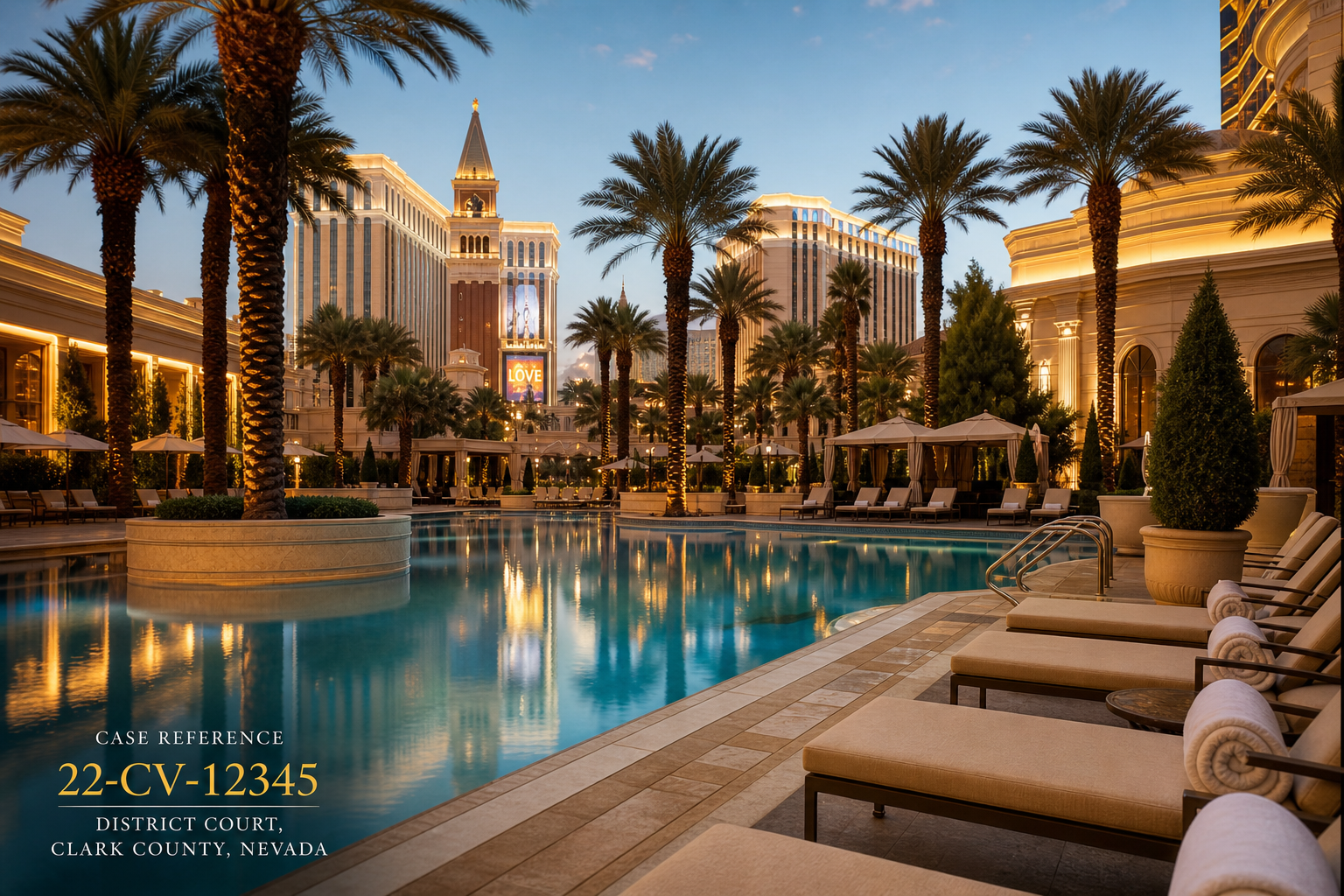
Swimming Pool and Drowning Accidents at Las Vegas Hotels: Your Rights and Legal Options
In This Article
Las Vegas is home to some of the most spectacular hotel pools in the world — rooftop infinity pools, lazy rivers, wave pools, and sprawling resort aquatic complexes. Every year, millions of tourists and locals enjoy these amenities. But when hotel pools are poorly maintained, understaffed, or lack adequate safety equipment, the results can be catastrophic. Swimming pool accidents and drowning incidents are among the most devastating personal injury cases — and Las Vegas hotels bear a serious legal duty under Nevada premises liability law to protect guests. If you or a loved one was injured or drowned at a Las Vegas hotel pool, you may be entitled to significant compensation.
Quick Summary
- Nevada premises liability law holds hotels to a high duty of care for pool areas as invitees
- Common causes include inadequate lifeguards, slippery decks, defective pool equipment, poor lighting, and inadequate barriers
- Hotels fight hard to minimize liability through waivers, quick settlements, and destroying evidence
- Act immediately — preserve evidence, photograph the scene, and report to management
- Damages include medical bills, lost income, wrongful death, and pain and suffering
- Free consultation: Call Thomas Boley at (702) 435-3333
Free case review
Injured or Facing Charges in Las Vegas?
Thomas Boley offers free consultations — no fees unless we win your case.
Nevada Premises Liability Law and Hotel Pools
Under Nevada premises liability law, hotels and resorts owe their guests — who are considered invitees, the highest protected class under the law — a duty to maintain reasonably safe premises. This duty extends fully to pool areas and aquatic amenities. Key Nevada statutes and principles governing pool safety include:
- NRS 41.130 (Negligence Standard): Property owners are liable for damages caused by their failure to exercise reasonable care to discover and remedy dangerous conditions
- Nevada Administrative Code Chapter 444: Detailed pool safety regulations including required signage, water quality standards, barrier requirements, and lifeguard ratios
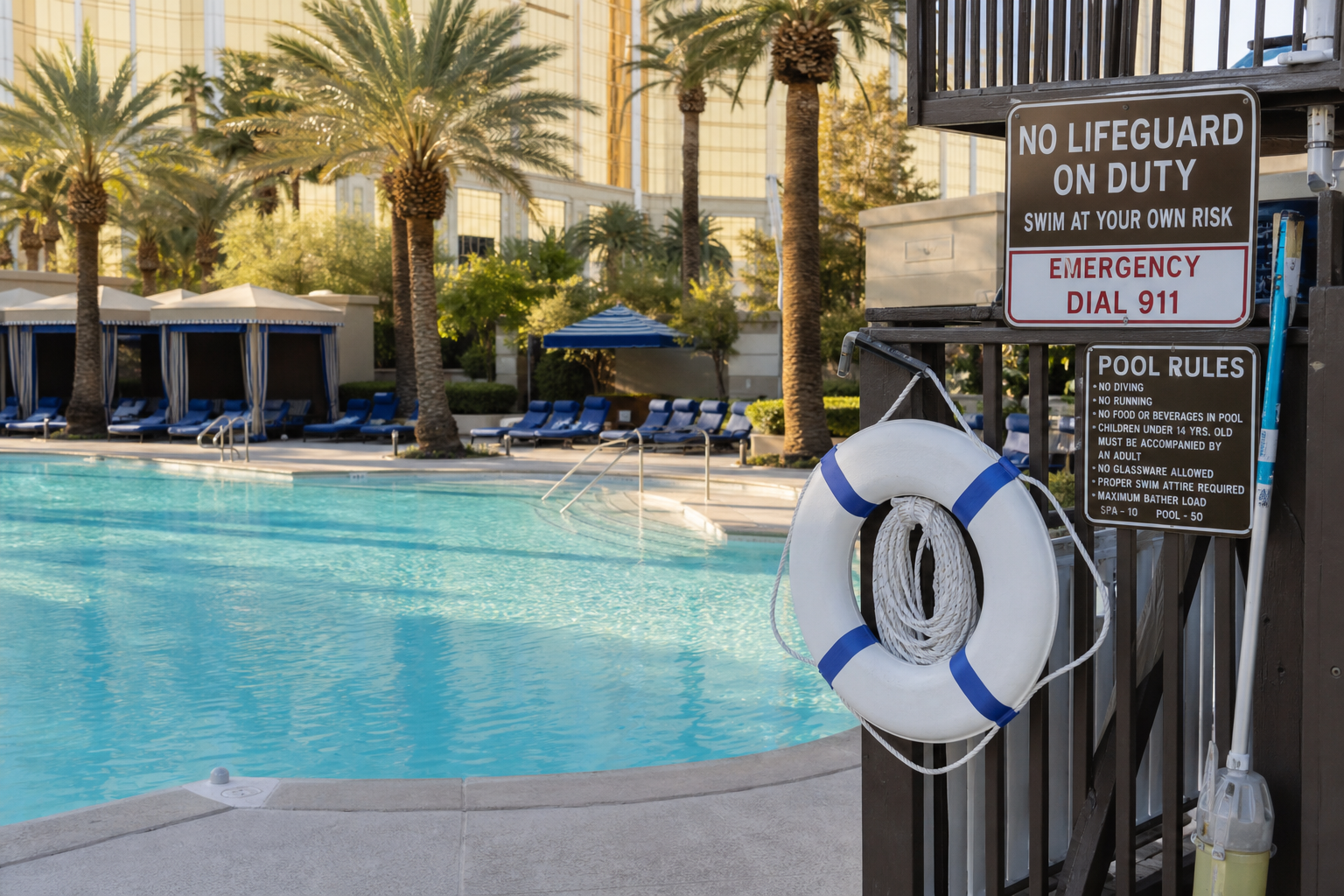
- Invitee duty: Hotels must actively inspect and address pool hazards — they cannot simply post a 'swim at your own risk' sign and escape liability
- Negligent hiring/supervision: If inadequately trained or distracted lifeguards fail to prevent a drowning, the hotel faces direct liability for its staffing decisions
Common Causes of Las Vegas Hotel Pool Accidents
Our personal injury attorneys have handled pool accident cases involving all of the following hotel negligence scenarios:
- Inadequate lifeguard coverage: Many Las Vegas hotel pools are understaffed or use unqualified staff as pool monitors rather than certified lifeguards. Nevada regulations specify required lifeguard-to-swimmer ratios that are routinely violated
- Slippery pool decks: Wet tile and concrete pool surrounds must have adequate non-slip surfaces. Hotels that fail to maintain these surfaces or promptly address standing water create serious fall hazards
- Inadequate depth markings: Unclear or missing depth markers lead to diving injuries and spinal cord damage — some of the most catastrophic pool injuries
- Defective pool drains: Powerful pool drains can trap swimmers — particularly children — creating entrapment and suction hazards. The federal Virginia Graeme Baker Act requires anti-entrapment drain covers
- Alcohol-related incidents: Las Vegas pools are notorious for serving alcohol liberally.
- Poor lighting: Inadequate nighttime illumination of pool areas and surrounding walkways creates dangerous conditions
- Inadequate fencing and barriers: Nevada regulations require pool areas to have appropriate barriers to prevent unauthorized access, particularly to protect young children
Near-Drowning vs. Fatal Drowning: Types of Las Vegas Pool Claims
Non-fatal drowning injuries (also called near-drowning or submersion injuries) can cause permanent brain damage, organ failure, and post-traumatic stress disorder even when the victim survives. Las Vegas hotel pool near-drowning claims typically involve children and non-swimmers who briefly lost supervision.
Fatal drowning claims are handled as wrongful death actions under NRS 41.085. Nevada law allows the surviving spouse, children, or estate of the deceased to recover damages including funeral expenses, lost future income, loss of companionship, and the victim's pain and suffering before death. These are among the most emotionally difficult and legally complex cases we handle.
Slip and fall pool accidents — injuries sustained on wet pool decks, pool stairs, or in surrounding walkways — are premises liability claims under the same legal framework as drowning cases, though with different injury profiles including broken bones, head injuries, and spinal damage.
How Las Vegas Hotels Fight Pool Accident Claims
Major Las Vegas hotel operators — MGM Resorts, Caesars Entertainment, Wynn Resorts, and others — have sophisticated risk management and legal teams specifically trained to minimize pool accident liability. Common tactics include:
- Destroying or 'losing' surveillance footage: Hotel security cameras capture pool areas, but this footage is typically overwritten within 30–72 hours. Attorneys must immediately send preservation demand letters to prevent destruction
- Obtaining quick statements: Hotel security and management may approach injured guests while still in shock to obtain statements minimizing the hotel's responsibility
- Pushing low initial settlements: Particularly in tourist cases where the victim will leave Las Vegas, hotels may offer quick settlements before the full extent of injuries is known
- Claiming assumption of risk: Hotels argue that swimming itself is an inherently dangerous activity and that guests assumed the risk — a defense that Nevada law limits significantly when hotel negligence caused the hazard
- Waiver and release arguments: Some hotels require guests to sign pool access waivers. These are often unenforceable in the context of hotel negligence, but you need an attorney to challenge them
Steps to Take After a Las Vegas Hotel Pool Accident
- Call 911 immediately: For any drowning or serious injury, emergency response is the priority. A police report creates critical official documentation
- Report the incident to hotel management: Request a formal incident report in writing — get a copy before leaving
- Photograph everything: The pool area, any hazards (slippery deck, missing signage, drain covers), your injuries, and the surrounding conditions
- Get witness information: Other guests who witnessed the incident are critical — collect names and contact information before they check out
- Seek immediate medical attention: Near-drowning victims require hospital evaluation even if they appear recovered — delayed pulmonary complications are common
- Do NOT sign any hotel release forms without attorney review
- Contact Thomas Boley immediately: Call (702) 435-3333 — our team will send evidence preservation letters to the hotel within hours
Compensation in a Las Vegas Hotel Pool Accident Case
Victims of Las Vegas hotel pool accidents may be entitled to recover:
- Medical expenses: Emergency room, hospitalization, rehabilitation, ongoing care, and future medical costs — including brain injury treatment which can run into millions of dollars
- Lost wages and earning capacity: Income lost during recovery, and permanently reduced earning ability if injuries prevent return to prior work
- Pain and suffering: Physical pain, emotional trauma, PTSD, and reduced quality of life
- Wrongful death damages: Funeral expenses, loss of future income, loss of companionship and consortium for surviving family members
- Punitive damages: Where hotel conduct was particularly reckless — such as knowingly operating with insufficient lifeguard staffing — Nevada courts may award punitive damages
The Attractive Nuisance Doctrine and Child Drowning Cases in Nevada
Child drowning is the most heartbreaking category of pool accident. In Nevada, the attractive nuisance doctrine imposes special responsibilities on pool owners when children are involved. Under this legal principle, a property owner can be liable for injuries to a trespassing child if: (1) the owner knows or should know that children are likely to trespass; (2) the condition (a swimming pool) poses an unreasonable risk of death or serious injury to children; (3) children, because of their age, cannot appreciate the danger; (4) the cost of eliminating the danger is slight compared to the risk; and (5) the owner fails to exercise reasonable care to protect children.
In practical terms, this means a Las Vegas homeowner who maintains a pool without compliant fencing, self-closing gates, and a pool cover or alarm system can be held liable if a neighborhood child enters the yard and drowns — even though the child was technically trespassing. Clark County code requires residential pools to be enclosed by a barrier at least five feet high with self-closing, self-latching gates that open outward. Doors and windows providing direct access to the pool area must have alarms or be otherwise secured. These are not optional recommendations — they are legal requirements, and failure to comply is strong evidence of negligence.
Statute of Limitations for Pool Accident Claims in Nevada
Under NRS 11.190, Nevada imposes a two-year statute of limitations for personal injury claims, including swimming pool accidents. For wrongful death claims, the two-year clock starts from the date of death. If the pool accident occurred at a government-owned facility (a public pool, a city park splash pad, or a pool at a government building), you must file a formal notice of claim within six months under NRS 41.036 — failure to meet this shortened deadline bars your claim entirely. Do not wait. Contact an attorney as soon as possible to ensure all deadlines are met and evidence is preserved.
HOA and Community Pool Accidents in Henderson, Summerlin, and North Las Vegas
Community pools managed by homeowners associations are among the most common sites of pool accidents in the Las Vegas suburbs. HOA pools in Henderson's Green Valley and Anthem communities, Summerlin's master-planned neighborhoods, and North Las Vegas developments serve thousands of residents. These pools are typically unstaffed — no lifeguard on duty — and rely on residents to supervise their own children.
HOAs have a legal duty to maintain community pool areas in safe condition. This includes ensuring fencing and gate locks function properly, maintaining compliant drain covers, keeping pool chemical levels safe, repairing deck hazards, posting required signage, and conducting regular safety inspections. When an HOA board defers pool maintenance to save money, ignores inspection reports, or fails to replace defective equipment, and someone is injured as a result, the HOA (and potentially individual board members, in cases of gross negligence) may be held liable.
Apartment Complex Pool Accidents in Las Vegas
Renters in Las Vegas apartment complexes throughout Paradise, Spring Valley, Winchester, and Enterprise rely on management to maintain safe pool facilities. Apartment pool accidents often involve inadequate fencing that allows unsupervised child access, broken gate locks that remain unrepaired for weeks, deferred chemical maintenance causing skin and eye injuries, cracked pool decks and broken tiles causing falls, and non-compliant drain covers. Landlords and property management companies cannot contract away their duty to maintain safe pool conditions. Even if a lease contains a liability waiver or "swim at your own risk" clause, these provisions do not protect a property owner from liability for negligent maintenance or code violations.
What is the Virginia Graeme Baker Pool and Spa Safety Act?
The Virginia Graeme Baker Pool and Spa Safety Act (P&SS Act) is a federal law enacted in 2007 that requires public pools and spas to use anti-entrapment drain covers that meet specific safety standards. The law was passed after a seven-year-old girl died when she was trapped by the suction of a wading pool drain. All public pools — including hotel, resort, HOA, and apartment complex pools — must comply. A pool operating with non-compliant drain covers is in violation of federal law, which is powerful evidence of negligence in a drain entrapment lawsuit.
Contact Thomas Boley — Las Vegas Hotel Pool Accident Attorney
At Thomas Boley Attorney At Law, we have represented families devastated by hotel pool accidents and drowning incidents throughout Las Vegas, Henderson, Summerlin, North Las Vegas, and the broader Clark County area. We handle all personal injury and wrongful death cases on a contingency fee basis — no win, no fee.
We know how to act fast to preserve surveillance footage, secure expert witnesses, and build a compelling case against major hotel corporations and their legal teams. See also our guides on hotel and resort injury claims, negligent security claims, and casino accident injuries in Las Vegas.
Call (702) 435-3333 for a free, confidential consultation available 24/7. Time is critical — hotel surveillance footage must be preserved within hours. Don't wait.
This article is for informational purposes only and does not constitute legal advice. Contact Thomas Boley Attorney At Law for a free consultation specific to your situation.
About the Author
Thomas Boley is a Nevada licensed attorney specializing in personal injury law and criminal defense. Since 2008, Thomas has represented thousands of clients in Las Vegas and Clark County, recovering millions of dollars in compensation for injury victims. He is a member of the State Bar of Nevada, the Clark County Bar Association, and the Nevada Justice Association.
Need Legal Help? Contact Thomas Boley for a free consultation: (702) 435-3333