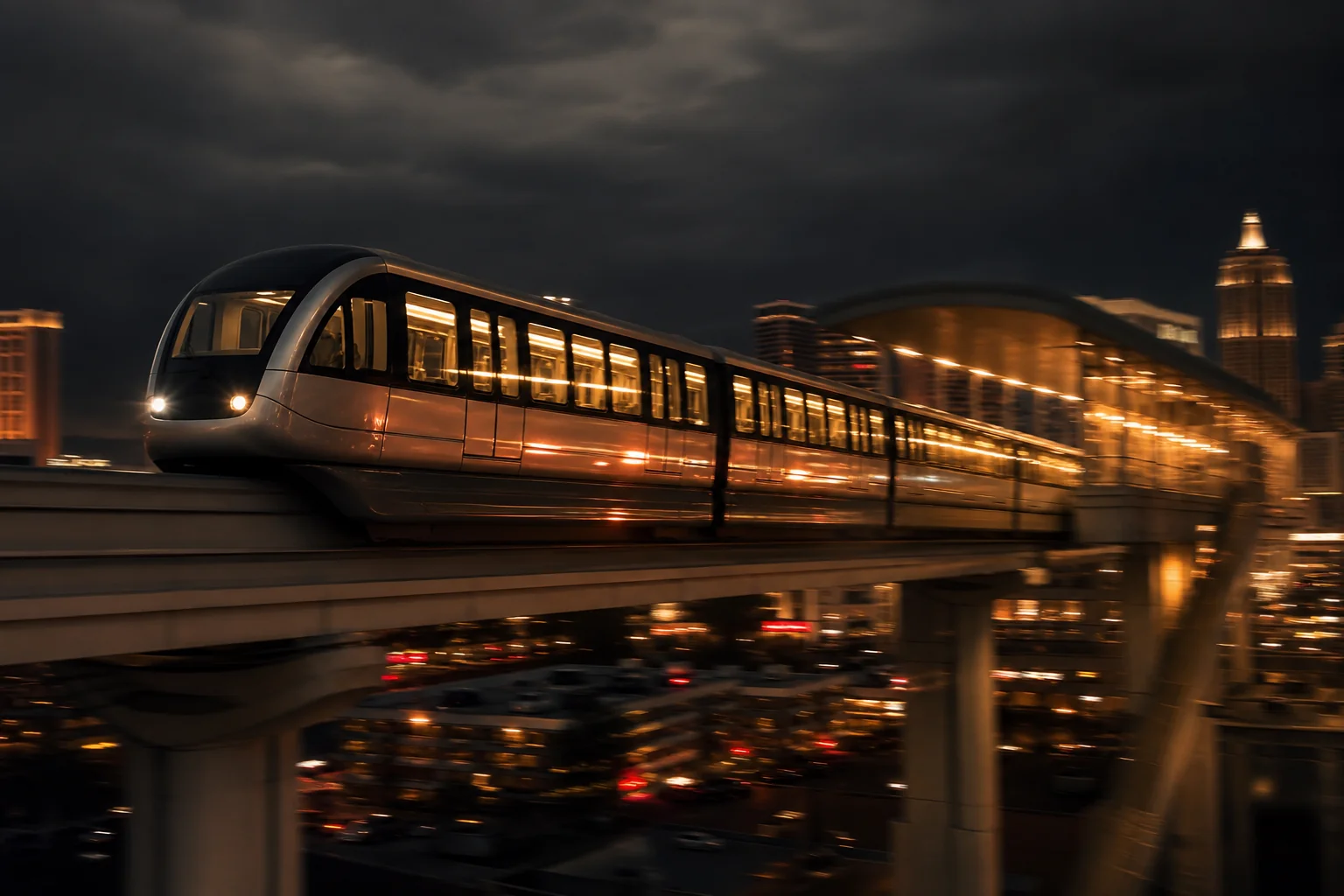
Las Vegas Monorail Accident Claims: Liability & Compensation
In This Article
A camera flashes from a stalled train car above the Strip. A door closes half a second too soon on a rider's bag strap. A gap between the platform and the car catches someone's heel during the evening rush between conventions. Las Vegas Monorail accident claims are far less common than car crash or slip-and-fall cases, but when they happen, they raise questions most Clark County personal injury lawyers rarely have to answer: who actually runs the train, who owns the track, and does a public agency's involvement change what you can recover? At Thomas Boley Attorney At Law, we help injured riders throughout Las Vegas sort out exactly that after a fall, a door malfunction, or a platform incident involving the system that carries millions of tourists and locals along the Strip corridor every year.
- Nevada's monorail statutes, NRS 705.610 through 705.700, authorize monorail systems only in counties with a population of 700,000 or more, a threshold written for Clark County, and require the owner to obtain a franchise from the county or city before operating.
- Nevada case law holds that a common carrier of passengers owes riders the highest degree of care that human judgment and foresight are capable of, a standard the Nevada Supreme Court applied in First Transit, Inc. v. Chernikoff, 445 P.3d 1253 (2019), limited to hazards of the transportation itself.
- Since 2020, the Las Vegas Monorail has been owned by the Las Vegas Convention and Visitors Authority (LVCVA), a Nevada government agency, which can pull an injury claim into the Nevada Tort Claims Act, NRS Chapter 41.
- NRS 41.035 caps a tort judgment against LVCVA at $200,000 per claimant and bars punitive damages entirely, and NRS 41.036 requires filing a claim with its governing body within two years.
- A claim against a private maintenance contractor or equipment manufacturer responsible for a defective door, brake, or platform gap is not automatically subject to that $200,000 cap.
- Nevada's modified comparative negligence rule, NRS 41.141, still lets an injured rider recover damages if their share of fault is 50% or less.
- The general personal injury statute of limitations is two years under NRS 11.190, but a government claim can carry an earlier practical notice deadline, so acting quickly matters.
Las Vegas Monorail Accident Claims Under Nevada Law
Free case review
Injured or Facing Charges in Las Vegas?
Thomas Boley offers free consultations — no fees unless we win your case.
Nevada law does not have a single statute that governs Monorail accident claims the way NRS 686A.2815 governs insurance fraud. Instead, liability is built from several sources layered on top of each other. The starting point is NRS 705.650, which defines a "monorail" as a passenger transport system installed and operated on an exclusive fixed guideway, along with its stations and propulsion systems. Nevada's monorail statutes, NRS 705.610 through 705.700, only apply to counties with a population of 700,000 or more — a threshold written for exactly one place in Nevada: Clark County. Before construction, an owner must obtain a franchise from the county or city under NRS 705.695, or enter into an agreement if no franchise ordinance exists. Notably, NRS 705.690 specifies that a monorail is not a public utility, which affects how it is regulated but says nothing about how an injury claim against it is handled. These franchise statutes establish who is legally authorized to build and run a monorail system in Las Vegas; they do not, by themselves, set the negligence standard that applies when a rider gets hurt. That standard comes from Nevada common carrier law, covered next.
Nevada's Common Carrier Duty of Care
Nevada courts hold that a common carrier of passengers — an entity that transports people for hire, whether by bus, taxi, or rail — owes its passengers the highest degree of care that human judgment and foresight are capable of providing. The Nevada Supreme Court applied this standard in First Transit, Inc. v. Chernikoff, 445 P.3d 1253 (2019), a case involving a passenger who died after choking on a sandwich aboard a paratransit bus. The Court held that a common carrier's heightened duty applies to the hazards of transportation itself — a sudden stop, a malfunctioning door, an unsafe boarding gap — but does not automatically extend to every injury that happens to occur while a passenger is on board. Applied to the Las Vegas Monorail, a mechanical failure, a door that closes on a rider before they clear the threshold, or an unreasonably wide gap between the platform and the car are squarely the kind of transportation hazard this heightened standard was built for. An assault by another passenger or a fall caused by a spill unrelated to the train's operation, by contrast, is more likely to be analyzed under ordinary premises liability principles rather than the common carrier standard — a distinction that can meaningfully change how a claim gets built and against whom.
How Injuries Happen on the Las Vegas Monorail
Most Las Vegas Monorail injuries fall into a handful of recurring patterns. The gap between the platform edge and the train doors is the most common hazard, especially when a car arrives packed with luggage-carrying tourists moving between resort towers and the Las Vegas Convention Center. A fall caused by the gap itself is evaluated much like a Las Vegas slip-and-fall claim, layered on top of the common carrier's heightened duty of care. Automatic doors that close before a rider, a child, or a bag strap has fully cleared the threshold are a close second, and can pull or strike a passenger who is still stepping through. Sudden braking or an unscheduled stop can throw a standing passenger without warning, particularly during peak convention traffic when cars run at capacity. Falls on the escalators and elevators connecting station platforms to hotel towers and skywalks are common enough that they overlap with the injury patterns we cover in our guide to elevator and escalator accidents on the Strip. And because Monorail stations sit inside or beside major resort properties, a security incident or assault on a platform can raise the same premises-liability questions we discuss in our article on injuries at Las Vegas hotels and resorts. Whatever the mechanism, the platform's surveillance footage and the train's own onboard cameras are typically the strongest evidence in a Monorail case — and like most transit systems, that footage is often overwritten within days to a few weeks, which makes reporting the incident and requesting preservation immediately far more important than in an ordinary car accident case.

Why LVCVA's Public Ownership Changes Your Claim
The Las Vegas Monorail opened along the Strip in 2004, built and initially operated by a private nonprofit, the Las Vegas Monorail Company. That changed in 2020, when the system was sold to the Las Vegas Convention and Visitors Authority (LVCVA), a Nevada government agency created by the Legislature and funded largely through room tax revenue. That ownership change matters enormously if you are hurt on the system today, because a claim against LVCVA is a claim against a Nevada political subdivision, which pulls in the Nevada Tort Claims Act under NRS 41.031. That statute waives Nevada's sovereign immunity for ordinary negligence, but NRS 41.035 then caps any tort judgment against a political subdivision at $200,000 per claimant and bars punitive damages entirely, and NRS 41.036 requires filing the claim with LVCVA's governing body within two years of when it accrues. None of that applies to a private common carrier like a tour bus operator, taxi company, or rideshare driver, where there is no statutory damages ceiling. But the cap only reaches LVCVA itself — if the real cause of your injury was a defective door mechanism, a maintenance contractor's negligent inspection, or a manufacturer's design defect in the train or platform equipment, a claim against that private company is not automatically subject to the $200,000 government cap. Sorting out whether your case is really a claim against LVCVA, a private contractor, an equipment manufacturer, or some combination of the three is one of the first and most consequential steps in a Las Vegas Monorail accident claim.
Comparative Negligence and Your Recovery
Nevada follows a modified comparative negligence rule under NRS 41.141, the same framework we explain in more detail in our overview of Nevada's comparative negligence rules. If you are 50% or less at fault for your own injury, you can still recover compensation, reduced by your percentage of fault; if you are found 51% or more responsible, you recover nothing. In a Monorail case, LVCVA's claims administrator or a contractor's insurer will often argue that a rider was distracted by a phone, rushed through closing doors after a chime warning, or stepped over a clearly marked gap without looking down. Those arguments can be countered with the same platform and onboard video evidence that documents the hazard itself, which is one more reason prompt evidence preservation matters so much in these cases.
Damages Available After a Monorail Injury
Compensation after a Las Vegas Monorail injury generally covers the same categories available in any Nevada personal injury case: past and future medical expenses, lost wages and diminished earning capacity, and pain and suffering. A serious fall between the platform and the car can produce the kind of fractures, joint injuries, or worse that we discuss in our guide to catastrophic injury claims in Las Vegas, and in the rare fatal case, a family may have grounds for a wrongful death claim. Remember that the $200,000 cap under NRS 41.035 applies specifically to a judgment against LVCVA as a government entity — it does not necessarily limit what you can recover from a private contractor or manufacturer found separately liable. The general personal injury statute of limitations in Nevada is two years under NRS 11.190, but a claim against a government entity like LVCVA can carry earlier practical deadlines for filing notice with its governing body. Waiting to find out which deadline actually applies to your situation is one of the easiest ways to lose a claim that would otherwise have been strong.
- Report the incident to Monorail station staff immediately and request a written incident report before you leave.
- Photograph the platform gap, the doors, your injuries, and the station and car number if visible.
- Get the names of any station employees, security officers, or witnesses on the platform.
- Keep your ticket, fare card, or app receipt showing the date, time, and boarding station.
- Seek medical care promptly and keep every record — a delayed diagnosis is one of the first things a government claims adjuster will question.
- Do not sign anything from LVCVA's claims administrator or give a recorded statement before speaking with a Las Vegas personal injury attorney.
- Is the Las Vegas Monorail owned by the government? Yes. Since 2020, the system has been owned by the Las Vegas Convention and Visitors Authority (LVCVA), a Nevada government agency, which means an injury claim against it falls under the Nevada Tort Claims Act.
- Is there a cap on how much I can recover after a Monorail accident? A tort judgment against LVCVA itself is capped at $200,000 per claimant under NRS 41.035, with no punitive damages allowed. That cap does not automatically apply to a separate claim against a private maintenance contractor or equipment manufacturer.
- How long do I have to file a claim after a Monorail injury? Nevada's general personal injury statute of limitations is two years under NRS 11.190, but a claim against LVCVA as a government entity can involve earlier notice-filing requirements under NRS 41.036. Acting quickly protects your options.
- What if I was partly responsible for my own fall? Nevada's comparative negligence rule under NRS 41.141 still lets you recover compensation as long as you were 50% or less at fault, reduced by your percentage of responsibility.
- Do I need a lawyer for a claim against a government agency like LVCVA? Strongly recommended. Government claims involve procedural deadlines, notice requirements, and a damages cap that don't exist in an ordinary negligence case, and identifying every private party who may share responsibility can significantly affect what you ultimately recover.
Speak With a Las Vegas Monorail Accident Attorney
Thomas Boley has represented injured clients throughout Clark County for more than 18 years, including cases that involve identifying the right defendant among a government agency, a maintenance contractor, and an equipment manufacturer.
Call (702) 435-3333 for a free consultation, or contact Thomas Boley online to discuss a Las Vegas Monorail accident, a station-area fall, or another Strip transit injury. Bring any incident report, medical records, or claims correspondence you have received from LVCVA or its insurer. If your injury also involved a fall or unsafe condition at a resort property, our personal injury practice can evaluate every angle of your case together. This article is informational only and is not legal advice. Every case is unique.
About the Author
Thomas Boley is a Nevada licensed attorney specializing in personal injury law and criminal defense. Since 2008, Thomas has represented thousands of clients in Las Vegas and Clark County, recovering millions of dollars in compensation for injury victims. He is a member of the State Bar of Nevada, the Clark County Bar Association, and the Nevada Justice Association.
Need Legal Help? Contact Thomas Boley for a free consultation: (702) 435-3333