
Left-Turn Accident Claims in Las Vegas: Your Legal Rights
In This Article
A driver eases into the intersection at Sahara Avenue and Rainbow Boulevard, waits for a gap, and starts a left turn just as the signal legalizes it — only for an oncoming sedan to clip the front quarter panel at 40 miles an hour. In the seconds after, both drivers are certain the other one caused it, and that dispute is exactly what makes left-turn accident claims in Las Vegas some of the most contested cases we handle. Nevada law does assign a default duty to the left-turning driver, but it also builds in exceptions that shift fault back onto the oncoming vehicle far more often than most insurers are willing to admit up front. At Thomas Boley Attorney At Law, we represent injured drivers and passengers throughout Las Vegas, Henderson, Summerlin, North Las Vegas, and the rest of Clark County, and this guide walks through how Nevada actually decides who pays after a left-turn collision.
- NRS 484B.253 requires a driver turning left within an intersection to yield the right-of-way to any oncoming vehicle that is within the intersection or close enough to be an immediate hazard.
- That same statute flips the duty once the left-turning driver has properly yielded and signaled: at that point, oncoming traffic must yield to the vehicle already completing its turn.
- NRS 484B.400 separately requires a left turn to be approached from the portion of the road nearest the centerline and completed to the right of the centerline of the road being entered.
- A left-turning driver is not automatically at fault — an oncoming driver who was speeding, ran a red light, or was not yet a lawful hazard when the turn began can be found partly or entirely responsible instead.
- Nevada's modified comparative negligence rule, NRS 41.141, still lets an injured driver recover damages, reduced by their own percentage of fault, as long as that share is 50% or less.
- Clark County's high-volume, high-speed arterial intersections — many without a protected left-turn arrow — make left-turn collisions one of the most common serious-injury crash types in the Las Vegas Valley.
- Nevada's statute of limitations gives an injured driver two years from the date of the crash to file a personal injury lawsuit, under NRS 11.190(4)(e).
Left-Turn Accident Claims in Las Vegas: How Nevada's Right-of-Way Law Works
Free case review
Injured or Facing Charges in Las Vegas?
Thomas Boley offers free consultations — no fees unless we win your case.
Left-turn collisions are among the most predictable — and most disputed — crashes on Las Vegas roads. They happen at nearly every signalized intersection in the valley, from Tropicana Avenue and Las Vegas Boulevard near the resort corridor to residential collectors in Henderson and Summerlin, and they almost always come down to the same two-second window: a driver waiting to turn left judges a gap in oncoming traffic, commits to the turn, and a vehicle coming the other way arrives faster or later than expected. Because both directions have a plausible story about who had the right-of-way, left-turn accident claims in Las Vegas are contested far more often than a straightforward rear-end collision, where fault is usually obvious from the point of impact alone. Nevada resolves that dispute with a specific right-of-way statute rather than leaving it to a jury's gut instinct, and understanding exactly what that statute requires — and what it doesn't — is the difference between accepting an insurer's first offer and building a claim that reflects what actually happened.
Who's at Fault in a Left-Turn Accident? Nevada's Right-of-Way Rules
Nevada's core left-turn rule is NRS 484B.253, and it sets up a two-part duty that many drivers — and more than a few insurance adjusters — only read half of. The first half is familiar: a driver within an intersection intending to turn left must yield the right-of-way to any vehicle approaching from the opposite direction that is within the intersection or close enough to constitute an immediate hazard. That's the default presumption insurers reach for immediately, and it's why a left-turning driver typically starts every claim discussion at a disadvantage. But the statute doesn't stop there. It goes on to say that once the left-turning driver has yielded and given a required signal, that driver may complete the turn — and at that point, the drivers of all other vehicles approaching from the opposite direction must yield the right-of-way to the vehicle making the left turn. In other words, Nevada law doesn't just ask who was turning left; it asks whether the turning driver had already lawfully earned the right-of-way before the oncoming vehicle arrived. NRS 484B.400 adds a second layer that matters just as much for how liability gets analyzed: it requires the approach for a left turn to be made from the portion of the road nearest the centerline, and requires the turn itself to be completed to the right of the centerline of the road being entered. A driver who turns left from the wrong lane, cuts the corner short, or swings wide into oncoming lanes has violated a separate statute even if the right-of-way analysis under NRS 484B.253 would otherwise have favored them — and that kind of positioning violation can flip fault in a close case.
When the Left-Turning Driver Is NOT at Fault
Insurance adjusters representing an oncoming driver like to treat left-turn accidents as automatic liability for whoever was turning, but Nevada's statute simply doesn't work that way, and several recurring fact patterns shift meaningful fault — sometimes all of it — onto the oncoming driver instead. The most common is speed: NRS 484B.253 only requires yielding to a vehicle that is close enough to be an immediate hazard at lawful speed, so a left-turning driver who reasonably judged a safe gap in traffic moving at the posted limit is not automatically responsible when an oncoming driver traveling well above that limit closes the distance faster than physics would otherwise allow. A second is the traffic signal itself: on Las Vegas's many permissive left-turn phases — a plain green circle rather than a protected green arrow — a left-turning driver only has to yield to oncoming traffic that is lawfully in the intersection, not to a vehicle that entered on a stale yellow or an outright red light. A third is a lane violation by the oncoming driver, such as an illegal pass on the right, a sudden unsignaled lane change into the turning driver's path, or drifting out of a marked lane approaching the intersection. And a fourth — the one adjusters resist hardest — is exactly what NRS 484B.253's second sentence describes: if the left-turning driver had already yielded, signaled, and begun a lawful turn before the oncoming vehicle became a hazard, the duty to avoid a collision shifts to the oncoming driver, not the other way around. Traffic signal timing data, intersection camera footage, black-box event data recorders, and independent witness statements are usually what turns one of these arguments from a plausible defense into a documented one.
Common Causes and Injuries in Las Vegas Left-Turn Accidents
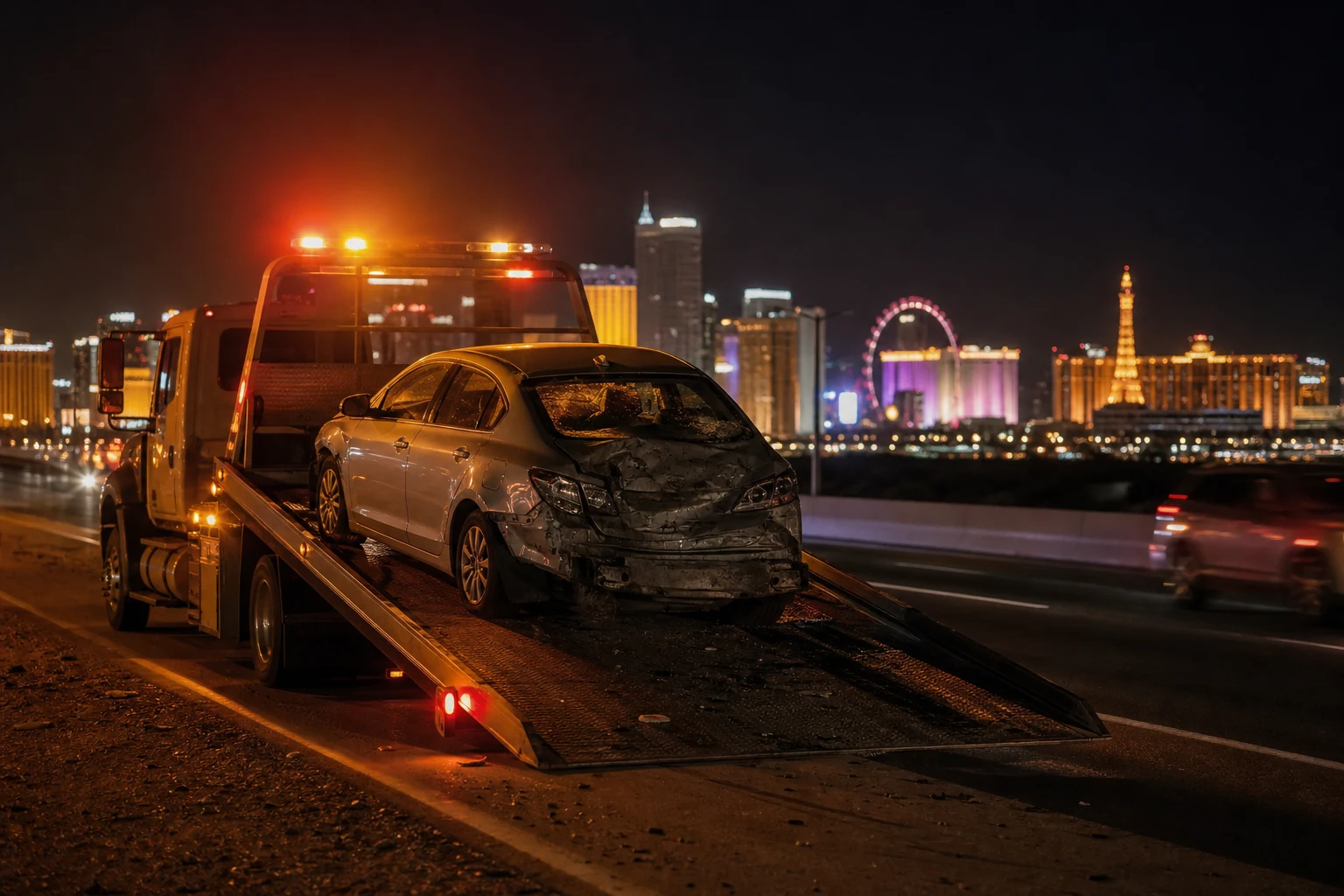
Las Vegas's road network makes left-turn crashes especially common. The valley is built on a wide arterial grid — Tropicana Avenue, Flamingo Road, Charleston Boulevard, Sahara Avenue, Rainbow Boulevard, and dozens of similar multi-lane corridors — where cross-traffic frequently moves at 45 miles an hour or faster, and a large share of those intersections still run a permissive left-turn phase instead of a protected arrow, especially outside peak hours. That combination means a left-turning driver is routinely asked to judge the speed and distance of fast-moving oncoming traffic with no dedicated signal to remove the guesswork, and misjudging that gap by even a second or two is enough to put two vehicles in the same space at the same time. Distracted driving compounds the risk on both sides of the collision — a left-turning driver glancing at a phone instead of timing the gap, or an oncoming driver failing to notice a turn signal until it's too late to brake. Dusk and nighttime turns raise the danger further, since headlight glare and reduced depth perception make an oncoming vehicle's true speed harder to judge, which is part of why so many of these crashes cluster in the early evening rush along the valley's busiest corridors. Because a left-turn collision is typically a broadside or quarter-panel impact rather than a bumper-to-bumper hit, the forces involved are often more severe than a comparable rear-end crash, and the injuries reflect that: T-bone-style impacts to the driver or passenger door, whiplash and other soft-tissue injuries from the sudden lateral force, and more serious harm — fractures, spinal injury, or traumatic brain injury — when the impact occurs at higher speed or before an airbag or side-curtain system has time to fully deploy.
How Comparative Negligence Affects Your Left-Turn Accident Claim
Most left-turn accidents in Las Vegas don't resolve into a clean, one-sided fault finding — they resolve into a percentage. Nevada's modified comparative negligence statute, NRS 41.141, allows an injured driver to recover damages even when they share some of the fault, as long as their own percentage of responsibility is 50% or less; the total award is simply reduced by that percentage. That structure gives an insurer a direct financial incentive to push a left-turning driver's fault share as close to 51% as the facts will bear, since crossing that line eliminates the claim entirely rather than just discounting it. This is where a comparative negligence dispute becomes the real fight in a left-turn case: an insurer for the oncoming driver will often argue the turning driver should have waited for a larger gap, while an insurer for the left-turning driver will argue the oncoming vehicle was speeding, distracted, or ran a stale light. Because Nevada allows fault to be split among more than two parties when the evidence supports it — a third vehicle that partially obstructed the turning driver's view, or a poorly timed signal, for example — a thorough investigation sometimes finds a source of liability neither insurer initially named.
- Call 911 and request police response — a Metro or NHP crash report documenting signal phase, point of impact, and officer observations is often the single most important piece of early evidence in a disputed left-turn claim.
- Photograph both vehicles' final resting positions, the point of impact, the traffic signal or sign controlling the intersection, and any skid marks before traffic clears the scene.
- Identify and get contact information from independent witnesses — in a fault dispute this close, a driver two cars back who saw the signal phase can matter more than either driver's own account.
- Seek medical evaluation promptly, even for injuries that feel minor at first; lateral-impact injuries from a broadside collision can worsen over the following days.
- Ask whether the intersection has traffic camera or red-light camera coverage, and ask your attorney to request that footage before it is overwritten.
- Do not admit fault or estimate your own speed at the scene — both drivers are often wrong about exact timing and distance in the adrenaline of the moment.
- Contact a Las Vegas personal injury attorney before giving a recorded statement to either insurer, since early statements are frequently used to lock in a fault percentage before all the evidence is in.
- Is the left-turning driver always at fault in Nevada? No. NRS 484B.253 requires a left-turning driver to yield only to oncoming traffic that is already in the intersection or close enough to be an immediate hazard. A driver who lawfully yielded, signaled, and began the turn before an oncoming vehicle became a hazard — or who was hit by a driver who was speeding or ran the light — can shift some or all of the fault onto the other driver.
- What if there was no left-turn arrow at the intersection? A permissive left-turn phase, shown as a plain green circle, still requires a left-turning driver to yield to oncoming traffic that is lawfully in the intersection, but it does not require yielding to a vehicle that entered on a stale yellow or a red light.
- Can I still recover damages if I was partly at fault? Yes, under Nevada's modified comparative negligence rule, NRS 41.141, as long as your share of fault is 50% or less. Your damages are reduced by your percentage of fault rather than eliminated.
- How long do I have to file a claim after a left-turn accident in Las Vegas? Nevada's statute of limitations for a personal injury lawsuit is generally two years from the date of the crash, under NRS 11.190(4)(e), though claim-filing deadlines in your own insurance policy may run sooner.
- What evidence matters most in a disputed left-turn claim? The police crash report, traffic signal timing information, intersection or red-light camera footage, event data recorder ("black box") data from either vehicle, and independent witness statements are typically the strongest evidence, since they don't depend on either driver's memory of a fast-moving, high-stress moment.
Speak With a Las Vegas Personal Injury Attorney About Your Left-Turn Accident Claim
Thomas Boley has represented injured drivers and passengers throughout Clark County for more than 18 years, including left-turn cases where the real dispute wasn't whether a collision happened, but which driver's account of the intersection the evidence actually supported. These claims are often won or lost on details that disappear quickly — a signal phase, a skid mark, a witness who was two cars back — which makes fast evidence preservation especially valuable.
Call (702) 435-3333 for a free consultation, or contact Thomas Boley online to discuss a left-turn accident in Las Vegas, Henderson, Summerlin, North Las Vegas, or elsewhere in Clark County. Our full personal injury practice handles intersection and right-of-way collisions of every kind, including cases similar to our guides to T-bone intersection accidents and head-on collisions, as well as ordinary auto accident claims. This article is informational only and is not legal advice. Every case is unique.
About the Author
Thomas Boley is a Nevada licensed attorney specializing in personal injury law and criminal defense. Since 2008, Thomas has represented thousands of clients in Las Vegas and Clark County, recovering millions of dollars in compensation for injury victims. He is a member of the State Bar of Nevada, the Clark County Bar Association, and the Nevada Justice Association.
Need Legal Help? Contact Thomas Boley for a free consultation: (702) 435-3333