Golf Cart Accident Claims in Las Vegas: Who's Liable?
In This Article
A golf cart accident in Las Vegas rarely looks like the collision most people picture. It can happen on a manicured fairway at a Summerlin resort course, in the golf-cart lane of a gated Henderson community, or on a hotel property where guests rent carts to get between towers. Nevada treats these low-speed vehicles more casually than most people expect: golf carts and low-speed vehicles are legal on many local streets, which means the same intersections, driveways, and blind curves that create ordinary traffic crashes create golf cart crashes too. At Thomas Boley Attorney At Law, we help injured riders and pedestrians throughout Las Vegas, Henderson, Summerlin, North Las Vegas, and the rest of Clark County sort out who is actually liable.
- Nevada defines a golf cart under NRS 482.044 and allows some golf carts on public streets only with local approval and a Clark County DMV permit; low-speed vehicles (LSVs) are a separate, stricter category street legal statewide up to 25 mph.
- Ordinary negligence law governs a golf cart accident whether it happens on a private golf course, inside a gated community, or on a public street — the operator owes every rider and bystander a duty of reasonable care.
- Liability can fall on the driver, the golf course or HOA that maintains the cart path, a rental company that fails to inspect its fleet, or a manufacturer if a design or mechanical defect caused the crash.
- Nevada requires higher golf cart liability insurance minimums in Clark County than the statewide standard, and many personal auto policies exclude golf carts and LSVs entirely, creating a coverage gap victims do not expect.
- Nevada's modified comparative negligence rule, NRS 41.141, bars recovery only if you are found 51% or more at fault, and reduces your award by your own percentage of fault otherwise.
- A two-year statute of limitations generally applies to Nevada personal injury claims, so evidence like cart maintenance logs and rental agreements should be secured quickly.
Golf Cart Accidents in Las Vegas: How Nevada Law Applies
Free case review
Injured or Facing Charges in Las Vegas?
Thomas Boley offers free consultations — no fees unless we win your case.
Nevada law defines a golf cart narrowly under NRS 482.044 as a vehicle with at least three wheels designed to carry golf equipment and no more than four people, including the driver. Golf carts are not automatically street legal — a local government has to approve their use on public roads first. In Clark County, that approval typically comes with a $10 annual DMV permit decal for carts used as transportation inside designated communities, and any permitted cart must carry headlights, taillights, reflectors, a slow-moving-vehicle emblem, a mirror, and working brakes under NRS 482.398. Low-speed vehicles, or LSVs, are a stricter and separate category: capable of up to 25 mph, they are street legal statewide on any road with a posted speed limit of 35 mph or less, but only if registered, insured, and driven by someone holding a valid license. Many Summerlin, Henderson, and Anthem communities blur these categories in everyday use, which is exactly why the vehicle's legal classification often becomes a contested issue after a golf cart accident in Las Vegas leaves someone hurt.
Where Golf Cart Accidents Happen in Henderson, Summerlin & Las Vegas
Most of the golf cart crashes we see fall into a few recurring settings. Golf courses themselves generate cart-versus-cart collisions, cart rollovers on steep cart paths, and carts striking golfers walking between holes. Master-planned communities built around golf — Sun City Summerlin, MacDonald Highlands and Lake Las Vegas in Henderson, and similar Anthem neighborhoods — allow residents to drive permitted carts on interior streets, where they share the road with regular traffic at intersections and blind curves never designed with a slow, low-visibility vehicle in mind. Strip-area resorts and casino properties use golf carts and utility carts to shuttle guests and staff across sprawling grounds, often on interior roadways with tourist pedestrian traffic unfamiliar with the property. Short-term vacation rentals near Lake Las Vegas or golf resorts increasingly include a golf cart as an amenity, handed to guests with little instruction and even less supervision.
Who Can Be Held Liable After a Golf Cart Accident
Nevada's ordinary negligence rules apply to a golf cart accident regardless of whether it happens on private course property, inside a gated community, or on a public street — every driver, whether behind the wheel of a golf cart or a full-size vehicle, owes a duty of reasonable care to other riders, pedestrians, and drivers. That makes golf cart claims similar in structure to the auto accident claims we handle throughout Clark County, even though the vehicle looks nothing like a car. Liability can rest with the cart's driver for speeding, distracted operation, or driving after drinking; with a golf course or homeowners association that failed to maintain a cart path, mark a blind intersection, or repair a known hazard; with a rental company that put an unsafe or poorly maintained cart into a guest's hands; or with a manufacturer if a steering, braking, or seatbelt defect contributed to the crash. When a minor was allowed to drive, a parent or guardian who authorized it can also share responsibility. Because more than one party is often at fault, identifying every liable defendant early — before a course's incident report disappears or a rental log gets overwritten — matters more in these cases than in a typical crash.
Common Injuries in Golf Cart Accidents
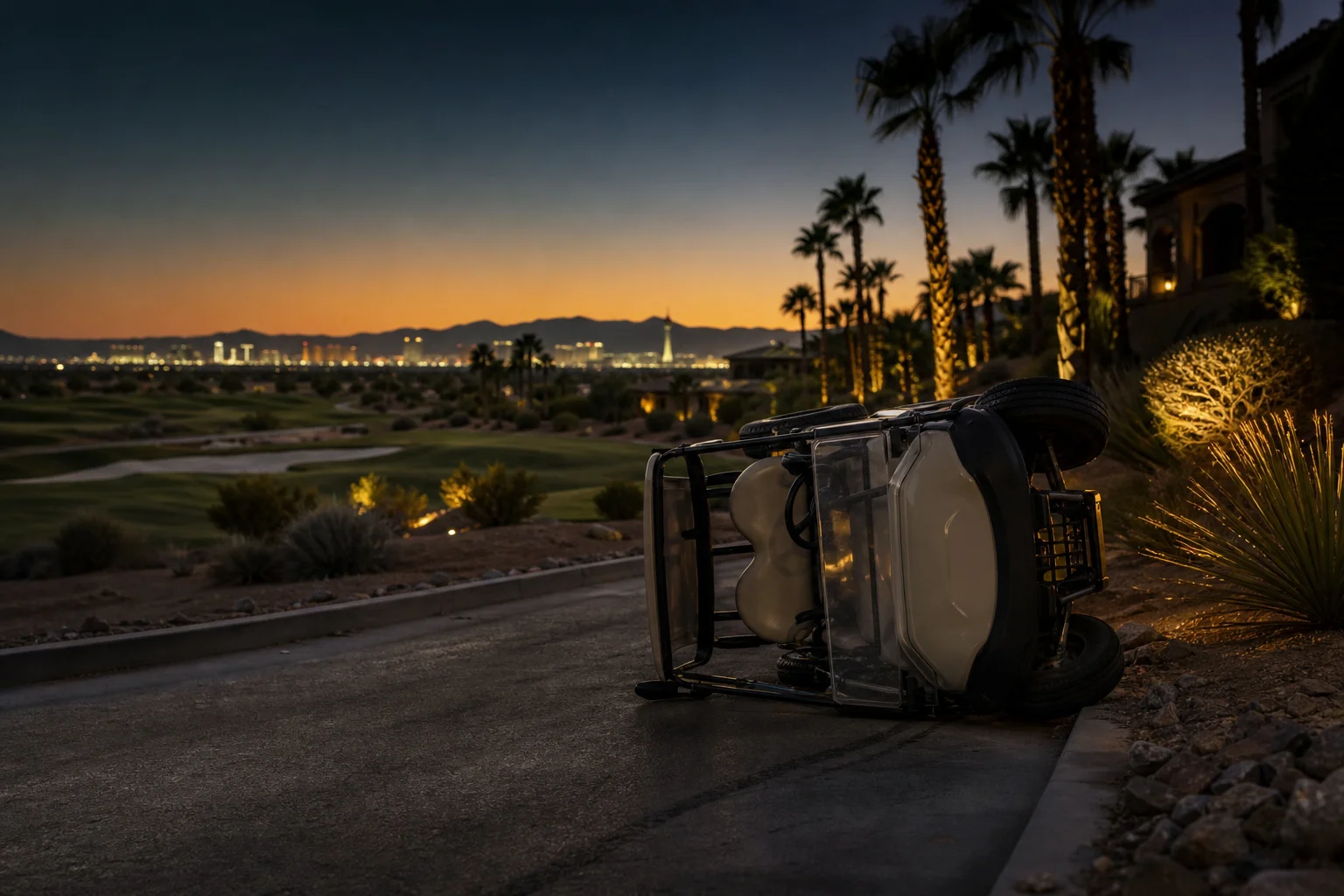
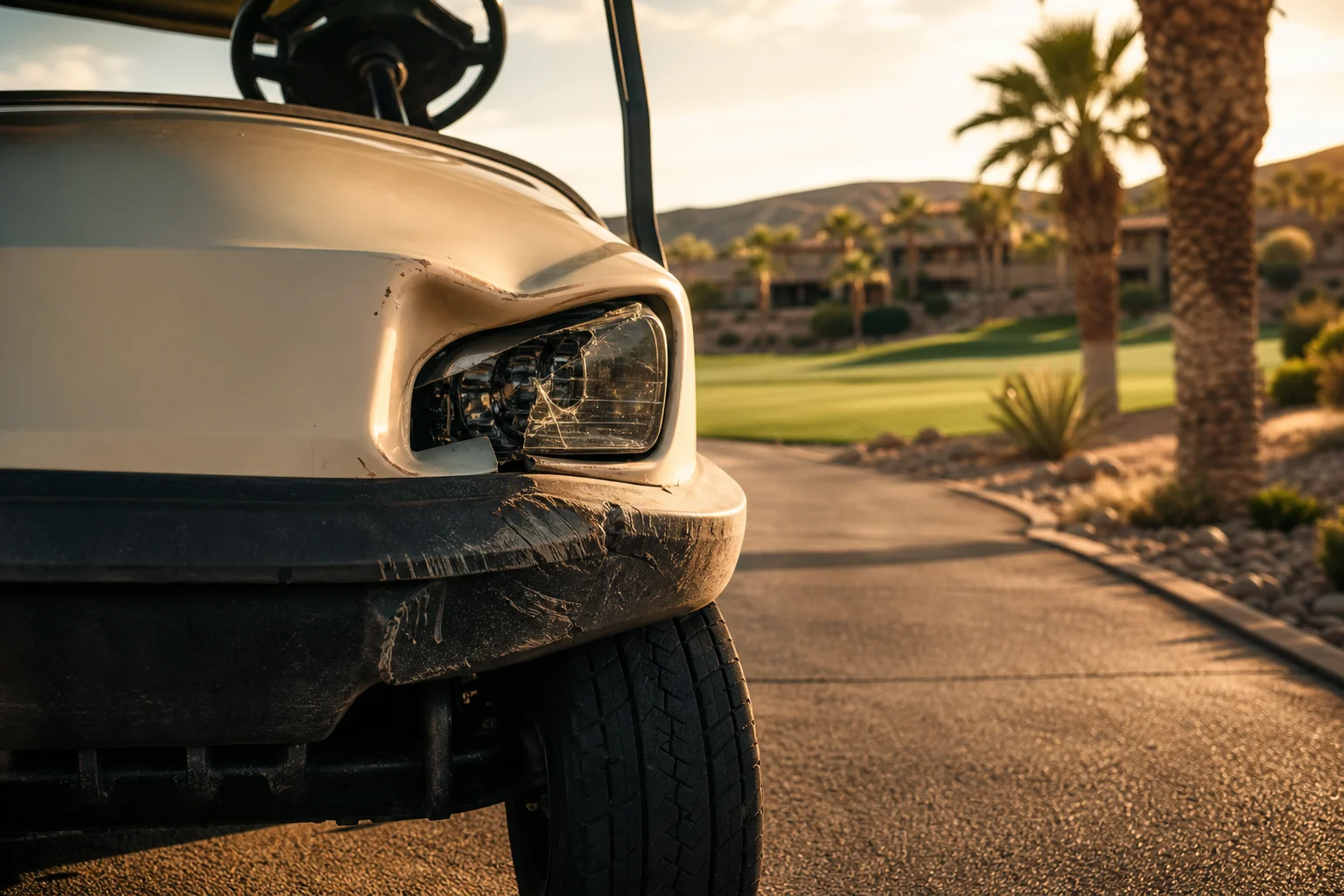
Golf carts have no seatbelts, doors, or airbags in most models, and their light frames roll over far more easily than a standard vehicle — a sharp turn taken too fast on a cart path is often enough to flip one. Riders thrown from a moving or rolling cart commonly suffer traumatic brain injuries, fractured wrists and collarbones from bracing a fall, and road rash or lacerations from pavement contact. Pedestrians struck by a cart on a resort walkway or community street face a different but equally serious injury pattern, closer to what we see in pedestrian accident cases — leg and hip fractures, spinal injury, and head trauma from a fall to pavement. Golf-specific hazards compound the risk, since carts frequently travel near bunkers, water hazards, and steep cart-path grades where a rollover can throw a rider well beyond the path itself.
Insurance Coverage Gaps After a Golf Cart Accident
Nevada sets golf cart liability insurance at a minimum of $10,000 in property damage and $15,000 in bodily injury coverage statewide, but in any county with a population over 700,000 — which today means Clark County alone — the minimum rises to $20,000 in property damage and $25,000 in bodily injury coverage. Those numbers sound reassuring until you compare them to an actual traumatic brain injury or spinal injury claim, where medical bills alone can exceed the entire policy limit within days. The bigger problem for injured riders is coverage that does not exist at all: most standard personal auto policies specifically exclude golf carts and low-speed vehicles, and a homeowner's or HOA policy may deny a claim by arguing the cart falls outside covered property or that the injury happened off common-area land. When the at-fault driver's coverage is thin or absent, an injured rider's own uninsured or underinsured motorist coverage can sometimes fill the gap, but only if the policy language treats a golf cart as a covered vehicle in the first place — another reason to have a lawyer review every applicable policy before accepting a quick settlement.
Comparative Negligence and Nevada's 51% Rule
Insurers routinely argue that an injured rider shares some blame — for standing on a moving cart, riding without holding on, or not warning the driver about a hazard. Nevada's modified comparative negligence rule, codified at NRS 41.141, allows you to recover damages as long as your own share of fault does not exceed 50%, with your award reduced by whatever percentage you are found responsible. A rider found 20% at fault on a $100,000 claim still recovers $80,000; a rider found 51% at fault recovers nothing. Because course operators, HOAs, and rental companies have every incentive to shift fault onto the injured rider, documenting exactly what happened — witness accounts, cart maintenance records, and the scene itself — early is critical to keeping that percentage as low as the facts support.
- Get medical care immediately, even for injuries that feel minor — a rollover or ejection can mask a head or spinal injury.
- Report the crash to the golf course, HOA, resort, or rental company and request a written incident report before it is discarded.
- Photograph the cart, the cart path or roadway, any skid marks, and your injuries before conditions change.
- Get the names and contact information of any witnesses, including other golfers, residents, or hotel staff nearby.
- Do not sign a liability waiver or accept a settlement from a course or rental company without legal advice.
- Call a Las Vegas personal injury attorney before giving a recorded statement to any insurance adjuster.
- Do I need a driver's license to operate a golf cart in Las Vegas? Only if the cart is registered as street legal or classified as a low-speed vehicle. On private golf course property, no license is typically required, but the operator still owes a duty of care to others.
- Can I sue a golf course or HOA after a golf cart accident? Yes. If the course, resort, or homeowners association failed to maintain the cart path, mark a hazard, or properly inspect and maintain its carts, premises liability principles can make it responsible.
- Does my car insurance cover a golf cart accident? Usually not. Most standard auto policies exclude golf carts and low-speed vehicles, so coverage often depends on a separate golf cart policy, HOA insurance, or the at-fault party's coverage.
- What if the golf cart accident happened on private property, not a public road? Nevada's negligence rules still apply. Whether the crash happened on a golf course, a resort driveway, or a public street, the operator and any responsible property owner can still be held liable.
- How long do I have to file a golf cart accident claim in Nevada? Nevada's personal injury statute of limitations generally gives you two years from the date of the accident, though evidence like maintenance records and incident reports should be secured much sooner.
Speak With a Las Vegas Golf Cart Accident Attorney
Thomas Boley has represented injured clients throughout Clark County for more than 18 years, and moves quickly to secure incident reports, maintenance logs, and insurance information before they disappear.
Call (702) 435-3333 for a free consultation, or contact Thomas Boley online to discuss a golf cart accident in Las Vegas, Henderson, Summerlin, North Las Vegas, or elsewhere in Clark County. Bring any incident report, rental agreement, or insurance correspondence you have received, along with photos from the scene. Our guide to Nevada's statute of limitations explains how much time you have to act. This article is informational only and is not legal advice. Every case is unique.
About the Author
Thomas Boley is a Nevada licensed attorney specializing in personal injury law and criminal defense. Since 2008, Thomas has represented thousands of clients in Las Vegas and Clark County, recovering millions of dollars in compensation for injury victims. He is a member of the State Bar of Nevada, the Clark County Bar Association, and the Nevada Justice Association.
Need Legal Help? Contact Thomas Boley for a free consultation: (702) 435-3333