Uninsured and Underinsured Motorist Claims in Nevada: How to Maximize Your Recovery
In This Article
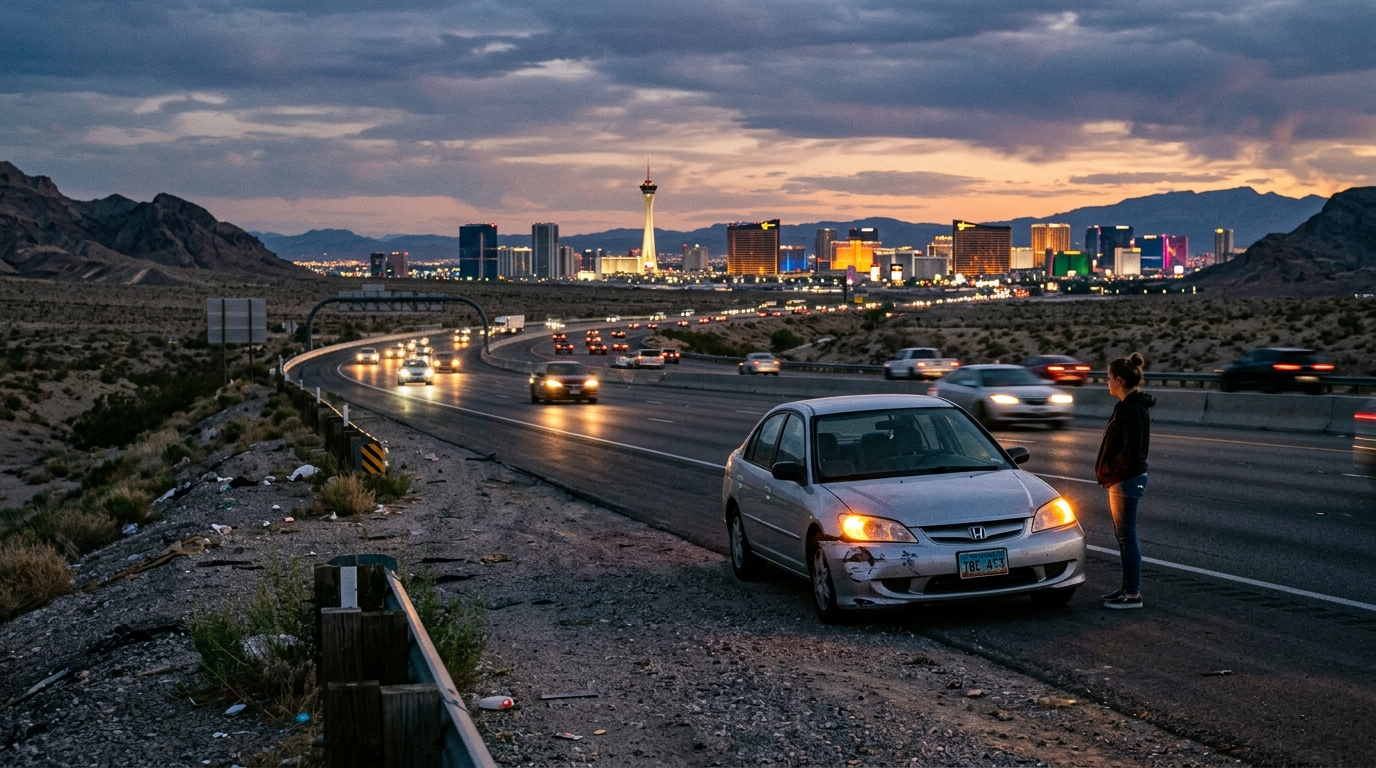
Nevada has one of the highest rates of uninsured drivers in the United States — consistently ranking in the top five states — and Las Vegas highways, including I-15, US-95, and I-215, see thousands of accidents each year. When you are injured by a driver who carries no insurance, or whose policy limits are too low to cover your losses, Nevada's uninsured motorist (UM) and underinsured motorist (UIM) coverage laws become your most important financial lifeline. The Law Offices of Thomas Boley handles UM and UIM claims throughout Clark County — fighting your own insurance company when they refuse to pay what you're owed.
Nevada's Uninsured Driver Problem
According to the Insurance Research Council, approximately 1 in 6 Nevada drivers is uninsured at any given time — even though Nevada law (NRS 485.185) requires all drivers to maintain minimum liability insurance of $25,000 per person / $50,000 per accident for bodily injury and $20,000 for property damage. Many drivers carry only the state minimum, which is woefully inadequate for serious injuries involving hospitalization, surgery, or long-term rehabilitation. Tourists, out-of-state visitors, and commercial rideshare drivers add additional complexity to Las Vegas accident claims.
Free case review
Injured or Facing Charges in Las Vegas?
Thomas Boley offers free consultations — no fees unless we win your case.
Related reading: what to Do After a Car Accident in Las Vegas and traumatic Brain Injury After a Car Accident in Las Vegas.
What Is Uninsured Motorist (UM) Coverage in Nevada?
Under NRS 687B.145, Nevada law requires every auto insurance policy issued in the state to offer UM and UIM coverage at limits matching your liability coverage — unless you reject it in writing. UM coverage applies when: (1) the at-fault driver carries no liability insurance at all; (2) the at-fault driver is unidentified (hit-and-run); or (3) the at-fault driver's insurer is insolvent. When you make a UM claim, you are filing against your own insurer — but this does not mean the claim is cooperative. Insurance companies apply the same adversarial tactics to UM claims that they do to third-party liability claims.
What Is Underinsured Motorist (UIM) Coverage in Nevada?
UIM coverage applies when the at-fault driver carries liability insurance, but those limits are lower than the value of your damages. For example, if you suffer a spinal cord injury worth $400,000 in damages and the at-fault driver carries only $25,000 in liability coverage, your UIM policy kicks in for the remaining $375,000 — up to your UIM policy limit. Under Nevada's offset rule (NRS 687B.145(2)), your UIM benefit is reduced by whatever the at-fault driver's insurer pays. This means UIM is triggered only when your damages genuinely exceed the at-fault driver's limits.
Critical note on UIM stacking: Nevada permits inter-policy stacking (combining UIM coverage from multiple policies you hold on different vehicles) but restricts intra-policy stacking (combining coverage on multiple vehicles within a single policy) depending on policy language. If you own multiple vehicles, reviewing your policies before settlement can unlock substantially higher coverage.

Hit-and-Run Accidents: Using UM Coverage in Nevada
Nevada law treats hit-and-run accidents as uninsured motorist events — your UM coverage applies. However, NRS 687B.145(1)(b) requires that the accident be reported to law enforcement promptly and that the hit-and-run vehicle make actual physical contact with your vehicle. Insurance companies frequently dispute these requirements, denying claims where contact is disputed or where the report was not filed immediately. Document everything at the scene — video, photos of paint transfer, witness statements — and contact law enforcement immediately. An experienced attorney can challenge improper denials.
How UM/UIM Claims Differ From Third-Party Claims
When you file a third-party claim, you are dealing with the at-fault driver's insurer — an adversary from the start. When you file a UM or UIM claim, you are filing against your own insurer. Many people assume this means the process will be fair and cooperative. It is not. Under Nevada's bad faith insurance law (NRS 686A.310), insurers owe their own policyholders a higher duty of good faith and fair dealing than they owe to third parties. However, insurers routinely: undervalue injuries; demand excessive documentation; delay investigations; request independent medical examinations (IMEs) by doctors known to minimize injuries; and make lowball offers.
If your insurer acts unreasonably in denying or delaying a UM/UIM claim, you may have a separate claim for insurance bad faith under NRS 686A.310 — which can include punitive damages against the insurance company in addition to your policy benefits.
The UM/UIM Claims Process in Nevada
Step 1 — Report the accident: Notify your insurer of the accident immediately. Failure to give timely notice can be used as a defense. Cooperation clauses in Nevada UM/UIM policies require you to cooperate with your insurer's investigation.
Step 2 — Exhaust the at-fault driver's coverage first (UIM): Before triggering your UIM policy, you must first settle with or obtain a judgment against the at-fault driver's insurer. Nevada requires your own insurer's consent before you settle the underlying liability claim — failure to obtain consent can waive your UIM benefits. We notify your UM/UIM carrier in writing before accepting any liability settlement and obtain consent or document a refusal.
Step 3 — Submit your UM/UIM claim: Provide medical records, wage loss documentation, expert reports, and all evidence supporting your damages. Your insurer will evaluate the claim, potentially dispatch an IME doctor, and make an offer.
Step 4 — Negotiate: UM/UIM negotiations are often protracted. We handle all communications with your insurer, document every delay, and track every response against the standards required by NRS 686A.310 (Nevada Unfair Claims Settlement Practices Act).
Step 5 — Arbitration or litigation: Most Nevada UM/UIM policies contain binding arbitration clauses. If negotiations fail, the dispute goes to arbitration — a private proceeding before a neutral arbitrator rather than a jury. We are experienced in UM/UIM arbitration, preparing full evidence packages, expert witnesses, and legal briefs. If the policy does not contain an arbitration clause, or if the arbitration award is insufficient, we file suit.
Damages Recoverable in Nevada UM/UIM Claims
UM/UIM coverage reimburses the same categories of damages you could recover from the at-fault driver directly: medical expenses (past and future); lost wages and loss of earning capacity; pain and suffering; emotional distress; loss of consortium (spouse's claim for loss of companionship); and property damage (separate UM property damage coverage may apply). Nevada has no cap on non-economic damages in UM/UIM cases. Recovery is limited only by your policy limits — which underscores the importance of carrying adequate UM/UIM coverage.
Statute of Limitations for Nevada UM/UIM Claims
Nevada's general personal injury statute of limitations is two years from the date of injury (NRS 11.190). However, UM/UIM claims have an additional layer: contractual limitation provisions in your policy may impose shorter deadlines — sometimes as short as one year from the date of the accident or from the denial of the underlying liability claim. Courts have enforced these contractual limitations in Nevada. Do not wait. Contact an attorney immediately after any accident involving an uninsured or underinsured driver.
Why Choose Thomas Boley for Your UM/UIM Claim
Fighting your own insurer requires understanding both personal injury valuation and insurance law. We know how Nevada UM/UIM policies are written, how arbitration proceedings work, and how to document bad faith exposure that pressures insurers to pay fair value. We handle all UM/UIM cases on a contingency fee — no charge unless we recover. Call (702) 435-3333 any time, 24/7, for a free confidential consultation. We serve Las Vegas, Henderson, Summerlin, North Las Vegas, Boulder City, and all of Clark County.
Frequently Asked Questions
Q: The at-fault driver fled the scene — can I still recover?
A: Yes, if your policy includes UM coverage. Nevada treats hit-and-run accidents as uninsured motorist events. You must report the accident to police promptly and your insurer must be notified. Physical contact between vehicles is generally required under most Nevada policies — witness statements and video evidence are essential when contact is disputed.
Q: My insurer is offering far less than my medical bills — what can I do?
A: A low offer does not end the process. We document the full value of your claim with medical records, expert opinions, and wage loss evidence — then negotiate and, if necessary, take the claim to arbitration. If your insurer is acting unreasonably, we also evaluate whether a bad faith claim under NRS 686A.310 is warranted.
Q: Do I have to give a recorded statement to my own insurer?
A: Your policy likely requires you to cooperate with the investigation, which may include a statement. However, you have the right to have an attorney present — and we strongly advise having counsel before giving any recorded statement on a UM/UIM claim. Adjusters use recorded statements to lock you into descriptions of your injuries that may minimize your recovery.
Q: I settled with the at-fault driver's insurer — did I give up my UIM claim?
A: Possibly, if you did not obtain your UIM insurer's written consent before settling. Under Nevada law, your UIM insurer must approve any settlement with the at-fault driver or be given the opportunity to advance the settlement amount in its place. Settling without consent may waive UIM benefits. Contact an attorney before accepting any liability settlement when UIM coverage may be at stake.
Q: I have multiple vehicles insured under separate policies — can I combine coverage?
A: Potentially yes. Nevada permits inter-policy stacking — combining UM/UIM limits from separate policies on different vehicles. This can significantly increase your available coverage when damages are severe. We review all available policies when evaluating UM/UIM exposure.
For more information, visit our Las Vegas personal injury attorney | schedule a free consultation.
About the Author
Thomas Boley is a Nevada licensed attorney specializing in personal injury law and criminal defense. Since 2008, Thomas has represented thousands of clients in Las Vegas and Clark County, recovering millions of dollars in compensation for injury victims. He is a member of the State Bar of Nevada, the Clark County Bar Association, and the Nevada Justice Association.
Need Legal Help? Contact Thomas Boley for a free consultation: (702) 435-3333