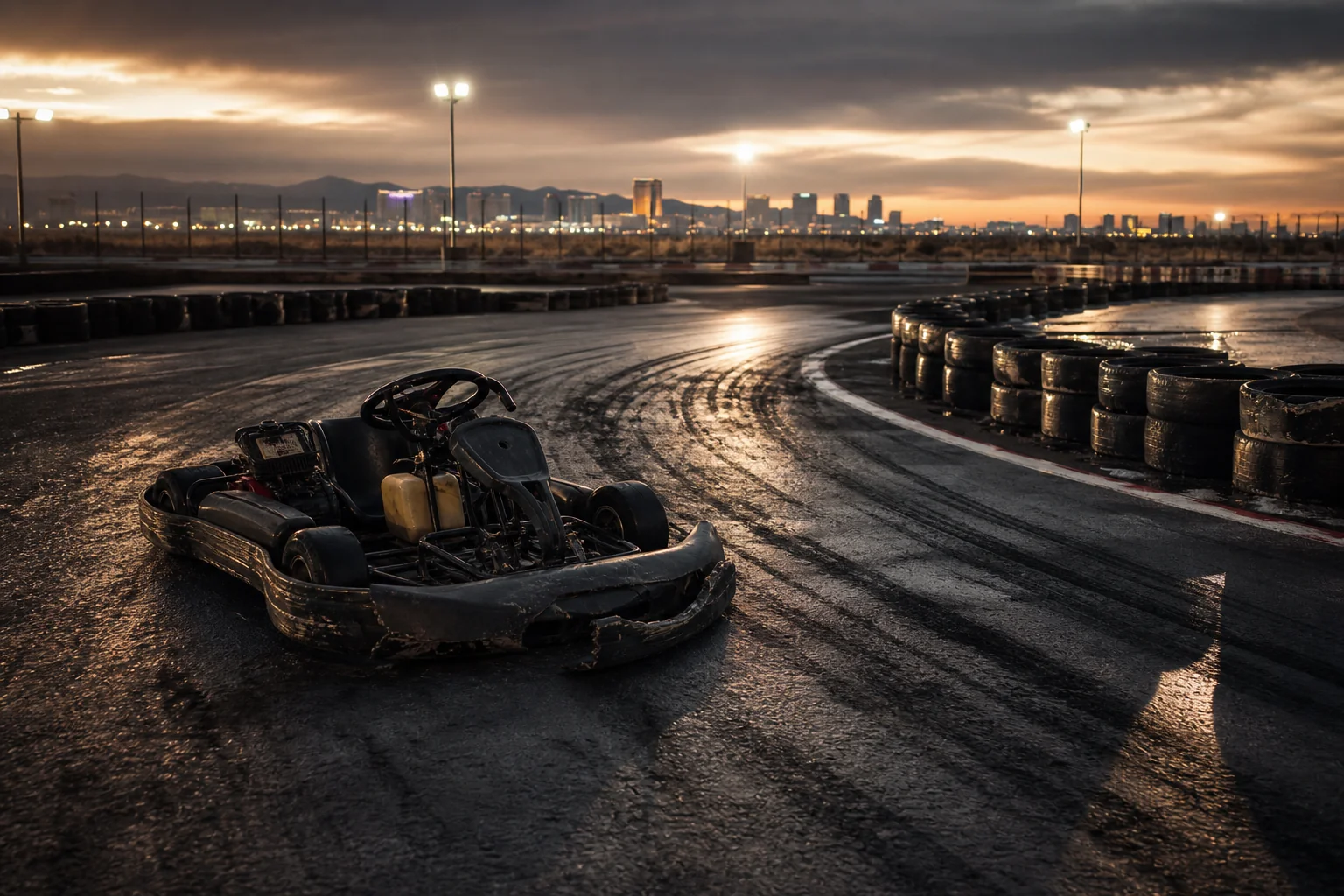
Go-Kart Accident Claims in Las Vegas: Your Legal Rights
In This Article
A go-kart accident in Las Vegas can happen in seconds — a kart clips the tire wall coming out of a hairpin turn, a driver locks up going into the last corner and gets rear-ended by the kart behind, or a mechanical failure sends a rider into the barrier at 40 miles per hour. With several high-speed karting attractions drawing tourists and locals across the valley, from arrive-and-drive indoor circuits near the Strip to outdoor tracks on the edge of the desert, a go-kart accident in Las Vegas is rarely just bad luck. More often it traces back to a poorly maintained kart, a track built without adequate run-off room, or an operator who let too many drivers onto the circuit at once. At Thomas Boley Attorney At Law, we help injured drivers and passengers throughout Las Vegas, Henderson, Summerlin, North Las Vegas, and the rest of Clark County figure out whether a signed waiver actually blocks their claim, and who else may be responsible.
- Nevada regulates many go-kart tracks and similar attractions under NRS Chapter 455B, the state's Recreational Parks law, which defines an "amusement ride" broadly enough to include a ride a passenger propels or steers inside a permanent public facility.
- NRS 455B.020 requires a track operator to take all measures reasonably necessary to protect rider safety in how the ride is built, maintained, operated, and supervised — a duty that exists independent of any waiver a driver signs.
- A signed liability waiver does not automatically bar a claim. Nevada generally enforces waivers for ordinary negligence in recreational activities, but not for gross negligence, reckless conduct, or a track's willful disregard for a known safety hazard.
- Liability can fall on the track operator, a kart rental or maintenance company, another driver who raced recklessly, or the parent who authorized a minor to drive.
- Nevada's modified comparative negligence rule, NRS 41.141, bars recovery only if you are found 51% or more at fault, and reduces your award by your own share of fault otherwise.
- Nevada's two-year statute of limitations for personal injury claims means waiver paperwork, maintenance logs, and track session records should be secured quickly, before they are discarded.
Go-Kart Accident Claims in Las Vegas Under Nevada Law
Free case review
Injured or Facing Charges in Las Vegas?
Thomas Boley offers free consultations — no fees unless we win your case.
Nevada regulates go-kart tracks and similar attractions under NRS Chapter 455B, the state's Recreational Parks law. NRS 455B.010 defines an "amusement ride" broadly as any mechanical device that carries passengers over a fixed or restricted route for their amusement, and the statute specifically extends that definition to a ride propelled by its passengers when it operates inside a permanent public facility — language broad enough to reach many arrive-and-drive go-kart circuits and racetrack attractions across the Las Vegas valley. Once a track qualifies, NRS 455B.020 requires the operator to take all measures reasonably necessary to protect the safety of passengers in how the ride is constructed, maintained, operated, and supervised. NRS 455B.030 goes further, requiring the operator to post signs at multiple conspicuous locations around the facility explaining rider responsibilities and identifying where an injury should be reported. When a track skips routine inspections, ignores a known mechanical problem, or fails to staff a session properly, that is not just a safety lapse — it can be a direct violation of a Nevada statute written specifically for this kind of attraction.
Do Liability Waivers Block a Go-Kart Accident Claim?
Nearly every go-kart track in Las Vegas requires drivers to sign a liability waiver before they are allowed on the circuit, and many injured drivers assume that signature ends any chance of recovery. It does not, at least not automatically. Nevada generally enforces liability waivers for ordinary negligence in recreational activities — the everyday bumps, spins, and contact that come with competitive kart racing. But Nevada courts, like most jurisdictions, will not enforce a waiver against gross negligence, reckless conduct, or a willful disregard for rider safety. A track that keeps racing karts with a known brake or steering defect, removes tire barriers to speed up turnover between sessions, or lets an intoxicated or clearly unqualified driver onto the circuit is not committing the ordinary negligence a waiver is written to cover. A waiver signed by a parent on behalf of a minor driver raises additional questions, since courts are often skeptical of a parent's ability to sign away a child's own future negligence claim. Whether a specific waiver actually bars a specific claim depends heavily on how it was written, what it disclosed, and what actually caused the crash — the kind of analysis a Las Vegas personal injury attorney reviews before advising a client to walk away from a claim.
Common Causes of Go-Kart and Racetrack Accidents
Some go-kart accidents come down to driver error — following too closely, spinning out on a wet track, or intentionally bumping another kart. Many others trace back to the track itself. Worn brake pads, sticking throttles, and steering that has not been serviced between rental sessions can turn an ordinary spin into a high-speed impact. Track design plays an equally large role: a hairpin turn without enough run-off room, a tire barrier that is too thin or improperly stacked to absorb an impact, or a blind corner where a stalled kart cannot be seen in time all create foreseeable hazards an operator is expected to address. Overcrowded sessions compound every one of these risks — the more karts on a circuit at once, the less room any driver has to react to another driver's mistake. Inadequate staff supervision, rushed safety briefings, and drivers who were never actually checked for basic kart-handling ability before being sent onto the track round out the most common causes we see in Las Vegas go-kart accident cases.
Who Can Be Held Liable After a Go-Kart Accident
More than one party is often responsible after a Las Vegas go-kart accident, and identifying every one of them early can significantly change the value of a claim. The track operator can be liable under ordinary premises liability principles and its specific NRS 455B duty of care if poor maintenance, inadequate barriers, or insufficient supervision contributed to the crash. A separate kart rental, leasing, or maintenance contractor can be liable if it supplied or serviced a kart with a defect the track operator did not know about. Another driver can be personally liable for reckless or intentional conduct on the track, similar to how a driver is held responsible in an ordinary golf cart accident or low-speed vehicle collision. When a minor is allowed to race, the parent or guardian who signed the waiver and authorized the drive can also share in the liability analysis. Because tracks, rental companies, and individual drivers each carry different insurance — or none at all — sorting out who is actually responsible, and how much coverage exists, is often the difference between a claim that is fully compensated and one that is not.

Common Injuries in Go-Kart and Racetrack Accidents
Go-karts sit low to the ground and offer little more protection than a harness, a roll bar, and a helmet, so even a moderate-speed impact can produce serious injuries. Rear-end collisions on the track commonly cause whiplash and other soft-tissue neck injuries, since the seating position offers almost no give when a following kart makes contact. Drivers who brace against the wheel during an impact frequently suffer wrist, hand, and finger fractures, while contact with a tire barrier or a spin across the asphalt can cause road rash, deep lacerations, and burns from the pavement or an exposed engine component. A cracked or improperly fitted helmet, or one that comes loose during an ejection, can turn what should have been a survivable impact into a traumatic brain injury. High-speed impacts into a barrier or another kart can also cause spinal injury, particularly when a track's harness or seating has not been properly maintained.
Comparative Negligence and Nevada's 51% Rule
Track operators and their insurers routinely argue that an injured driver shares the blame — for following too closely, ignoring a staff instruction, or violating one of the passenger conduct rules Nevada law itself sets out under NRS 455B.050 and 455B.060. Nevada's modified comparative negligence rule, codified at NRS 41.141, allows you to recover damages as long as your own share of fault does not exceed 50%, with your award reduced by whatever percentage you are found responsible. A driver found 20% at fault on a $100,000 claim still recovers $80,000; a driver found 51% at fault recovers nothing. Because track operators have every incentive to argue the injured driver caused their own crash, documenting exactly what happened — witness statements from other racers, the track's own incident report, and session video if the facility records it — early is critical to keeping that percentage as low as the facts support.
Insurance Issues After a Racetrack Accident
Most Las Vegas go-kart and racetrack attractions carry general liability insurance, but that coverage is written to protect the business, not to make an injured driver whole, and insurers frequently point to the signed waiver as a reason to deny a claim outright before ever addressing fault. A personal auto policy almost never covers a racetrack accident, since go-karts are not registered or licensed vehicles and track driving falls outside standard liability coverage. Health insurance is often the first payer for emergency treatment, but it typically comes with a subrogation right to be reimbursed out of any eventual settlement, which needs to be accounted for when evaluating what a claim is actually worth. When the at-fault party's coverage is limited, additional sources — a rental company's separate policy, a manufacturer's product liability coverage, or a parent's homeowner's policy in a minor-driver case — sometimes fill the gap, but only if someone identifies them before a claim is settled.
- Get medical care immediately, even for injuries that feel minor — whiplash and head injuries are often not obvious right after a high-speed impact.
- Report the crash to the track operator and request a copy of the written incident report before it can be lost or altered.
- Photograph the kart, the barrier or track surface, your helmet and harness, and your injuries before anything is repaired or discarded.
- Get the names and contact information of any witnesses, including other drivers and track staff who were present.
- Do not sign a second document, release, or settlement offer from the track without legal advice, even if you already signed a waiver before racing.
- Call a Las Vegas personal injury attorney before giving a recorded statement to the track's insurance company.
- Can I still sue if I signed a liability waiver before racing? Often, yes. Nevada generally enforces waivers only for ordinary negligence, not for gross negligence, reckless conduct, or a track's willful disregard for a known safety hazard.
- Is a go-kart track legally an "amusement ride" under Nevada law? Many are. NRS 455B.010 defines an amusement ride broadly enough to include a ride propelled by its passengers inside a permanent public facility, which brings many arrive-and-drive tracks under the statute's safety duties.
- Can I hold the track responsible if another driver hit me? Possibly, in addition to the other driver. If the track allowed overcrowded sessions, failed to screen drivers, or provided inadequate supervision, the operator can share liability alongside the driver who hit you.
- Does my car insurance cover a go-kart accident? Almost never. Go-karts are not registered vehicles, and standard auto policies do not extend to racetrack driving, so coverage typically depends on the track's insurance or another responsible party's policy.
- How long do I have to file a go-kart accident claim in Nevada? Nevada's personal injury statute of limitations generally gives you two years from the date of the accident, though waiver paperwork and track records should be secured much sooner.
Speak With a Las Vegas Go-Kart Accident Attorney
Thomas Boley has represented injured clients throughout Clark County for more than 18 years, and moves quickly to secure waiver paperwork, maintenance logs, and incident reports before a track can argue they no longer exist.
Call (702) 435-3333 for a free consultation, or contact Thomas Boley online to discuss a go-kart or racetrack accident in Las Vegas, Henderson, Summerlin, North Las Vegas, or elsewhere in Clark County. Bring any waiver you signed, incident report, or insurance correspondence you have received, along with photos from the scene. Our guide to Amusement Park and Attraction Injuries in Las Vegas explains how these same safety duties apply at other attractions across the valley. This article is informational only and is not legal advice. Every case is unique.
About the Author
Thomas Boley is a Nevada licensed attorney specializing in personal injury law and criminal defense. Since 2008, Thomas has represented thousands of clients in Las Vegas and Clark County, recovering millions of dollars in compensation for injury victims. He is a member of the State Bar of Nevada, the Clark County Bar Association, and the Nevada Justice Association.
Need Legal Help? Contact Thomas Boley for a free consultation: (702) 435-3333