Flash Flood Accident Claims in Las Vegas: Who Is Liable?
In This Article
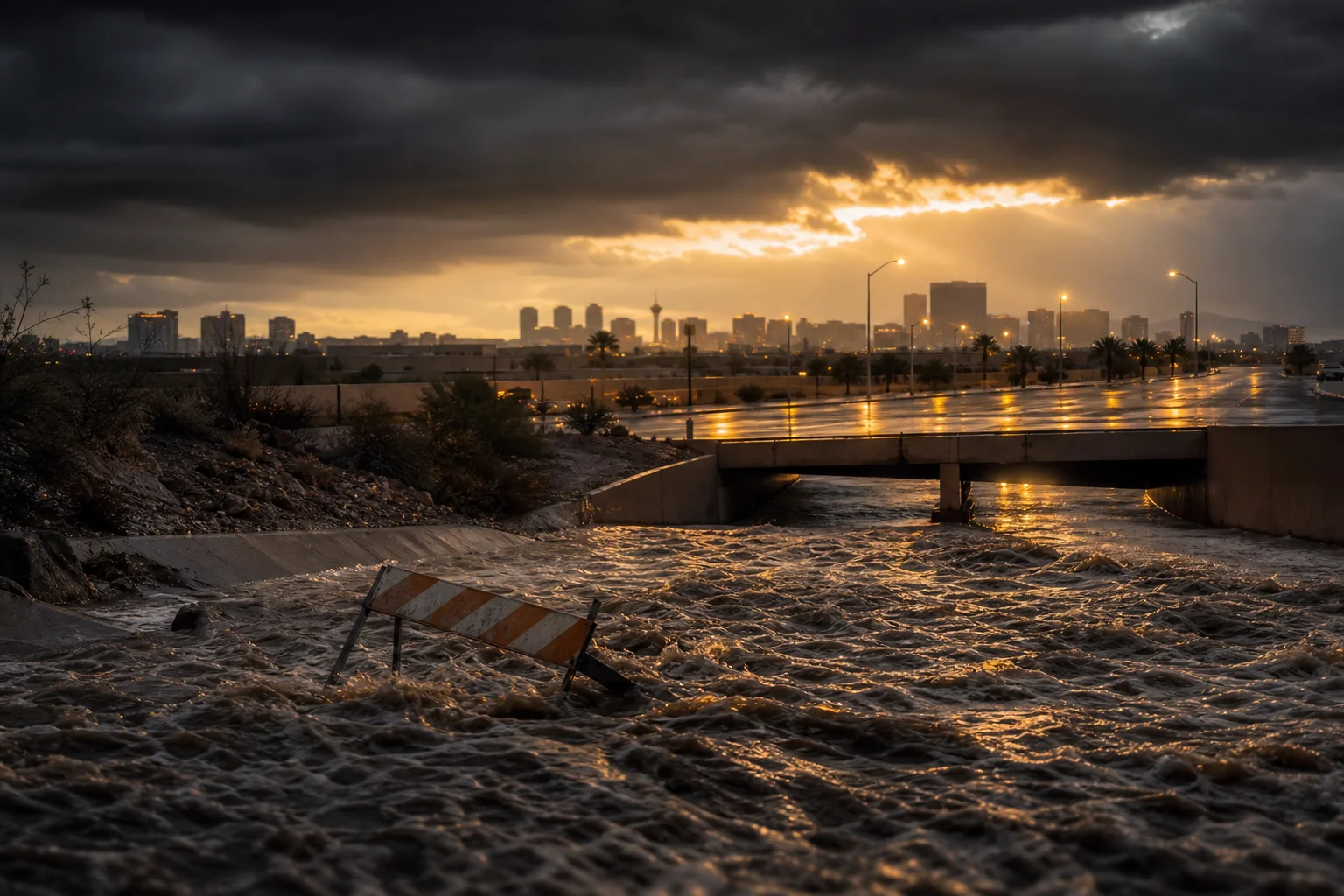
A monsoon cell rolls over the valley on a July afternoon, and within twenty minutes a bone-dry wash near Flamingo Road turns into a churning brown river carrying shopping carts, patio furniture, and — some years — a car that never should have driven past the barricade. Flash flood accident claims in Las Vegas follow a grimly predictable pattern each summer: a driver misjudges how deep the water running across a dipped underpass really is, a warning sign goes up only after someone has already driven past the last dry pavement, or a pedestrian is swept off a sidewalk that looked passable seconds earlier. The Clark County Regional Flood Control District has tied dozens of deaths across the valley to local flooding since 1990, and several more have died in flood-related incidents since 2020 alone. At Thomas Boley Attorney At Law, we represent injured victims and grieving families throughout Las Vegas, Henderson, Summerlin, North Las Vegas, and the rest of Clark County after a flash flood, wash, or storm-related accident.
- Nevada does not have a blanket law that automatically bars an injured driver's claim after entering floodwater — NRS 484B.574 instead makes a driver who bypasses a flood barricade, or who is convicted of reckless driving through floodwater, liable for up to $2,000 in emergency-response costs.
- Government entities — Clark County, the City of Las Vegas, the City of Henderson, NDOT, and the Regional Flood Control District — can be held liable for a dangerous wash, culvert, or roadway condition, but a judgment against a government entity is capped at $200,000 under NRS 41.035 and cannot include punitive damages.
- A written notice of claim generally must reach the responsible government body within 2 years under NRS 41.036, on a separate track from the ordinary personal injury deadline.
- Discretionary-function immunity under NRS 41.032 can shield a government's design and engineering decisions, but failing to close a road or post a barricade after a credible flood warning is a different question than the decision of where to build the wash in the first place.
- Nevada's modified comparative negligence rule, NRS 41.141, bars recovery only when you are found more than 50% at fault — driving around a barricade can reduce a recovery, but it does not automatically eliminate a claim against another negligent party.
- When a flash flood proves fatal, surviving family members may bring a separate wrongful death claim under NRS 41.085.
- Southern Nevada's monsoon season typically runs from roughly June through September, and most flood deaths in the valley happen when a vehicle is swept off a flooded roadway.
Flash Flood Accident Claims in Las Vegas: How Nevada Law Applies
Free case review
Injured or Facing Charges in Las Vegas?
Thomas Boley offers free consultations — no fees unless we win your case.
A flash flood or wash accident claim in Las Vegas is not a special category of law with its own statute governing every scenario — it is an ordinary negligence, premises liability, or government tort claim that happens to be triggered by weather instead of a distracted driver or a wet grocery store floor. That distinction matters because it shapes who can be sued and how. If another driver hydroplanes into your car during a downpour, that is standard auto-negligence law. If you are hurt because a hotel parking structure drained poorly and flooded a walkway, that is premises liability, similar to the issues we cover in our guide to dangerous road condition accidents in Las Vegas. If you are hurt because a public wash, culvert, or dip in a Clark County roadway was left unmarked, unbarricaded, or poorly maintained despite years of known flooding at that location, that is a government tort claim governed by Nevada's Tort Claims Act, NRS Chapter 41. The Regional Flood Control District's own safety data, published at regionalflood.org, documents just how often these three fact patterns repeat across the valley every monsoon season — which is exactly why insurers and government claims adjusters already have a playbook for minimizing what they pay, and why victims benefit from having one too.
How Wash and Flash Flood Accidents Happen in the Las Vegas Valley
Every wash in the Las Vegas Valley is designed to carry a specific volume of water, and every summer at least a few storms exceed it. The most common injury pattern is a vehicle driven into a flooded dip or underpass — locations like the low crossings along the Flamingo, Tropicana, and Las Vegas Wash channels, or foothill washes near Summerlin, Anthem, and the Henderson bench, can go from dry to axle-deep in minutes once a storm cell parks over the western mountains. Water moving at just a foot or two per second can float and sweep a passenger vehicle sideways into a culvert wall or downstream drop structure, and a stalled engine in rising water quickly becomes a life-threatening situation rather than an inconvenience. A second pattern involves pedestrians and cyclists caught on a sidewalk or multi-use path that parallels a wash channel when a flash flood arrives faster than the storm itself, sweeping someone off their feet before they can reach higher ground. A third, less obvious pattern is the ordinary traffic collision made worse by the storm — a driver hydroplanes on Las Vegas Boulevard or the 215 Beltway and rear-ends another car, or loses control on standing water and crosses the center line, producing an injury claim that looks like any other crash but where the weather and road-drainage conditions become central evidence. Finally, resort and apartment properties with poor storm drainage can flood parking garages, valet areas, and walkways, creating a slip-and-fall or trapped-vehicle claim against the property owner rather than the government — an issue closely related to what we discuss in our guide to hotel and resort injury claims in Las Vegas.
Who Can Be Held Liable for a Las Vegas Flash Flood Accident
Liability after a flash flood accident depends entirely on whose negligence put you in the water in the first place. A private driver who plows through standing water at an unsafe speed, tailgates in heavy rain, or ignores hazard lights and a slowing line of traffic can be held liable under ordinary Nevada negligence law, the same as in any other car accident. A property owner — a hotel, resort, apartment complex, or shopping center — that fails to maintain drainage, storm grates, or retention areas on its land can be liable under premises liability principles when that failure floods a walkway, stairwell, or parking structure and someone is hurt. Government liability is where these claims get more complicated. Clark County, the City of Las Vegas, the City of Henderson, the Nevada Department of Transportation, and the Clark County Regional Flood Control District all bear some responsibility for different pieces of the valley's flood-control infrastructure and roadway network, and any of them can potentially be named depending on which stretch of road or wash channel is involved. Nevada's Tort Claims Act waives sovereign immunity for ordinary negligence under NRS 41.031, but NRS 41.032 preserves immunity for a "discretionary function" — meaning the government's engineering judgment about how to design a wash or culvert is generally protected, even if a different design would have performed better. That protection is not unlimited: it typically does not extend to a failure to act on specific, known notice of a hazard, such as ignoring repeated reports that a particular barricade is missing or that a warning sign has been knocked down for weeks before the storm that hurts you. Even where liability is proven, NRS 41.035 caps any judgment against a government entity at $200,000 and bars punitive damages entirely, and NRS 41.036 requires a written notice of claim to reach the responsible entity within 2 years — a separate, earlier-triggering procedural step than simply filing a lawsuit before the statute of limitations under NRS 11.190 runs out. In a fatal case, a family's wrongful death claim proceeds under these same government-liability rules whenever a public entity is a defendant.

NRS 484B.574: Nevada's Flood Barricade and Reckless Driving Law
Nevada does not have anything like Arizona's so-called "Stupid Motorist Law," which can bar a driver's own claim outright for driving around a flood barricade. Nevada's version, NRS 484B.574, is narrower and works differently: a person who unlawfully drives through a temporary roadblock established because of flooding, or who is convicted of reckless driving for entering an area covered by rising floodwater, becomes liable to reimburse the agency that performs the rescue for its emergency-response expenses — things like personnel time, volunteer wages, and equipment costs — capped at $2,000 for a single incident. Ambulance and air-ambulance fees are specifically excluded from that cap and billed separately. The statute carves out an important exception: a person who violates it while making a good-faith effort to rescue someone else who is or appears to be in danger is immune from this particular liability. NRS 484B.574 is a cost-recovery statute aimed at reimbursing first responders, not a rule that automatically forfeits an injured driver's right to pursue a separate negligence or government-liability claim against whoever else contributed to the crash — though a citation or conviction under this section will almost certainly be used as evidence of your own fault when an insurer or government adjuster evaluates your case.
Comparative Negligence and Your Own Actions During a Storm
Because driving around a barricade or misjudging standing water can look like carelessness, insurers and government claims adjusters lean hard on Nevada's comparative negligence rules to reduce or deny a flash flood accident claim. Under NRS 41.141, Nevada follows a modified comparative negligence rule: you can still recover damages as long as your own share of fault is 50% or less, with your award reduced by that percentage, but a finding of 51% or more fault bars recovery entirely. That means the specific facts — whether a barricade was actually in place and visible, whether the water's depth was obvious from where you approached, whether you were following posted detour signs, and how fast conditions changed — can be the difference between a full recovery, a reduced one, and no recovery at all. Our guide to comparative negligence in Nevada personal injury claims walks through how fault percentages get argued and assigned in more detail. This is exactly the kind of fact-intensive dispute where documenting the scene — photos of any barricades, warning signs, or their absence, and the depth and speed of the water — makes a measurable difference in the outcome.
- Get to higher ground and call 911 first — do not stay with a vehicle in rising water to gather evidence.
- Once safe, photograph the water level, any barricades or warning signs present (or missing), and the general condition of the roadway or wash.
- Save screenshots of any weather alerts, road-closure notices, or storm radar you saw before or during the incident.
- Get the names of any other drivers, witnesses, or first responders on scene, including the agency that performed a rescue.
- Seek medical treatment even if you feel only shaken up — some injuries from being swept or from a collision surface hours later.
- If a government entity may be responsible, remember the notice-of-claim clock under NRS 41.036 can start running immediately — do not wait to speak with an attorney.
- Can I sue the government if I was hurt driving into a flooded Las Vegas wash? Potentially, yes. Nevada's Tort Claims Act allows negligence claims against Clark County, the City of Las Vegas, NDOT, and similar entities, though the claim is subject to a $200,000 damages cap under NRS 41.035, a notice-of-claim requirement under NRS 41.036, and discretionary-function immunity under NRS 41.032 for certain design decisions.
- Does NRS 484B.574 mean I can't recover damages after a flash flood accident? No. That statute only makes you liable to reimburse an emergency-response agency for its rescue costs, capped at $2,000. It does not automatically bar a separate negligence or government-liability claim against another party, though it can be used as evidence of your own comparative fault.
- How long do I have to file a claim after a Las Vegas flash flood accident? The general Nevada personal injury statute of limitations is 2 years under NRS 11.190. If a government entity may be liable, a separate written notice of claim generally must also reach that entity within 2 years under NRS 41.036 — do not assume you have until the last day of the deadline to start that process.
- What if I was partly at fault for driving through high water? Nevada's modified comparative negligence rule under NRS 41.141 still allows recovery as long as you are found 50% or less at fault, with your award reduced proportionally. You are only completely barred from recovery if you are found more than 50% at fault.
- Can my family file a wrongful death claim if someone drowned in a Las Vegas wash? Yes. Surviving family members may bring a wrongful death claim under NRS 41.085 against a negligent driver, property owner, or, subject to the Tort Claims Act's rules, a responsible government entity.
Speak With a Las Vegas Flash Flood Accident Attorney
Thomas Boley has represented injured victims and grieving families throughout Clark County for more than 18 years, including flash flood, wash, and severe-weather accident claims against private drivers, property owners, and government entities alike.
Call (702) 435-3333 for a free consultation, or contact Thomas Boley online to discuss a flash flood, wash, or storm-related accident in Las Vegas, Henderson, Summerlin, North Las Vegas, or elsewhere in Clark County. Bring any photos, weather alerts, police or incident reports, and medical records you have. If your case involves a vehicle collision made worse by the storm, our auto accident practice can evaluate every angle, and our full personal injury practice handles every related claim. This article is informational only and is not legal advice. Every case is unique.
About the Author
Thomas Boley is a Nevada licensed attorney specializing in personal injury law and criminal defense. Since 2008, Thomas has represented thousands of clients in Las Vegas and Clark County, recovering millions of dollars in compensation for injury victims. He is a member of the State Bar of Nevada, the Clark County Bar Association, and the Nevada Justice Association.
Need Legal Help? Contact Thomas Boley for a free consultation: (702) 435-3333