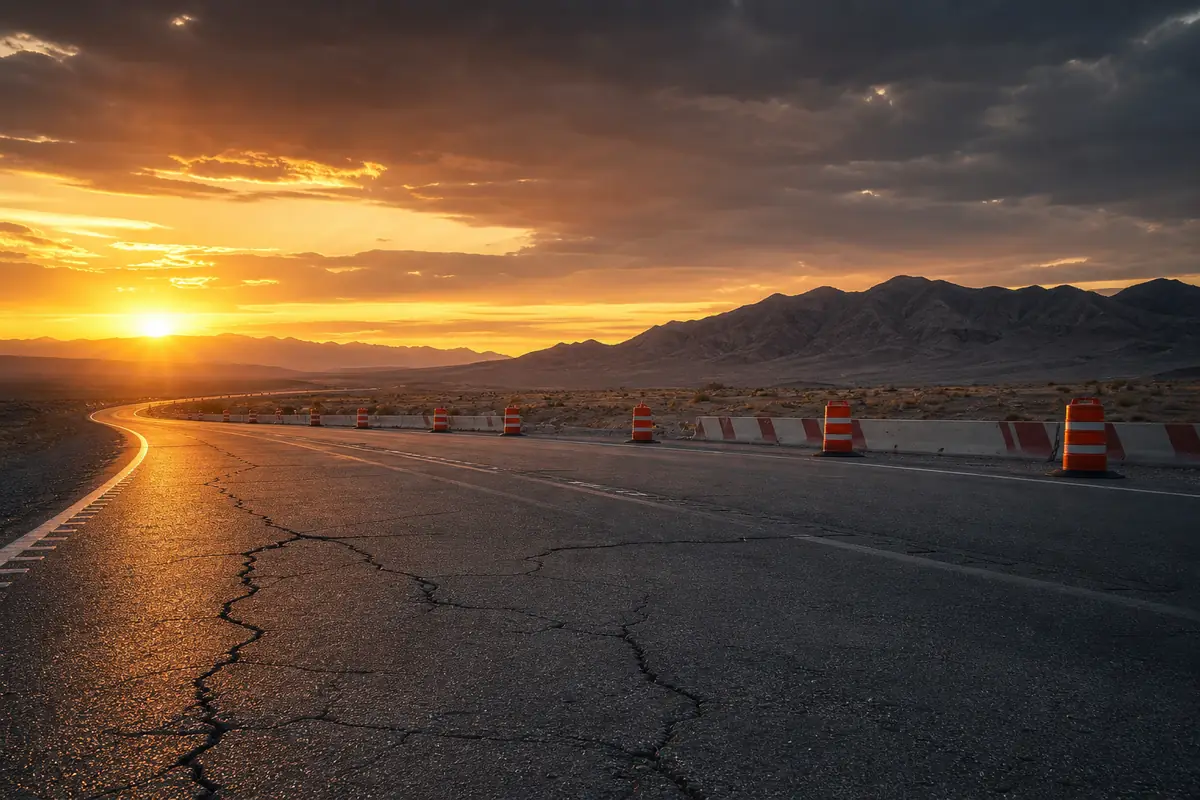
Dangerous Road Conditions and Accident Claims in Las Vegas
In This Article
Las Vegas and Clark County are home to some of the busiest roads in the American West — from the Las Vegas Strip and I-15 to the Las Vegas Beltway and US-95. With rapid population growth, constant construction, and extreme desert weather conditions, dangerous road conditions are a persistent and serious problem. Potholes, missing signage, unmarked construction zones, inadequate lighting, crumbling shoulders, and poor road design cause hundreds of accidents across the Las Vegas Valley every year — injuring drivers, motorcyclists, bicyclists, and pedestrians alike.
When a dangerous road condition causes an accident, the legal landscape is more complex than a typical car crash. You may need to pursue a claim against a government entity — the City of Las Vegas, City of Henderson, Clark County, or the Nevada Department of Transportation (NDOT) — or against a private construction contractor responsible for road work. At Thomas Boley Attorney At Law, we handle road defect and dangerous condition cases throughout Clark County, holding negligent parties accountable for the injuries they cause.
Common Dangerous Road Conditions in Las Vegas and Clark County
Free case review
Injured or Facing Charges in Las Vegas?
Thomas Boley offers free consultations — no fees unless we win your case.
The Las Vegas Valley's unique combination of extreme heat, rapid development, and heavy tourist traffic creates road hazards that are both common and dangerous. In our experience handling personal injury cases throughout the region, these are the most frequent dangerous conditions we encounter:
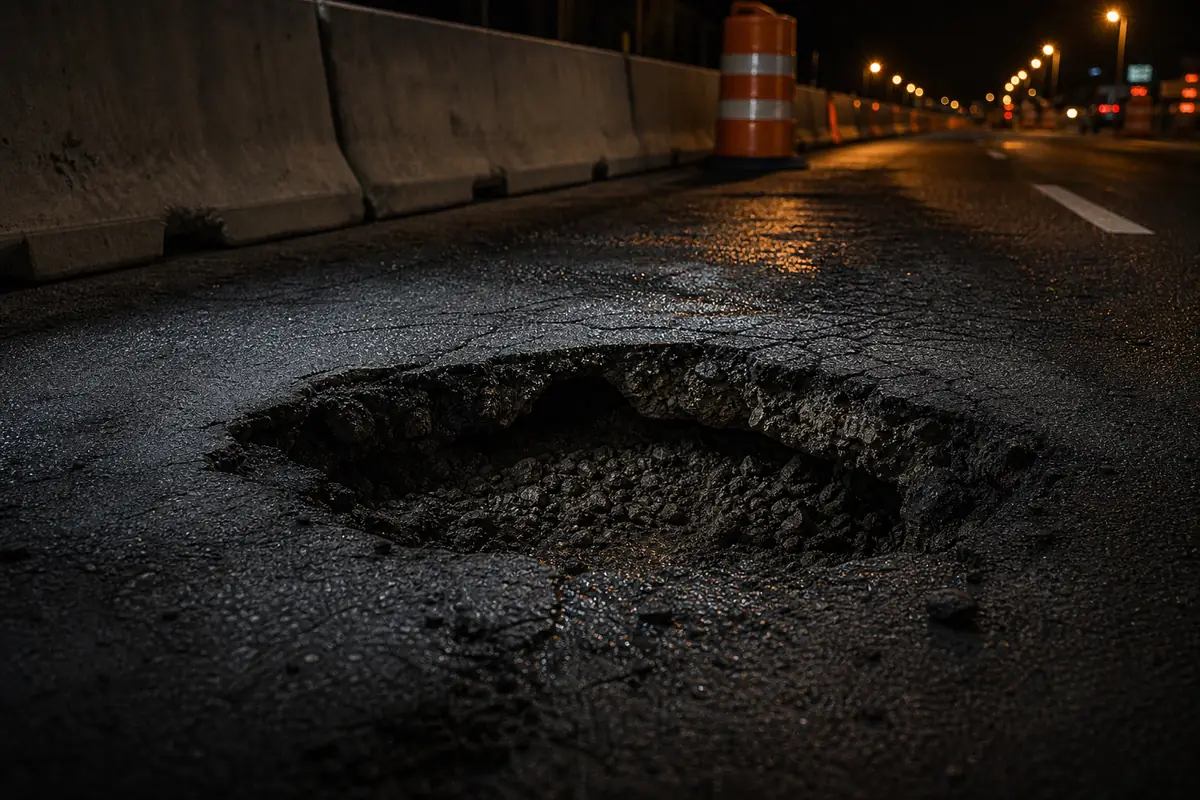
- Potholes and pavement deterioration: Extreme temperature swings — from 115°F summers to near-freezing winter nights — cause asphalt to expand, contract, and crack. Water infiltration during flash floods accelerates the damage. Potholes on roads like Boulder Highway, Tropicana Avenue, and Flamingo Road are reported constantly but often go unrepaired for weeks or months.
- Missing or obscured road signs: Stop signs, yield signs, speed limit signs, and lane-change warnings that are knocked down, faded beyond legibility, or blocked by vegetation create dangerous intersections and merge points. We see this particularly on older roads in North Las Vegas and unincorporated Clark County.
- Inadequate construction zone safety: Las Vegas is perpetually under construction — I-15 widening projects, Beltway extensions, new resort developments, and utility work. When contractors fail to install proper barriers, signage, lane markings, flaggers, or speed reduction warnings, construction zones become death traps. NRS 484B.363 imposes enhanced penalties for speeding in work zones, but contractors have independent duties to keep work zones safe.
- Defective road design: Some roads are dangerous by design — blind curves with inadequate banking, intersections without proper sight lines, highway on-ramps that are too short for safe merging, and drainage systems that flood the roadway during storms. The Spaghetti Bowl interchange (I-15/US-95), portions of Charleston Boulevard, and several Henderson intersections have been flagged repeatedly for design deficiencies.
- Inadequate lighting: Many roads in the Las Vegas Valley — particularly in newer suburban developments in Summerlin, Henderson, and the southwest — lack sufficient lighting at intersections, crosswalks, and pedestrian areas. Poor lighting contributes to pedestrian accidents and makes road hazards invisible to drivers at night.
- Shoulder drop-offs and uneven lanes: When the edge of a paved road drops off sharply to an unpaved shoulder — sometimes by several inches — vehicles that drift even slightly off the road can lose control. This is especially dangerous on rural highways in Clark County and roads under active construction.
- Flooding and drainage failures: Las Vegas receives most of its annual rainfall in short, intense monsoon storms. When storm drains are clogged, undersized, or improperly graded, roads flood rapidly. Water pooling on roadways causes hydroplaning, obscures potholes and debris, and creates conditions for rollover accidents.
Every case turns on its specific facts, which is why speaking with a Las Vegas personal injury attorney early matters. send us the details through our contact form or call (702) 435-3333 — the consultation is free and confidential.
Who Is Liable for Dangerous Road Conditions in Nevada?
Determining liability in a road defect case is one of the most complex aspects of personal injury law. Unlike a standard car accident where the at-fault driver is obvious, road condition cases often involve government entities, private contractors, engineering firms, and sometimes multiple parties. Understanding who maintained — or failed to maintain — the roadway is critical to pursuing the right claim.
Government Entity Liability Under NRS Chapter 41
Nevada's NRS 41.031 waives sovereign immunity and allows injured persons to sue state and local government entities for negligence — including the failure to maintain safe roadways. Under this statute, the City of Las Vegas, City of Henderson, City of North Las Vegas, Clark County, and NDOT can be held liable for dangerous road conditions they knew about — or should have known about — and failed to repair.
However, claims against government entities carry critical procedural requirements that differ from standard personal injury lawsuits:
- Notice requirement: Under NRS 41.036, you must file a written notice of claim with the government entity within two years of the date of the accident. Failure to provide proper notice can permanently bar your claim, regardless of how strong your evidence is.
- Damage caps: NRS 41.035 caps damages against government entities at $100,000 per claimant. This cap applies to combined economic and non-economic damages, making it essential to identify all potentially liable parties — including private contractors — who may not be subject to the cap.
- Discretionary function immunity: Under NRS 41.032, government entities are immune from liability for discretionary acts — policy-level decisions about road design, funding priorities, and project scheduling. However, once a government decides to build, maintain, or repair a road, the execution of that decision is an operational function subject to ordinary negligence standards. The distinction between discretionary and operational acts is often the key legal battleground in road defect cases.
Private Contractor Liability
When a road construction or maintenance project is contracted to a private company, that contractor has an independent duty to maintain safe conditions in and around the work zone. This includes proper signage, barriers, traffic control, and lane markings. If a construction company's negligence causes an accident — whether through inadequate safety measures, debris left on the roadway, unmarked lane shifts, or defective pavement installation — the contractor can be held directly liable for damages without the $100,000 government cap.
We frequently investigate whether a private contractor was involved in any road defect case. Clark County and NDOT contract road work to private firms for nearly every major project — from the I-15/Tropicana interchange reconstruction to neighborhood repaving in Henderson. Identifying the contractor and their insurer often opens up significantly more compensation for our injured clients.
Proving a Dangerous Road Condition Caused Your Accident
Road defect cases require strong evidence connecting the hazardous condition to your accident and injuries. Nevada applies a standard negligence analysis: you must show that the responsible party owed you a duty of care, breached that duty by allowing a dangerous condition to exist, and that the breach directly caused your injuries. The specific evidence we gather in these cases includes:
- Accident scene documentation: Photos and videos of the road defect, surrounding conditions, lighting, signage (or lack thereof), and the accident scene. Time-stamped evidence is critical — conditions can change rapidly, especially in construction zones.
- Government maintenance records: Through public records requests and litigation discovery, we obtain road inspection reports, maintenance logs, repair schedules, and citizen complaint records. These documents can show that the government entity knew about the hazard and failed to act — establishing the critical element of notice.
- Prior accident history: Evidence of previous accidents at the same location strengthens your case significantly. If others have been injured by the same pothole, the same poorly designed intersection, or the same flooding-prone road segment, it demonstrates that the hazard was known and foreseeable.
- Expert analysis: Road defect cases often require expert testimony from traffic engineers, road design specialists, and accident reconstruction experts. These professionals can testify about whether the road condition violated applicable design standards, NDOT maintenance protocols, or the Manual on Uniform Traffic Control Devices (MUTCD).
- Weather and environmental data: For cases involving flooding, ice, or visibility issues, we obtain historical weather data, drainage system design documents, and lighting specifications to show whether the road was designed and maintained to handle foreseeable conditions.
Nevada's Comparative Negligence and Road Defect Cases
Nevada follows a modified comparative negligence standard under NRS 41.141. If you were partially at fault for the accident — for example, if you were speeding, distracted, or failed to avoid a visible hazard — your compensation is reduced by your percentage of fault. However, you can still recover damages as long as your fault does not exceed 50%. Government defendants frequently argue comparative negligence in road defect cases, claiming the driver should have seen and avoided the hazard. An experienced attorney anticipates these arguments and builds evidence to counter them.
Types of Injuries Caused by Dangerous Road Conditions
Dangerous road conditions cause a wide range of injuries depending on the type of accident — from single-vehicle crashes caused by potholes to multi-vehicle pileups in poorly marked construction zones. Common injuries in road defect cases include:
- Traumatic brain injuries (TBI): Sudden impacts from hitting potholes, drop-offs, or debris can cause drivers and passengers to strike their heads on steering wheels, windows, or dashboards. TBI cases involving road defects can be particularly severe because the initial impact is often unexpected.
- Spinal cord injuries: Violent jolts from road defects and subsequent collisions can cause herniated discs, vertebral fractures, and spinal cord damage — potentially resulting in partial or complete paralysis.
- Broken bones and fractures: The sudden jarring impact of hitting a pothole or debris — especially on motorcycles and bicycles — frequently causes fractures to wrists, arms, collarbones, ribs, and legs.
- Soft tissue injuries: Whiplash and soft tissue injuries are common when vehicles hit road defects at speed, causing sudden deceleration or loss of control.
- Wrongful death: The most catastrophic road defect accidents — construction zone collisions on I-15, flooding-related rollovers, and head-on crashes caused by missing signage — result in fatalities. Wrongful death claims against government entities and contractors follow specific procedural requirements under Nevada law.
Construction Zone Accidents on Las Vegas Highways
Las Vegas is one of the fastest-growing metropolitan areas in the United States, and its highway infrastructure is constantly under construction. The I-15 corridor between the Strip and the California border, the US-95 expansion through the northwest valley, the 215 Beltway completion projects, and countless local road improvements create a maze of construction zones that drivers must navigate daily.
Construction zone accidents are among the most preventable — and among the most devastating — road condition cases we handle. Nevada law requires construction companies to follow strict safety protocols, including:
- Proper advance warning signs placed at required distances before the work zone
- Concrete barriers or channeling devices to separate traffic from active work areas
- Flaggers or automated traffic control at lane shifts and closures
- Adequate temporary lighting for nighttime work zones
- Speed reduction signage appropriate to the work zone conditions
- Removal of debris, equipment, and materials from active travel lanes
- Proper lane markings — including temporary striping when permanent markings are removed
When a contractor fails to implement these safety measures and an accident results, the contractor — and potentially the government entity that hired them — can be held liable. We have handled construction zone accident cases involving unmarked lane shifts on I-15, debris left on US-95, and inadequate lighting during nighttime road work in Henderson and Summerlin.
Steps to Take After an Accident Caused by a Road Defect
If you believe a dangerous road condition caused or contributed to your accident, take these steps to protect your legal rights:
- Document the road condition immediately. Take photos and videos of the pothole, debris, missing sign, construction zone, or other hazard from multiple angles. Include wide shots showing the surrounding road context and close-ups showing the severity of the defect. Photograph any lack of warning signs.
- Report the accident to law enforcement. Call 911 and request a police report. Tell the responding officer specifically that you believe a road condition caused the accident. The police report creates an official record connecting the hazard to your crash.
- Seek medical attention promptly. Even if your injuries seem minor, get evaluated by a medical professional. Many road defect accident injuries — particularly brain injuries and soft tissue damage — may not present symptoms immediately.
- Identify the responsible entity. Determine which government agency or contractor is responsible for maintaining the road where the accident occurred. City streets are typically maintained by the respective city; highways fall under NDOT; county roads are Clark County's responsibility.
- Do not delay — contact an attorney. Road defect cases require prompt investigation. Evidence disappears quickly — road crews may repair the defect within days, surveillance footage gets overwritten, and witness memories fade. Government claims also have strict procedural deadlines. Call Thomas Boley at (702) 435-3333 immediately.
Frequently Asked Questions About Road Defect Accident Claims in Nevada
Q: Can I sue the government for a pothole that damaged my car or caused an accident?
A: Yes. Under NRS 41.031, Nevada waives sovereign immunity for negligent acts of government employees and entities. If a government entity knew or should have known about a dangerous pothole and failed to repair it within a reasonable time, you can pursue a claim. However, damages against government entities are capped at $100,000 per claimant under NRS 41.035.
Q: How long do I have to file a claim for a road defect accident?
A: You must file a written notice of claim with the government entity within two years under NRS 41.036. The general statute of limitations for personal injury in Nevada is also two years from the date of the accident. Against private contractors, the same two-year statute applies. Do not wait — evidence in road defect cases deteriorates rapidly.
Q: What if I was partially at fault — for example, I was speeding when I hit a pothole?
A: Nevada's comparative negligence law (NRS 41.141) allows you to recover damages even if you were partially at fault, as long as your fault does not exceed 50%. Your compensation will be reduced by your percentage of fault. For example, if you were found 20% at fault and your damages total $200,000, you would recover $160,000.
Q: Can I sue a construction company for a work zone accident?
A: Yes. Private contractors have an independent duty to maintain safe conditions in their work zones. If a contractor's negligence — such as failing to install proper signage, barriers, or lighting — caused your accident, you can sue the contractor directly. Unlike government entities, private contractors are not subject to the $100,000 damage cap, which can result in significantly higher recoveries.
Q: What damages can I recover in a road defect accident case?
A: Depending on the severity of your injuries and the liable parties, you may recover medical expenses (past and future), lost wages and earning capacity, pain and suffering, property damage, and — in wrongful death cases — funeral expenses and loss of companionship. Against private contractors, there is no statutory cap on these damages.
Contact Thomas Boley — Las Vegas Road Defect Accident Attorney
Dangerous road conditions are not acts of nature — they are the result of negligence. When a government entity fails to maintain a safe roadway, when a contractor cuts corners on a construction zone, or when a road is designed with defects that make accidents inevitable, someone must be held accountable. At Thomas Boley Attorney At Law, we have extensive experience handling road defect and dangerous condition cases throughout Las Vegas, Henderson, Summerlin, North Las Vegas, and all of Clark County. We understand the unique procedural requirements for government claims under NRS Chapter 41, and we know how to identify all liable parties — including private contractors who are not protected by the government damage cap. Call (702) 435-3333 today for a free, no-obligation consultation. We handle all personal injury cases on a contingency fee basis — you pay nothing unless we win. This article is for informational purposes only and does not constitute legal advice. Every case is unique. Contact Thomas Boley Attorney At Law for a free consultation specific to your situation.
About the Author
Thomas Boley is a Nevada licensed attorney specializing in personal injury law and criminal defense. Since 2008, Thomas has represented thousands of clients in Las Vegas and Clark County, recovering millions of dollars in compensation for injury victims. He is a member of the State Bar of Nevada, the Clark County Bar Association, and the Nevada Justice Association.
Need Legal Help? Contact Thomas Boley for a free consultation: (702) 435-3333