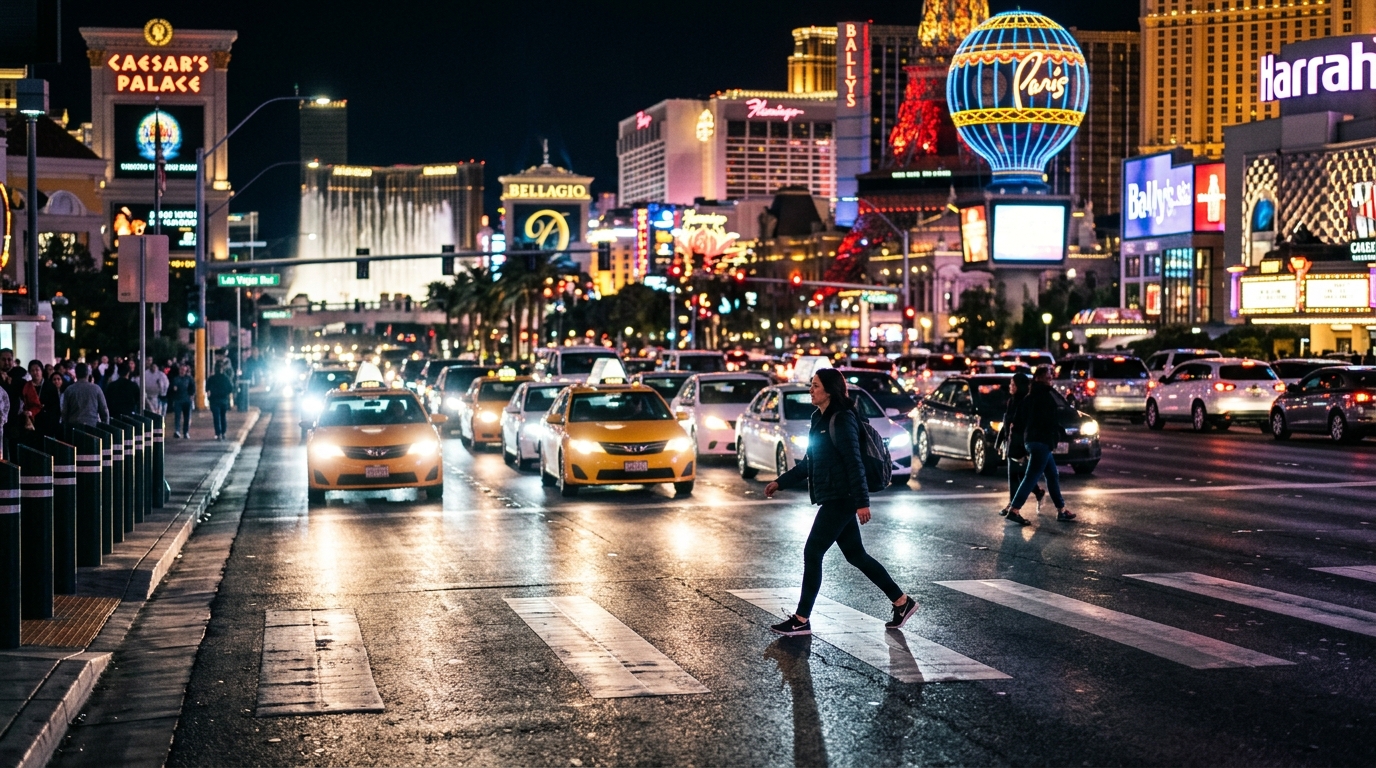
Pedestrian Accidents in Las Vegas: Your Rights When Hit by a Car
In This Article
Las Vegas is one of the most dangerous cities in the United States for pedestrians. According to the Nevada Department of Transportation, Clark County consistently ranks among the highest in the state for pedestrian fatalities and serious injuries — driven by high-speed arterials, distracted drivers, and a 24-hour culture that keeps people on foot at all hours. If you or a loved one was struck by a vehicle in Las Vegas, Henderson, Summerlin, or anywhere in Clark County, you have legal rights — and you need to act quickly to protect them.
At Thomas Boley Attorney At Law, we have represented pedestrian accident victims throughout the Las Vegas Valley for more than 18 years. In this guide, we walk through Nevada's pedestrian accident laws, who can be held liable, what your claim may be worth, and the critical steps to take in the days and weeks after being hit by a car.
- Nevada law gives pedestrians the right-of-way in marked crosswalks — drivers who fail to yield can be held liable for all your damages.
- Even if you were partially at fault, Nevada's comparative fault rule may still allow you to recover compensation.
- Pedestrian accident claims can cover medical bills, lost wages, pain and suffering, and future care costs.
- You have 2 years from the accident date to file a personal injury lawsuit in Nevada (NRS 11.190).
- Call (702) 435-3333 immediately — evidence disappears fast and insurers begin working against you from day one.
Free case review
Injured or Facing Charges in Las Vegas?
Thomas Boley offers free consultations — no fees unless we win your case.
Nevada Pedestrian Laws: What the Statute Says
Nevada Revised Statutes Chapter 484B governs pedestrian rights on public roads. The key rules every Las Vegas pedestrian should know:
- NRS 484B.283 — Right-of-way in crosswalks: Drivers must yield to pedestrians in marked crosswalks and at intersections with pedestrian signals. A driver who fails to yield and strikes a pedestrian is presumptively at fault.
- NRS 484B.287 — Pedestrian duties: Pedestrians may not suddenly step off a curb into the path of a vehicle that is so close it cannot reasonably stop. Jaywalking does not automatically bar your claim, but it can reduce your recovery under comparative fault.
- NRS 484B.290 — Drivers must exercise due care: Even when a pedestrian is outside a marked crosswalk, drivers are required to exercise due care and give warning when necessary. Striking a pedestrian anywhere on a road — even mid-block — does not automatically excuse the driver.
- NRS 484B.270 — Right-of-way at signals: Pedestrians facing a steady 'Walk' signal have the right-of-way over all vehicles. Drivers turning at a signalized intersection must yield to pedestrians in the crosswalk before making their turn.
These statutes create a strong legal foundation for pedestrian injury claims in Nevada. When a driver violates any of these provisions and causes injury, they face civil liability for all resulting damages. The fact that Las Vegas streets are engineered for vehicle speed — wide lanes on Charleston Boulevard, Flamingo Road, and Tropicana Avenue — makes pedestrian safety even more critically dependent on driver compliance with these laws.
For a deeper dive, read hit-and-Run Accidents in Las Vegas and what to Do After a Car Accident in Las Vegas.
Common Causes of Pedestrian Accidents in Las Vegas
Understanding what caused your accident matters not just legally, but practically — it determines which parties can be held liable and what evidence you need to preserve. The most common causes of pedestrian accidents in the Las Vegas Valley include:
- Distracted driving: Phone use, GPS interaction, and passenger distraction are leading causes of pedestrian strikes, particularly near the Strip and in high-density areas like downtown Las Vegas and the Fremont Street corridor.
- Failure to yield at crosswalks: Drivers running red lights or failing to stop for pedestrians at marked crosswalks along Las Vegas Boulevard, Maryland Parkway, and other high-traffic corridors account for a significant share of collisions.
- Speeding: High-speed arterials like I-15 service roads, US-95 adjacent streets, and the Las Vegas Beltway encourage driving at speeds that dramatically reduce a driver's reaction time when a pedestrian enters the roadway.
- Impaired driving: Given Las Vegas's 24-hour entertainment culture, DUI-related pedestrian strikes — especially in the early morning hours near the Strip, Fremont Street, and Downtown — are disturbingly common.
- Failure to yield when turning: Right-turn-on-red collisions at signalized intersections are a leading cause of crosswalk accidents. Drivers focusing on gaps in vehicle traffic often fail to check for pedestrians already in the crosswalk.
- Poor visibility and lighting: Many residential areas in North Las Vegas and Henderson lack adequate street lighting, increasing nighttime pedestrian risk substantially.
- Backing vehicles: Parking lot strikes, particularly in shopping centers in Summerlin and Henderson, frequently injure pedestrians who are invisible to reversing drivers.
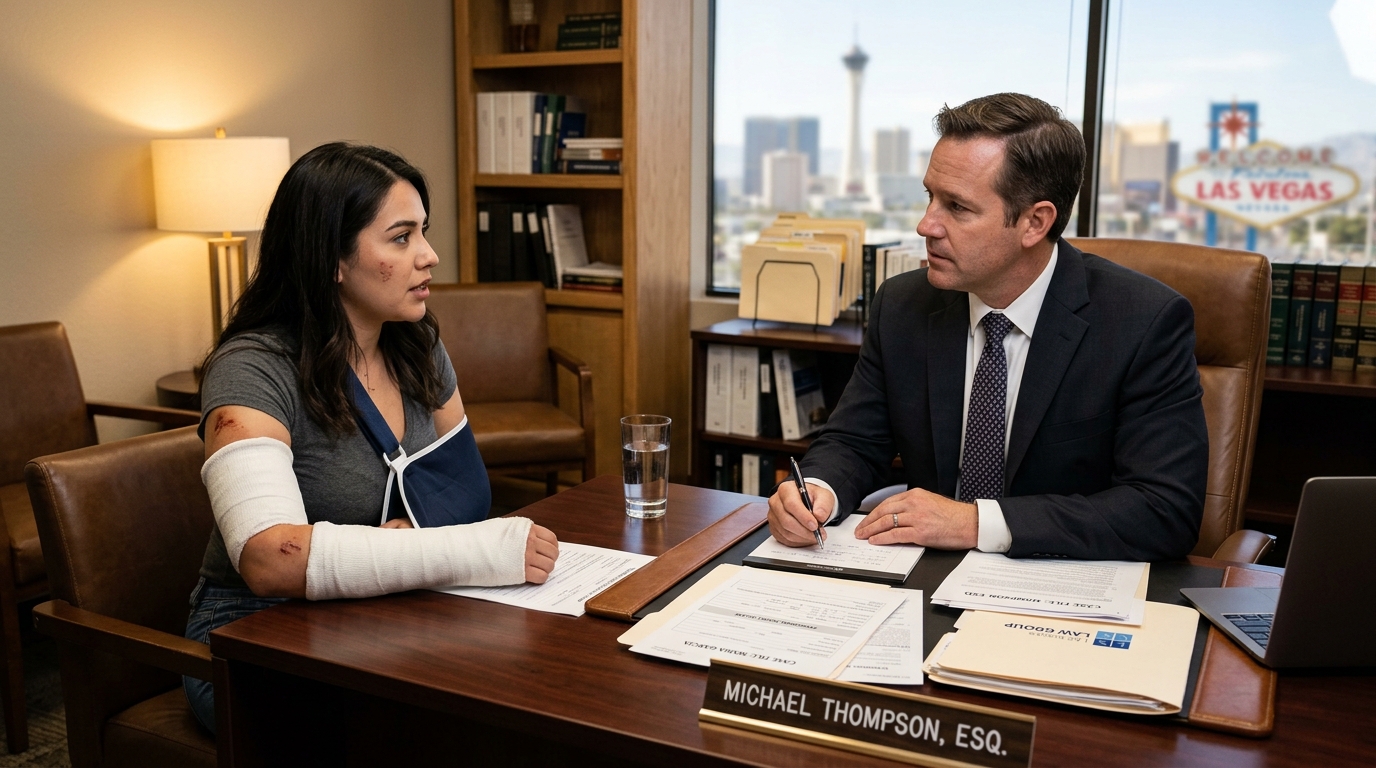
Who Is Liable in a Las Vegas Pedestrian Accident?
Liability in a pedestrian accident depends on the facts — but in most cases, the driver bears primary responsibility. Potentially liable parties include:
- The driver: If the driver was negligent — speeding, distracted, impaired, running a light, or failing to yield — they are liable for your injuries. Their auto insurance policy is typically the first source of recovery.
- The vehicle owner: If the driver was operating someone else's vehicle, the vehicle owner may also be liable under Nevada's permissive use doctrine (NRS 41.440), which generally imposes liability on owners who lend their vehicle to another person.
- An employer: If the driver was operating a vehicle in the course and scope of their employment — a delivery driver, a commercial truck operator, a rideshare driver on an active trip — their employer may be vicariously liable.
- A government entity: If a dangerous road design, missing crosswalk signal, obscured signage, or broken streetlight contributed to your accident, the responsible government agency (Nevada DOT, Clark County, City of Las Vegas, City of Henderson) may bear partial liability. Claims against government entities have special notice requirements and shorter deadlines — typically 6 months — so act quickly.
- A bar or casino (dram shop liability): If the driver who struck you was visibly intoxicated and was served alcohol by a licensed establishment prior to the accident, Nevada's dram shop law (NRS 41.1305) may allow you to pursue a claim against that establishment.
Nevada's Comparative Fault Rule: You Can Still Recover Even If You Were Partly at Fault
One of the most important things pedestrian accident victims need to understand is Nevada's modified comparative fault rule under NRS 41.141. Under this law:
- If you are found 50% or less at fault for the accident, you can still recover compensation — but your award is reduced proportionally. For example, if you were found 20% at fault and your damages are $200,000, you recover $160,000.
- If you are found more than 50% at fault, you are barred from recovery entirely.
- Insurance adjusters routinely attempt to inflate the pedestrian's share of fault to reduce or eliminate their payout. Having an attorney negotiate on your behalf is critical to preventing this tactic from succeeding.
Common fault arguments insurers raise against pedestrians include: jaywalking, crossing against a signal, wearing dark clothing at night, stepping from between parked cars, or being distracted by a phone. Even when some of these are true, the driver may still bear the majority of fault — particularly if they were speeding or not paying attention. Do not accept an insurer's characterization of fault without consulting an attorney.
What Damages Can You Recover After a Pedestrian Accident in Nevada?
Pedestrian accident injuries are frequently severe. A human body struck by a vehicle moving at even 30 mph can suffer catastrophic, life-altering trauma. Recoverable damages typically include:
- Medical expenses: Emergency room care, surgery, hospitalization, physical therapy, specialist consultations, prescription medications, medical equipment, and all future medical treatment reasonably related to your injuries.
- Lost wages: Income lost while you were unable to work during recovery — including salary, hourly wages, self-employment income, tips, bonuses, and other compensation.
- Loss of future earning capacity: If your injuries prevent you from returning to your prior occupation or reduce your earning potential permanently, you can recover the present value of that lost future income.
- Pain and suffering: Compensation for the physical pain you experienced and continue to experience as a result of your injuries. In Nevada, there is no statutory cap on pain and suffering damages in personal injury cases.
- Emotional distress and mental anguish: PTSD, anxiety, depression, and the psychological trauma of surviving a violent collision are compensable in Nevada.
- Loss of enjoyment of life: If your injuries prevent you from participating in activities you previously enjoyed — hobbies, sports, social engagements — you can recover for that diminishment in quality of life.
- Wrongful death damages: If a loved one was killed in a pedestrian accident, their family may recover funeral expenses, loss of financial support, loss of companionship, and the victim's pre-death pain and suffering under NRS 41.085.
Critical Steps to Take After Being Hit by a Car in Las Vegas
What you do in the hours and days after a pedestrian accident can significantly affect the strength of your claim. Follow these steps:
- Call 911 immediately. A police report creates an official record of the accident, the driver's information, witness statements, and the officer's initial assessment of fault. Never skip this step — 'settling it without police' almost always harms the pedestrian.
- Seek emergency medical care — even if you feel okay. Adrenaline masks pain. Many serious injuries (traumatic brain injury, internal bleeding, spinal damage) present delayed symptoms. Gaps in medical treatment give insurers ammunition to argue your injuries were not serious or were caused by something else.
- Document the scene. If you are physically able, photograph the vehicle, the driver's license plate, the road conditions, any crosswalk markings, traffic signals, skid marks, and your injuries. If you are incapacitated, ask a bystander to do this or note the names and contact information of witnesses.
- Preserve your clothing and footwear. Do not wash or discard the clothing you were wearing at the time of the accident. Physical evidence — contact marks, road debris, torn fabric — can support your version of events.
- Do not give a recorded statement to the driver's insurance company. Insurers routinely contact pedestrian victims within 24–48 hours to get a recorded statement while the victim is still in shock and before they have legal representation. Anything you say will be used to minimize your claim. Politely decline and direct them to your attorney.
- Contact a Las Vegas pedestrian accident attorney as soon as possible. Evidence is time-sensitive. Surveillance footage from nearby casinos, businesses, and traffic cameras is often overwritten within 24–72 hours. Your attorney can issue preservation letters to lock that footage down before it disappears.
The Statute of Limitations for Pedestrian Accident Claims in Nevada
Under NRS 11.190, you generally have two years from the date of the pedestrian accident to file a personal injury lawsuit in Nevada. If you miss this deadline, your claim is permanently barred — regardless of how serious your injuries are or how clearly the driver was at fault.
Important exceptions to be aware of:
- Claims against government entities: If a government agency (City of Las Vegas, Clark County, Nevada DOT) bears any responsibility — for example, a defective crosswalk signal or dangerous road design — you must file a formal tort claim notice within 6 months of the accident under NRS 41.036. Miss this deadline and you lose your right to sue the government entity, even if the two-year period has not yet run.
- Minor victims: If the injured pedestrian was under 18 at the time of the accident, the two-year statute of limitations is typically tolled (paused) until they turn 18.
- Discovery rule: In rare cases where injuries were not immediately apparent, the limitations period may begin when the injury is discovered or reasonably should have been discovered.
FAQs: Pedestrian Accident Claims in Las Vegas
What if I was hit in a parking lot — does Nevada law still apply?
Yes. Nevada's general negligence standard applies in private parking lots, not just public roads. If a driver struck you due to inattention, excessive speed, or failure to yield in a parking lot at a casino, shopping center, or other property — whether in Henderson, Summerlin, or the Strip area — you may have a claim against the driver and potentially the property owner.
What if the driver fled the scene — a hit-and-run?
Hit-and-run pedestrian accidents are unfortunately common in Las Vegas. If the driver flees and cannot be identified, you may be able to pursue a claim under your own auto insurance policy's uninsured motorist (UM) coverage — even as a pedestrian. Nevada requires insurers to offer UM coverage (NRS 687B.145), and pedestrians struck by unidentified vehicles are often covered under policies they hold as drivers or household members. Contact an attorney immediately — we can help identify the vehicle through surveillance footage and investigate all possible insurance sources.
Will I have to go to court?
The vast majority of pedestrian accident cases in Nevada resolve through insurance settlement negotiations before trial. At Thomas Boley Attorney At Law, we prepare every case as if it will go to trial — because the strength of your trial-ready case is what drives fair settlement offers. If the insurer refuses to pay a reasonable amount, we file suit and litigate aggressively in Clark County District Court.
Pedestrian accidents leave real people with real injuries that change their lives. Whether you were struck at a crosswalk on Las Vegas Boulevard, hit by a distracted driver on Eastern Avenue in Henderson, or struck in a parking lot in Summerlin, you deserve full and fair compensation — not a quick, low-ball settlement from an insurance company protecting its bottom line. At Thomas Boley Attorney At Law, we fight for pedestrian accident victims throughout Clark County on a contingency fee basis — you pay nothing unless we win. Call us today at (702) 435-3333 for a free, no-obligation consultation. This article is for informational purposes only and does not constitute legal advice. Every case is unique. Contact Thomas Boley Attorney At Law for a free consultation specific to your situation.
For more information, visit our Las Vegas personal injury attorney.
About the Author
Thomas Boley is a Nevada licensed attorney specializing in personal injury law and criminal defense. Since 2008, Thomas has represented thousands of clients in Las Vegas and Clark County, recovering millions of dollars in compensation for injury victims. He is a member of the State Bar of Nevada, the Clark County Bar Association, and the Nevada Justice Association.
Need Legal Help? Contact Thomas Boley for a free consultation: (702) 435-3333