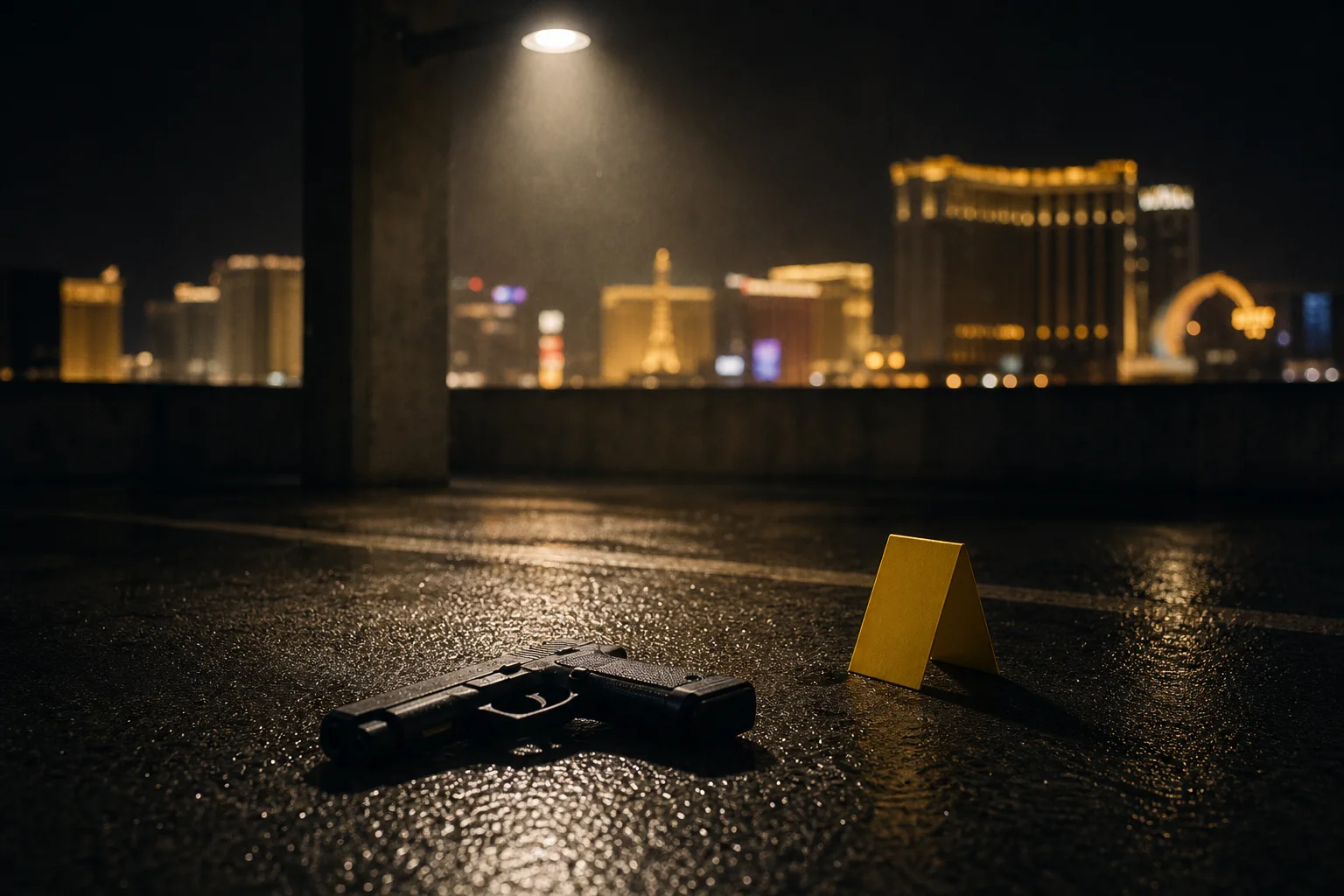
Brandishing a Weapon Charges in Las Vegas: NRS 202.320 Guide
In This Article
A road-rage argument on the 215 boils over and a pistol comes out from under the driver's seat before either car ever stops moving. A dispute in a Strip parking garage ends when someone pulls a knife just to make a point, then puts it away without ever touching anyone. A shouting match outside a Fremont Street bar turns into a 911 call because a bystander says someone "had a gun." Brandishing a weapon charges in Las Vegas often start exactly like this — no shot fired, no contact made, sometimes no injury at all — yet they can still put a defendant in handcuffs and, if mishandled, on the losing end of a felony plea offer the facts never actually supported. At Thomas Boley Attorney At Law, we defend clients throughout Las Vegas, Henderson, Summerlin, North Las Vegas, and the rest of Clark County who are facing a brandishing charge or a related weapons allegation after a confrontation that escalated faster than anyone intended.
- Nevada's brandishing statute, NRS 202.320, is a misdemeanor — not a felony — punishable by up to 6 months in county jail and/or a $1,000 fine under NRS 193.150, Nevada's general misdemeanor penalty statute.
- The statute requires that a deadly weapon be drawn or exhibited in the presence of two or more persons in a rude, angry, or threatening manner, or unlawfully used in a fight or quarrel — conduct not done in necessary self-defense.
- Nevada prosecutes the same rough conduct under three different statutes depending on the facts: brandishing (NRS 202.320, misdemeanor), aiming a firearm at a person (NRS 202.290, gross misdemeanor, up to 364 days and $2,000), and assault with a deadly weapon (NRS 200.471(2)(b), a category B felony carrying 1 to 6 years in prison).
- A sheriff, deputy, marshal, constable, or other peace officer acting in the lawful discharge of duty is exempt from brandishing charges under NRS 202.320(2).
- Prosecutors sometimes file a misdemeanor brandishing count alongside a felony assault charge from the same incident, which can open the door to a favorable resolution with the right defense strategy.
- Misdemeanor weapons cases are heard in the municipal or justice court with jurisdiction over where the incident occurred — Las Vegas Municipal Court, Las Vegas Justice Court, Henderson Municipal Court, or North Las Vegas Municipal Court.
- Nevada allows open carry of a firearm without a permit, so lawfully carrying a visible weapon is not, by itself, brandishing.
Brandishing a Weapon Charges in Las Vegas Under Nevada Law
Free case review
Injured or Facing Charges in Las Vegas?
Thomas Boley offers free consultations — no fees unless we win your case.
Brandishing a weapon charges in Las Vegas are prosecuted under NRS 202.320, Nevada's "drawing a deadly weapon in a threatening manner" statute. The law applies to a person who has, carries, or procures from another person a dirk, dirk-knife, sword, sword cane, pistol, gun, or other deadly weapon, and who, in the presence of two or more persons, draws or exhibits that weapon in a rude, angry, or threatening manner not done in necessary self-defense — or who unlawfully uses the weapon in a fight or quarrel. Every element matters. The weapon has to be a deadly weapon in the first place. The display has to happen with at least two other people present, not just one. And the manner has to be rude, angry, or threatening, or the weapon has to be used unlawfully in an altercation — merely carrying it, even openly, is not enough. A violation is a straight misdemeanor under the statute, punished under NRS 193.150, Nevada's general misdemeanor penalty provision, at up to 6 months in county jail, a fine of up to $1,000, or both. NRS 202.320(2) also carves out a specific exception for a sheriff, deputy sheriff, marshal, constable, or other peace officer drawing or exhibiting a weapon while lawfully discharging official duties. Our Nevada Criminal Laws entry on NRS 202.320 breaks down each element in more detail alongside the statute's exact language.
How Brandishing Charges Typically Arise in Las Vegas
Brandishing allegations in Las Vegas tend to follow a handful of recurring patterns, and almost none of them involve a planned crime. Road-rage incidents on the 215 Beltway, the I-15 resort corridor, or Las Vegas Boulevard itself are among the most common triggers — a near-miss lane change or a brake-check escalates, and someone reaches for a firearm kept in the vehicle to end the confrontation rather than continue it. Casino floor and parking garage disputes, whether over a valet mix-up, a gaming table disagreement, or a late-night argument in a resort structure, can turn into a brandishing case when one party displays a weapon in front of security staff, valet attendants, or other patrons who count as the statute's required witnesses. Bar and nightclub arguments around Fremont Street and the Downtown corridor generate a similar pattern, often complicated by alcohol and by security camera footage that can either support or undercut a self-defense claim depending on exactly what it shows. A fourth pattern involves lawful open carry: Nevada does not require a permit to openly carry a firearm, and a holstered or visibly carried weapon that a nervous bystander reports to police is not brandishing unless it was actually drawn or exhibited in a rude, angry, or threatening way — a distinction that gets lost easily in a 911 call made in the heat of the moment.
Brandishing vs. Aiming a Firearm vs. Assault With a Deadly Weapon
The same few seconds of conduct in Las Vegas can be charged three very different ways, and the differences change everything about a defendant's exposure. Brandishing under NRS 202.320 is a misdemeanor that requires the weapon actually be drawn or exhibited, requires it to be a deadly weapon by nature, and requires two or more witnesses present. NRS 202.290, aiming a firearm at a human being, is a gross misdemeanor punishable by up to 364 days in jail and a $2,000 fine — it applies whenever someone willfully aims a firearm, loaded or not, at another person, and it does not require any witnesses beyond the person the gun was aimed at, nor any proof of intent to actually cause harm. NRS 200.471(2)(b), assault with a deadly weapon, is a category B felony carrying 1 to 6 years in Nevada state prison and up to a $5,000 fine — and it can be charged even if the weapon was never drawn at all, as long as the defendant had the present ability to use it and intentionally placed another person in apprehension of immediate bodily harm, with an object that is not inherently a "deadly weapon" sometimes still qualifying. That last distinction is why the same road-rage incident might be charged as a felony against one driver and never charged at all against the other: whether the state can prove apprehension of harm, present ability, and intent looks very different from whether it can prove a weapon was actually drawn in front of two witnesses. Our guide to battery with a deadly weapon charges in Las Vegas covers what happens when a confrontation like this crosses the line from a threat into actual physical contact.

Penalties for a Brandishing Conviction in Las Vegas
A conviction under NRS 202.320 is capped at 6 months in county jail and a $1,000 fine under NRS 193.150 — meaningfully less than the felony exposure that can attach to assault with a deadly weapon or even the gross-misdemeanor exposure under NRS 202.290. That does not make a brandishing charge minor. A misdemeanor conviction still creates a permanent criminal record in Nevada, can complicate a Clark County concealed carry permit application, and can be treated as an aggravating factor if the same person is ever investigated for a firearm-related offense again. Because a single incident can support charges under more than one of these statutes at once, prosecutors sometimes file a felony assault count and a misdemeanor brandishing count from the same confrontation, using the more serious charge as leverage in negotiations. An experienced defense attorney who understands exactly which elements the state can and cannot prove is often able to negotiate a felony assault exposure down to the misdemeanor brandishing charge, or to a lesser resolution still. Misdemeanor weapons cases in Clark County are heard in the municipal or justice court with jurisdiction over where the incident occurred — Las Vegas Municipal Court for offenses within city limits, Las Vegas Justice Court for unincorporated areas including much of the Strip and Summerlin, Henderson Municipal Court, or North Las Vegas Municipal Court — and each court has its own scheduling practices and plea-negotiation tendencies worth knowing before your first appearance.
Common Defenses to Brandishing Charges
Because NRS 202.320 builds several specific elements directly into the statute, a brandishing charge often has more built-in defenses than people expect. Necessary self-defense is written into the statute itself: if you drew or exhibited a weapon because you reasonably believed it was necessary to prevent an imminent attack, the conduct falls outside what the law prohibits, not just outside what a jury might excuse. The two-witness requirement is a genuine defense, not a technicality — if only one other person actually saw the weapon displayed, the state cannot make out a brandishing charge under this statute, though it may still attempt to charge the incident under NRS 202.290 or NRS 200.471 instead, which is why the specific facts matter so much. Lawful open carry is another common defense: Nevada does not require a permit to openly carry a firearm, so a visible holstered weapon that was never drawn or exhibited threateningly does not satisfy the statute no matter how alarmed a witness felt. And as in any criminal case, insufficient or conflicting evidence — inconsistent witness accounts, no security footage, or a weapon that was never actually recovered — can leave the state unable to prove every element beyond a reasonable doubt. Our overview of Nevada weapons charges and firearm laws covers how these same defenses apply across the broader range of Nevada gun-related offenses.
- Do not discuss the incident with police beyond identifying yourself — invoke your right to remain silent and ask for an attorney.
- Write down everything you remember about who was present and where they were standing; the witness count is a real element the state must prove.
- Note any security cameras, doorbell cameras, or dashcams nearby that may have captured the incident before that footage is overwritten.
- If you carry lawfully, keep your permit or proof of lawful ownership accessible for your attorney, even though NRS 202.320 does not require a permit for open carry.
- Do not contact the other party involved, even to apologize or "clear the air" — that contact can be used against you.
- Call a Las Vegas criminal defense attorney before your first court date in Las Vegas Municipal Court, Las Vegas Justice Court, or the applicable Henderson or North Las Vegas court.
- Is brandishing a weapon a felony in Nevada? No. Brandishing under NRS 202.320 is a misdemeanor, punishable by up to 6 months in county jail and/or a $1,000 fine. Related conduct can be charged as a gross misdemeanor under NRS 202.290 or a category B felony under NRS 200.471(2)(b), depending on the facts.
- Do I need a permit to openly carry a firearm in Las Vegas? No. Nevada allows open carry of a firearm without a permit. Simply carrying a visible weapon is not brandishing unless it is drawn or exhibited in a rude, angry, or threatening manner.
- Does brandishing require someone to actually be threatened with the weapon? The statute requires the weapon be displayed in a rude, angry, or threatening manner, or used unlawfully in a fight or quarrel, in the presence of two or more people — it does not require that a specific person be the direct target.
- What if only one person saw me with the weapon? NRS 202.320 specifically requires the display happen in the presence of two or more persons. If only one witness was present, the state cannot prove a brandishing charge under this statute, though other charges may still be possible depending on the facts.
- Can a brandishing charge be reduced from a felony assault charge? Often, yes. Prosecutors sometimes file both a felony assault count and a misdemeanor brandishing count from the same incident, and negotiating the case down to the misdemeanor is a common resolution when the felony elements are difficult to prove.
Speak With a Las Vegas Weapons Charge Defense Attorney
Thomas Boley has represented clients throughout Clark County for more than 18 years, including defendants facing brandishing, aiming-a-firearm, and assault-with-a-deadly-weapon charges arising from the same fast-moving confrontation.
Call (702) 435-3333 for a free consultation, or contact Thomas Boley online to discuss a brandishing charge, a weapons allegation, or a related criminal matter in Las Vegas, Henderson, Summerlin, North Las Vegas, or elsewhere in Clark County. Bring any citation, criminal complaint, or court paperwork you have received. If your case also involves a physical altercation, our assault and battery defense practice can evaluate both issues together, and our full criminal defense practice handles every related weapons charge. This article is informational only and is not legal advice. Every case is unique.
About the Author
Thomas Boley is a Nevada licensed attorney specializing in personal injury law and criminal defense. Since 2008, Thomas has represented thousands of clients in Las Vegas and Clark County, recovering millions of dollars in compensation for injury victims. He is a member of the State Bar of Nevada, the Clark County Bar Association, and the Nevada Justice Association.
Need Legal Help? Contact Thomas Boley for a free consultation: (702) 435-3333