Airport Accident Claims in Las Vegas: Suing Clark County
In This Article
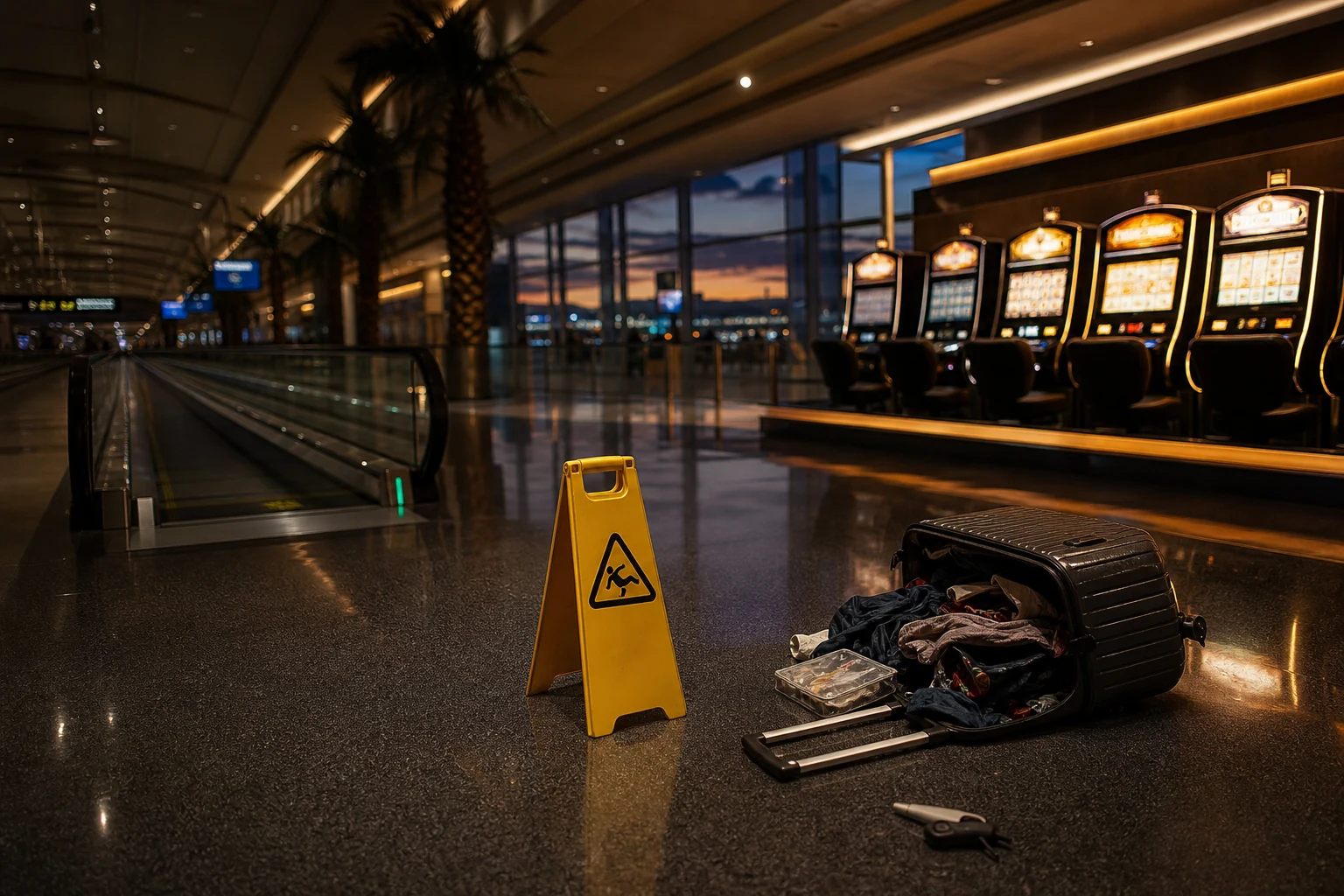
Every day, tens of thousands of travelers move through Harry Reid International Airport's terminals, riding moving walkways past rows of slot machines, waiting at baggage carousels, and dodging luggage carts on the way to a rideshare curb that never seems to sit still. Most trips end without incident. When a maintenance gap, a spilled drink, or a distracted cart driver turns a routine layover into a fall or a collision, though, airport accident claims in Las Vegas raise a legal wrinkle most visitors never expect: the airport itself is owned and operated by Clark County government, not a private company. At Thomas Boley Attorney At Law, we represent injured travelers and residents throughout Las Vegas, Henderson, Summerlin, North Las Vegas, and the rest of Clark County, and this guide explains how Nevada's Tort Claims Act, a damages cap, and even federal law can all apply to the very same accident depending on exactly who was responsible.
- NRS 41.031 waives Clark County's sovereign immunity for ordinary negligence, letting you sue the county under the same rules of law that apply to a private business.
- NRS 41.032 still protects true policy-level "discretionary function" decisions, but not routine maintenance failures like an unrepaired moving walkway or an unmopped spill.
- NRS 41.035 caps total recovery against Clark County and its employees at $200,000 per claimant and bars punitive damages entirely.
- NRS 41.036 calls for a written tort claim filed with Clark County within 2 years, though filing it is no longer a strict condition precedent to suing under current Nevada law.
- If TSA screening caused your injury, the federal Federal Tort Claims Act applies instead, requiring a Standard Form 95 administrative claim filed with the Department of Homeland Security within 2 years before any lawsuit can proceed.
- Nevada's standard 2-year statute of limitations (NRS 11.190) still applies to the underlying suit, but airlines, concessionaires, and shuttle operators at the airport are private businesses with none of these government protections.
Airport Accident Claims in Las Vegas: Why Harry Reid International Airport Cases Are Different
Free case review
Injured or Facing Charges in Las Vegas?
Thomas Boley offers free consultations — no fees unless we win your case.
Harry Reid International Airport is not a privately owned building like a Strip resort or a shopping mall — it is owned and operated by Clark County through its Department of Aviation, making it a government-run facility that happens to look and feel like any other major commercial building. That single fact changes the legal landscape for airport accident claims in Las Vegas more than almost any other variable. A slip on a wet terminal floor, a moving-walkway malfunction, or a luggage cart collision at Harry Reid can trigger Nevada's Tort Claims Act rather than the ordinary premises liability rules that would apply if the same fall happened at a casino resort down the street. Layer in the reality that dozens of private airlines, concessionaires, rental car companies, and a federal security agency all operate inside the same terminals, and a single incident can implicate county, federal, and private liability rules all at once — often before an injured traveler even reaches baggage claim.
How Accidents Happen at Harry Reid International Airport
Airport injuries follow a few recurring patterns, and Harry Reid's mix of gaming areas, long walking distances, and curbside congestion makes several of them worse:
- Moving walkways and escalators: A worn handrail, a sudden stop, or a gap at the comb plate can catch a rolling bag, a heel, or a stroller wheel.
- Baggage claim hazards: Overloaded carousels, unclaimed bags left circling the belt, and wet floors tracked in near exterior doors during monsoon season.
- Slot machine and gaming areas: Loose carpeting, spilled drinks, and dim lighting around the airport's gaming pits, an amenity unique to Las Vegas terminals.
- Curbside and rideshare zones: Congested passenger loading lanes where shuttle buses, taxis, and rideshare vehicles compete for the same narrow curb space.
- Luggage carts and jet bridges: An improperly secured cart, or a gap between the jet bridge and the aircraft door during boarding.
- The APM tram between terminals: The automated people mover connecting Terminal 1 and Terminal 3 can involve sudden stops or door malfunctions.
- TSA security checkpoints: Bins, belts, and hastily re-stacked trays at the screening line create their own slip-and-trip hazards.

Suing Clark County: Nevada's Tort Claims Act and Sovereign Immunity
Because Harry Reid International Airport is a Clark County facility, an injury claim against the airport itself is really a claim against a county government — and Nevada handles those very differently than a lawsuit against a private landlord. NRS 41.031 waives Nevada's sovereign immunity for the state and all of its political subdivisions, including counties, and requires their liability to be determined "in accordance with the same rules of law" that apply to a lawsuit against a private person or business. In practice, that means ordinary negligence — a spill an employee should have cleaned up, or a moving walkway with a known defect nobody repaired — is fully open to a lawsuit against Clark County. The waiver is not unlimited, though. NRS 41.032 preserves immunity for a true "discretionary function" — a policy-level judgment call, such as how much annual budget to allocate to terminal renovations or which model of moving walkway to purchase. Nevada courts draw a sharp line between that kind of high-level policy decision and routine operational negligence: once the county decides to install and operate a moving walkway, failing to inspect, maintain, or repair it is an operational failure, not a protected discretionary choice, and NRS 41.032 generally will not shield the county from a claim built on that kind of everyday maintenance lapse.
Damages Caps and Notice-of-Claim Deadlines Against Clark County
Even when Clark County is liable, Nevada law limits what you can recover from it. NRS 41.035 caps the total damages a claimant can collect from the county and its employees at $200,000 per person, per cause of action, and it flatly bars any award of punitive damages against a government entity — a protection a private defendant like an airline or a rental car company does not get. Before you can sue, NRS 41.036 also calls for filing a written tort claim with the Clark County Clerk's office within 2 years of the incident, describing the facts, the injuries, and the amount claimed. Filing that claim is no longer treated as a strict jurisdictional condition precedent to filing suit under current Nevada law, but skipping it, or filing it late or incompletely, still hands the county's insurer and outside counsel an early, and often persuasive, argument that your claim was never properly preserved — which is why we file it promptly and precisely as a matter of practice rather than relying on the statute's outer limits.
When the Federal Government Is Responsible: TSA and FTCA Claims
Not every hazard at Harry Reid traces back to Clark County. The Transportation Security Administration is a federal agency, and its officers, not county employees, staff the checkpoints where a large share of airport injuries actually happen, from a dropped bin catching a traveler's ankle to a screener who mishandles a passenger during a pat-down. A claim against TSA or another federal actor at the airport does not run through Nevada's Tort Claims Act at all; it runs through the federal Federal Tort Claims Act, a completely separate system with its own two-year deadline. Under the FTCA, you must first file a Standard Form 95 administrative claim with the Department of Homeland Security specifying a "sum certain" dollar amount within two years of the incident, and unlike Clark County's notice requirement, this federal claim genuinely is a mandatory condition precedent to suit — a lawsuit filed before the agency denies the claim, or before six months pass without a response, will typically be dismissed outright. Sorting out at the outset whether a fall or injury happened on county-controlled property, inside a TSA checkpoint, or inside a private airline's gate area is one of the first and most consequential steps in any airport accident case.
Who Else Can Be Held Liable After an Airport Accident
Beyond Clark County and the federal government, several private parties operate inside Harry Reid's terminals and can carry their own liability, without any of the caps or notice rules that protect a government defendant:
- Airlines: Responsible for jet bridge conditions, gate-area hazards, and baggage handling equipment under their direct control.
- Concessionaires and retailers: Restaurants, bars, and shops inside the terminal owe the same premises liability duty as any Las Vegas business, including keeping floors clear of spills and merchandise.
- Rental car companies and shuttle operators: Liable for shuttle bus accidents, loading-area collisions, and hazards at rental car center facilities.
- Maintenance and inspection contractors: Companies the county or an airline hires to service moving walkways, escalators, or jet bridges can be independently liable if a contracted inspection missed a defect.
- Rideshare and taxi drivers: A collision or a rushed loading-zone incident involving an Uber, Lyft, or taxi driver at the curb follows the same rules we cover in our guide to rideshare accident claims.
Common Injuries From Airport Accidents in Las Vegas
Airport accidents range from minor to serious, depending on the hazard and the fall involved:
- Fractures and sprains: From falls on escalators, moving walkways, or wet terminal floors.
- Traumatic brain injuries and concussions: From falls onto hard terminal flooring or a collision with a luggage cart.
- Shoulder and rotator cuff injuries: From lifting bags off a jammed carousel or bracing during a moving-walkway fall.
- Back and spinal injuries: From moving-walkway malfunctions, shuttle bus accidents, or hard falls on stairs.
- Cuts and lacerations: From broken luggage, damaged carousel equipment, or shattered glass at a gate area.
Statute of Limitations for Airport Accident Claims in Nevada
Nevada's standard two-year personal injury statute of limitations under NRS 11.190 applies to most airport accident claims, whether the defendant is Clark County, an airline, or a concessionaire. But two-year windows do not all run the same way in practice: the NRS 41.036 notice of claim against Clark County should be filed well before that outer deadline to preserve leverage in settlement talks, and a Federal Tort Claims Act claim against TSA carries its own independent two-year administrative filing deadline that runs separately from, and in addition to, the underlying lawsuit deadline. Missing any one of these dates, even while the others remain open, can permanently eliminate your ability to recover from that specific defendant, which is one of the biggest reasons airport accident claims benefit from an early, deadline-specific review rather than a single generic two-year mental note.
- Can I sue Clark County if I was injured at Harry Reid International Airport? Yes. NRS 41.031 waives the county's immunity for ordinary negligence, though NRS 41.035 caps your recovery at $200,000 and NRS 41.036 requires a timely written notice of claim.
- What if TSA caused my injury? A TSA-related injury goes through the Federal Tort Claims Act, not Nevada's Tort Claims Act, and requires a Standard Form 95 filed with the Department of Homeland Security within two years before you can sue.
- Is there a damages cap if an airline or rental car company caused my injury? No. The $200,000 cap applies only to claims against Clark County and its employees; private defendants like airlines, concessionaires, and rental car companies face no such limit.
- How long do I have to file a notice of claim against Clark County? NRS 41.036 calls for filing within two years of the incident, and filing it promptly and completely is the safest course even though it is no longer treated as a strict precondition to suing.
- What should I do after an accident at the airport? Report the incident to airport or airline staff, request a copy of the incident report, photograph the hazard before it is cleaned up or repaired, and contact a Las Vegas personal injury attorney before speaking with an insurance adjuster.
Speak With a Las Vegas Personal Injury Attorney About an Airport Accident Claim
Thomas Boley has represented injured travelers and residents throughout Clark County for more than 18 years, including cases that turned on whether a hazard was Clark County's responsibility, a private airline's, or the federal government's — a distinction that can determine whether a case is capped at $200,000, subject to no cap at all, or governed by an entirely different federal claims process. Because airport cases often involve multiple, overlapping deadlines, getting an early and accurate read on exactly who is responsible protects your ability to recover before any one of them closes.
Call (702) 435-3333 for a free consultation, or contact Thomas Boley online to discuss an airport accident in Las Vegas, Henderson, Summerlin, North Las Vegas, or elsewhere in Clark County. Our full personal injury practice handles premises liability and government tort claims of every kind, and our guides to rental car accident claims and Nevada's statute of limitations cover closely related ground. This article is informational only and is not legal advice. Every case is unique.
About the Author
Thomas Boley is a Nevada licensed attorney specializing in personal injury law and criminal defense. Since 2008, Thomas has represented thousands of clients in Las Vegas and Clark County, recovering millions of dollars in compensation for injury victims. He is a member of the State Bar of Nevada, the Clark County Bar Association, and the Nevada Justice Association.
Need Legal Help? Contact Thomas Boley for a free consultation: (702) 435-3333