Uber/Lyft Accidents in Las Vegas: Your Rights and What to Do
In This Article
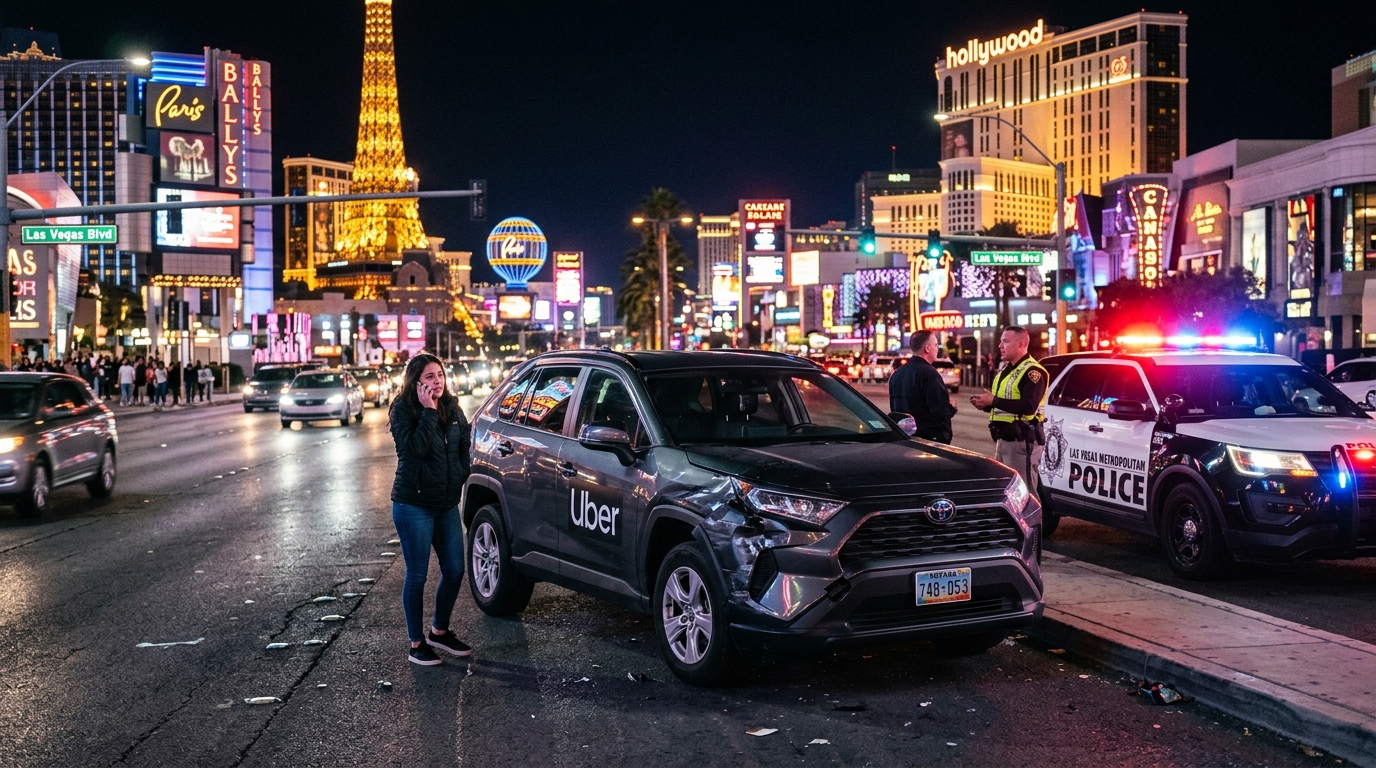
Las Vegas is one of the busiest rideshare markets in the United States. Millions of trips are completed each year on the Strip, in Henderson, Summerlin, North Las Vegas, and throughout Clark County — transporting tourists from airports, hotel guests between venues, and residents running everyday errands. With that volume comes a significant number of accidents. If you were injured in an Uber or Lyft crash in Las Vegas — whether as a passenger, a pedestrian, or a driver in another vehicle — you may have multiple sources of compensation available to you. But rideshare accident cases are genuinely more complicated than standard car crashes, and the stakes are high.
Nevada has its own rideshare regulatory framework under NRS 706.011 et seq., which classifies companies like Uber and Lyft as Transportation Network Companies (TNCs) and imposes specific insurance coverage requirements that vary depending on the driver's status at the time of the crash. Getting these coverage tiers right — and knowing which insurer to pursue and in what order — requires a clear understanding of how Nevada law interacts with Uber's and Lyft's own insurance policies. This guide explains everything you need to know about rideshare accident claims in Las Vegas, from immediate steps to final resolution.
Nevada Rideshare Law: NRS 706.011 and the Three Coverage Tiers
Free case review
Injured or Facing Charges in Las Vegas?
Thomas Boley offers free consultations — no fees unless we win your case.
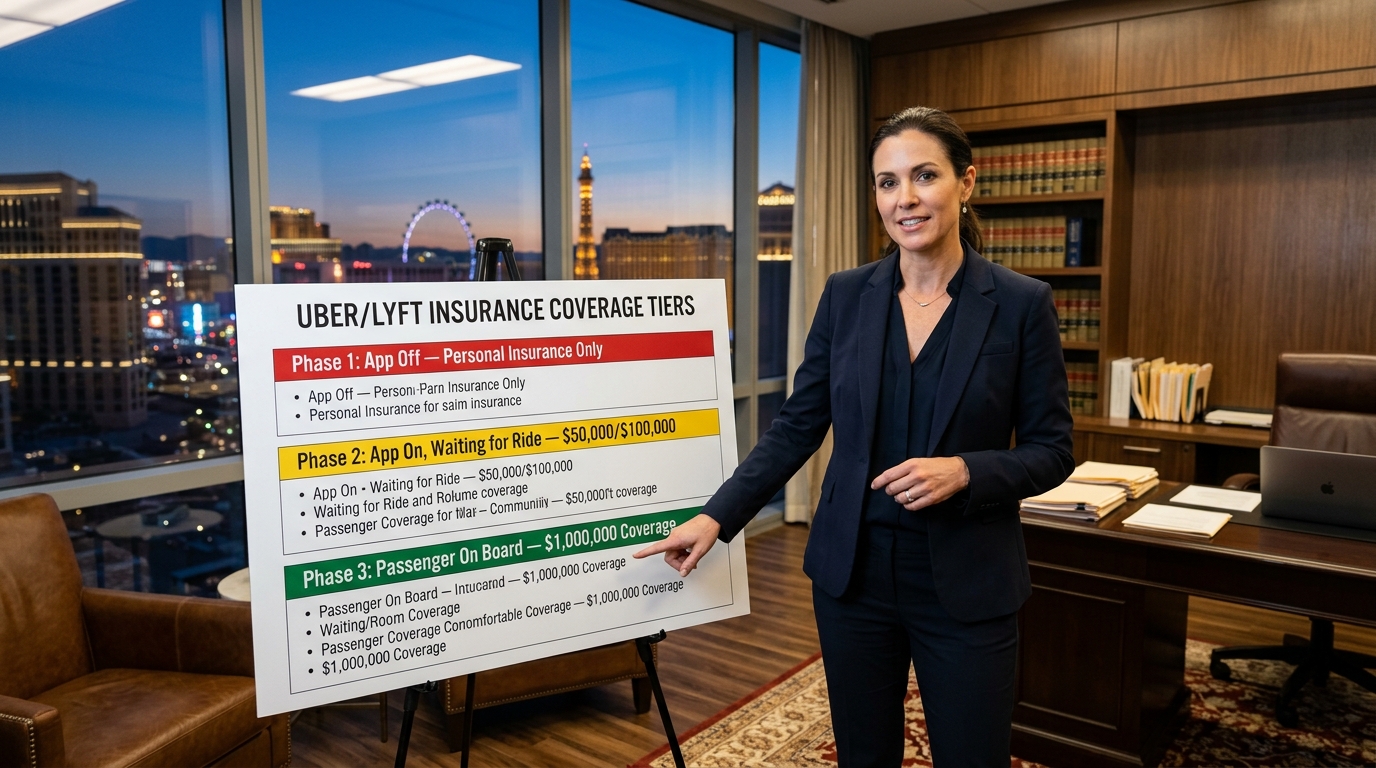
One of the most important — and most misunderstood — aspects of Uber and Lyft accidents is that insurance coverage is not the same in every situation. Under Nevada law, the applicable coverage tier depends entirely on what the driver was doing with the app at the moment of the crash. There are three distinct phases:
- Phase 1 — App Off (personal use): The driver's rideshare app is completely off. The driver is using their personal vehicle for personal purposes. In this phase, only the driver's personal auto insurance applies. Uber and Lyft provide zero coverage. If the driver carries minimum limits (Nevada requires $25,000/$50,000/$20,000 under NRS 485.185), that may be the only coverage available.
- Phase 2 — App On, No Ride Accepted (waiting for a match): The driver has logged into the rideshare app and is waiting for a ride request but has not yet accepted one. In this phase, Nevada law requires TNCs to provide contingent liability coverage of at least $50,000 per person / $100,000 per accident / $25,000 property damage — but only if the driver's personal insurance does not apply or is exhausted. Uber and Lyft typically provide this coverage directly in Phase 2.
- Phase 3 — Ride Accepted or Passenger On Board (active ride): The driver has accepted a trip request, is en route to pick up the passenger, or has a passenger in the vehicle. This is where Uber and Lyft's primary commercial liability policy kicks in: $1,000,000 in third-party liability coverage, plus uninsured/underinsured motorist (UM/UIM) coverage and contingent comprehensive/collision. This is the highest coverage tier and applies to passengers, pedestrians, and occupants of other vehicles injured during an active Uber or Lyft trip.
Determining which phase applies to your crash is the first critical step in any rideshare accident case. This requires preservation of evidence — including Uber's or Lyft's trip data showing the driver's app status at the exact moment of impact. Insurance adjusters are aware that if they can argue a driver was in Phase 1 or Phase 2 rather than Phase 3, liability exposure drops dramatically. An experienced attorney can compel trip records and preserve this data before it disappears.
For more background, see our guides on what to Do After a Car Accident in Las Vegas.
The $1 Million Policy: What It Covers and What It Doesn't
Both Uber and Lyft maintain a $1,000,000 third-party liability policy that applies when a ride is active (Phase 3). This is meaningfully higher than the minimum coverage most individual drivers carry, and it provides a substantial source of compensation for seriously injured passengers, pedestrians, and occupants of other vehicles. However, there are important nuances to understand:
- It is per-occurrence, not per-person: The $1 million limit applies to the entire accident — all claimants combined. In a multi-vehicle crash with several injured parties, the $1 million may be divided among all victims, potentially leaving each individual with less than the total policy limit.
- Fault still matters: Nevada follows a modified comparative negligence rule under NRS 41.141. Even against Uber or Lyft, the insurer will argue the rideshare driver was not at fault, or that another driver was primarily responsible. If the rideshare driver was not at fault, the at-fault driver's personal insurance becomes the primary source.
- UM/UIM coverage is included: If the accident was caused by an uninsured or underinsured motorist, both Uber and Lyft carry UM/UIM coverage as part of their active-ride policy. This protects passengers who would otherwise have no recourse against an uninsured at-fault driver.
- Contingent collision coverage: If the rideshare driver's personal insurance does not cover vehicle damage during an active ride, Uber and Lyft provide contingent comprehensive and collision coverage (subject to a deductible), protecting the driver's own vehicle.
Common Injuries in Las Vegas Rideshare Accidents
Rideshare accidents in the Las Vegas valley occur most frequently in high-traffic corridors: the Strip (Las Vegas Boulevard), I-15, US-95, Tropicana Avenue, Flamingo Road, and near Harry Reid International Airport. The nature of rideshare driving — frequent stops, map navigation, passenger pickups in traffic lanes, and unfamiliarity with local roads — creates real collision risks. Common injuries include:
- Whiplash and cervical spine injuries: Rear-end collisions are common in rideshare scenarios where a driver brakes abruptly to pick up a passenger. Whiplash can cause chronic neck pain, headaches, and restricted range of motion that persists for months or years.
- Traumatic brain injuries (TBI): Any significant collision can cause a TBI, from mild concussion to severe brain damage. TBIs are often underdiagnosed at the scene and may manifest days later as cognitive difficulties, mood changes, or persistent headaches.
- Spinal cord injuries: High-speed crashes on Nevada highways can cause herniated discs, nerve damage, or in serious cases, partial or complete paralysis.
- Broken bones: Fractured ribs, wrists, arms, and legs are common in side-impact or rollover crashes. Healing times vary, and some fractures require surgical repair.
- Internal organ damage: Blunt-force trauma from seatbelt loading or airbag deployment can injure internal organs, including the spleen, liver, or kidneys — injuries that may not be apparent without imaging.
- Lacerations and scarring: Broken glass, deployed airbags, and metal intrusion can cause significant cuts that result in permanent scarring, particularly on the face, hands, and arms.
- Soft tissue injuries: Muscle tears, ligament sprains, and tendon damage are highly common and can cause significant pain and disability despite not always being visible on standard imaging.
Regardless of how severe you believe your injuries to be at the scene, you should seek immediate medical evaluation. Emergency rooms and urgent care centers can identify serious injuries that are not yet symptomatic. Delaying treatment not only puts your health at risk — it gives insurance adjusters grounds to argue that your injuries were not caused by the accident.
Determining Fault in a Rideshare Accident
Fault determination in a rideshare crash involves the same legal analysis as any other vehicle collision in Nevada, but with additional complexity because multiple parties may bear responsibility:
- The rideshare driver: If the Uber or Lyft driver caused the accident through negligence — speeding, distracted driving, running a red light, making an illegal turn — they are directly liable. Their personal auto insurance and (if applicable) Uber's or Lyft's commercial policy will apply.
- Another driver: A third-party driver (not the rideshare driver) may have caused or contributed to the crash. If so, that driver's personal insurance is the primary target for compensation. If they are underinsured, the rideshare company's UM/UIM coverage may fill the gap.
- Multiple parties sharing fault: Nevada's modified comparative negligence standard applies. If fault is shared between the rideshare driver and another driver, each is responsible for their proportionate share of damages. An injured passenger's recovery is not reduced unless the passenger themselves contributed to the accident.
- The vehicle manufacturer: In rare cases, a vehicle defect — faulty brakes, tire blowout, airbag malfunction — may have caused or contributed to the crash, opening a product liability claim against the manufacturer.
- A government entity: Road defects — potholes, missing signage, malfunctioning traffic signals, dangerous road design — can cause accidents. Claims against Nevada government entities involve specific notice and procedural requirements under NRS 41.031.
Preserving evidence for fault determination is critical. This includes the police crash report (Nevada requires accident reporting under NRS 484E.030), the rideshare app trip records, witness contact information, and any available surveillance or dashcam footage from the area. An attorney can send evidence preservation demands to Uber or Lyft immediately after being retained, ensuring that trip logs and GPS data are not overwritten.
What to Do After a Rideshare Accident in Las Vegas
The steps you take in the minutes and hours after an Uber or Lyft accident in Las Vegas directly affect both your health and your ability to recover compensation. Follow this checklist:
- Call 911 immediately. Even if injuries seem minor, a police report is critical evidence in any personal injury claim. Metro or Henderson Police will document the scene, take statements, and generate an official report number. Request the report number before you leave.
- Seek medical care without delay. If you are transported by ambulance, go. If you are not, go to an emergency room or urgent care within 24 hours regardless. Some of the most serious injuries — brain trauma, internal bleeding, spinal damage — are not immediately apparent.
- Document the scene thoroughly. Take photographs and video of all vehicles involved, the point of impact, road conditions, signage, traffic signals, skid marks, and any visible injuries. If you are too injured to do this yourself, ask someone at the scene to help.
- Collect information from all parties. Get the names, phone numbers, driver's license numbers, and insurance information of all drivers involved — including the rideshare driver. Also note the Uber or Lyft driver's name and the trip ID displayed in your app.
- Get witness contact information. Bystanders who saw the crash can provide independent accounts that corroborate your version of events. Get names and phone numbers before people disperse.
- Screenshot your rideshare app. Immediately after the crash, take a screenshot of your Uber or Lyft app showing the active trip, the driver's name, and the trip details. This preserves proof that you were an active passenger during Phase 3 coverage.
- Do not give a recorded statement to any insurance company. This includes Uber's or Lyft's insurance carrier. You have no legal obligation to provide a recorded statement, and doing so before consulting an attorney can seriously harm your claim.
- Contact a Las Vegas rideshare accident attorney. A lawyer who handles Uber and Lyft accident cases can send immediate evidence preservation demands to the rideshare company, open a claim with the correct insurer, and handle all communications while you focus on your recovery.
Uninsured and Underinsured Motorist Coverage in Rideshare Accidents
Nevada has a significant uninsured motorist problem. The Insurance Research Council consistently ranks Nevada among the states with the highest rates of uninsured drivers. If you are injured in an Uber or Lyft during an active ride and the at-fault driver has no insurance — or insufficient insurance to cover your damages — you have options under Uber's and Lyft's mandatory UM/UIM coverage. Both companies are required by Nevada law to carry uninsured and underinsured motorist coverage as part of their active-ride policy.
This means that if you are a passenger injured by an uninsured driver during an active Uber or Lyft trip, you can make a UM/UIM claim directly against Uber's or Lyft's insurer for compensation beyond what the at-fault driver's (non-existent or insufficient) policy provides. Your own personal auto insurance policy may also carry UM/UIM coverage that stacks on top of the rideshare company's coverage, depending on the specific policy terms and Nevada stacking rules. An attorney can analyze all available coverage layers to maximize your recovery.
What Compensation Can You Recover?
Injured victims in Las Vegas rideshare accidents can pursue both economic and non-economic damages. Depending on the severity of the crash and your injuries, recoverable compensation may include:
- Medical expenses: All past and future costs related to treatment of your injuries — emergency transport, hospitalization, surgery, imaging studies, physical therapy, prescription medications, and any ongoing care required by permanent impairments.
- Lost wages: Income lost while you were unable to work during your recovery, including vacation or sick time you were forced to use.
- Loss of earning capacity: If your injuries result in a permanent limitation that reduces your ability to earn income at the same level going forward, you can recover compensation for projected future lost earnings.
- Pain and suffering: Compensation for the physical pain endured during and after the crash and throughout your recovery, as well as the psychological toll of trauma, anxiety, and lifestyle disruption.
- Emotional distress: PTSD, depression, anxiety, and fear of riding in vehicles are common consequences of serious accidents and are compensable under Nevada law.
- Loss of consortium: If your injuries have harmed your relationship with your spouse or domestic partner, a loss of consortium claim may be available.
- Property damage: If your personal property was damaged in the crash (including your own vehicle if you were in another car hit by a rideshare driver), you can recover repair or replacement costs.
- Punitive damages: Under NRS 42.005, if the rideshare driver's conduct was especially egregious — such as driving while intoxicated or with a suspended license — punitive damages may be available in addition to compensatory damages.
Dealing With Uber and Lyft Insurance Claims
Filing an insurance claim after a rideshare accident is not the same as filing a claim after an ordinary car accident. Uber and Lyft both use third-party insurance administrators — James River Insurance and Zurich Insurance are among the carriers that have historically underwritten their policies — and these adjusters are experienced at minimizing rideshare payouts. Be prepared for the following:
- Disputes over Phase classification: The insurer may claim the driver was in Phase 1 or Phase 2 rather than Phase 3 to apply lower policy limits. They will scrutinize trip logs closely to argue the ride had not technically been accepted or was already completed.
- Early settlement pressure: You may receive an early, low settlement offer before your full diagnosis is known. Accepting any settlement before your treatment is complete — and before you know whether you have long-term impairments — is almost always a mistake.
- Requests for recorded statements: An adjuster will ask you to give a recorded account of the crash. You are not legally required to do so, and your attorney should handle all communications with insurers.
- Arguments about pre-existing conditions: If you have any prior injuries or medical conditions, the insurer may argue that your current symptoms are not causally related to the crash.
- Delayed claims processing: Multi-party rideshare accidents often involve competing insurers pointing fingers at each other over primary coverage responsibility, leading to delays. An attorney can move this process forward.
For a comprehensive overview of how personal injury claims work in Nevada, including the documentation process and how attorneys negotiate with insurance carriers, see our practice area guide. Having an attorney represent you from the outset changes the dynamic significantly — insurers know represented claimants are more likely to litigate, which typically results in higher settlement offers.
Nevada's Statute of Limitations for Rideshare Claims
Under NRS 11.190(4)(e), you have two years from the date of the accident to file a personal injury lawsuit in Nevada. Missing this deadline permanently bars your claim — regardless of how serious your injuries are or how strong your evidence may be.
While two years sounds like ample time, rideshare accident cases require an investigation that must begin immediately. Trip records and GPS data at Uber and Lyft can be overwritten. Surveillance footage from nearby businesses, traffic cameras, or the Strip's ubiquitous camera networks is typically retained for only 30 to 90 days. Witness memories fade. Medical documentation of the connection between the crash and your injuries is strongest when established early. We consistently advise clients: contact an attorney as soon as possible after a rideshare crash — not after months of attempting to navigate the claims process alone.
FAQs About Uber/Lyft Accidents in Las Vegas
Can I sue Uber or Lyft directly after an accident in Las Vegas?
In most cases, you cannot directly sue Uber or Lyft as your primary remedy — both companies classify their drivers as independent contractors, which generally insulates them from direct employer liability for driver negligence. However, you can make a claim against their commercial liability insurance policy, which provides up to $1,000,000 in coverage when a ride is active. In some circumstances, particularly if Uber or Lyft had notice of dangerous driver behavior and continued to allow the driver to work, a direct negligence claim against the company may be viable. An attorney can evaluate whether the independent contractor classification applies in your specific situation.
What if the Uber or Lyft driver was at fault but was not carrying a passenger?
If the driver had the app on and was waiting for a ride request (Phase 2), Uber's or Lyft's contingent coverage applies: $50,000 per person / $100,000 per accident in liability coverage, with the rideshare company's coverage activated if the driver's personal insurance is insufficient. If the driver was completely offline (app off, Phase 1), you are limited to their personal auto insurance, which may carry only minimum Nevada coverage limits. This is why documenting the driver's app status at the time of the crash is so important.
How long does it take to settle an Uber or Lyft accident claim in Nevada?
Settlement timelines vary widely depending on injury severity, the clarity of fault, and whether the insurance carriers dispute coverage. Cases involving minor injuries and clear liability may settle within three to six months. Serious injury cases — spinal cord damage, TBI, significant surgery — typically take one to two years or more, particularly if the case proceeds to litigation in Clark County District Court. We generally advise clients not to settle before reaching maximum medical improvement, so the full value of future treatment and permanent impairments is captured in the settlement.
Does it matter if I was wearing a seatbelt in the rideshare vehicle?
Nevada law requires all vehicle occupants to wear seatbelts under NRS 484D.495. If you were not wearing a seatbelt, the defense may argue that you contributed to your own injuries, which could reduce your recovery under Nevada's comparative negligence rule. However, Nevada courts limit the seatbelt defense — it can only be used to argue that your failure to wear a seatbelt caused or worsened specific injuries, not as a complete bar to recovery. An attorney can counter these arguments effectively.
What if the rideshare driver fled the scene after the accident?
If the Uber or Lyft driver fled the scene, your first step is to immediately report the incident to Uber or Lyft through the app and to law enforcement. Because rideshare drivers are identified in the app by name, photo, and license plate, law enforcement can typically locate the driver. For insurance purposes, a hit-and-run by the rideshare driver during an active trip may trigger the rideshare company's UM coverage or direct liability coverage depending on how the incident is classified. Your own personal UM/UIM coverage may also apply. See our guide on hit-and-run accidents in Las Vegas for additional context.
If you or a loved one was injured in an Uber or Lyft accident in Las Vegas, Henderson, North Las Vegas, Summerlin, or anywhere in Clark County, do not navigate the claims process alone. Rideshare accident cases involve multiple overlapping insurance policies, complex coverage tier disputes, and aggressive defense tactics that most injured victims are not equipped to handle without experienced legal help. At Thomas Boley Attorney At Law, we have the knowledge and experience to identify every available insurance source, preserve critical evidence, and pursue the full compensation you deserve. Call us at (702) 435-3333 for a free, confidential consultation — available 24/7. There is no fee unless we win. This article is for informational purposes only and does not constitute legal advice. Every case is unique. Contact Thomas Boley Attorney At Law for a free consultation specific to your situation.
About the Author
Thomas Boley is a Nevada licensed attorney specializing in personal injury law and criminal defense. Since 2008, Thomas has represented thousands of clients in Las Vegas and Clark County, recovering millions of dollars in compensation for injury victims. He is a member of the State Bar of Nevada, the Clark County Bar Association, and the Nevada Justice Association.
Need Legal Help? Contact Thomas Boley for a free consultation: (702) 435-3333