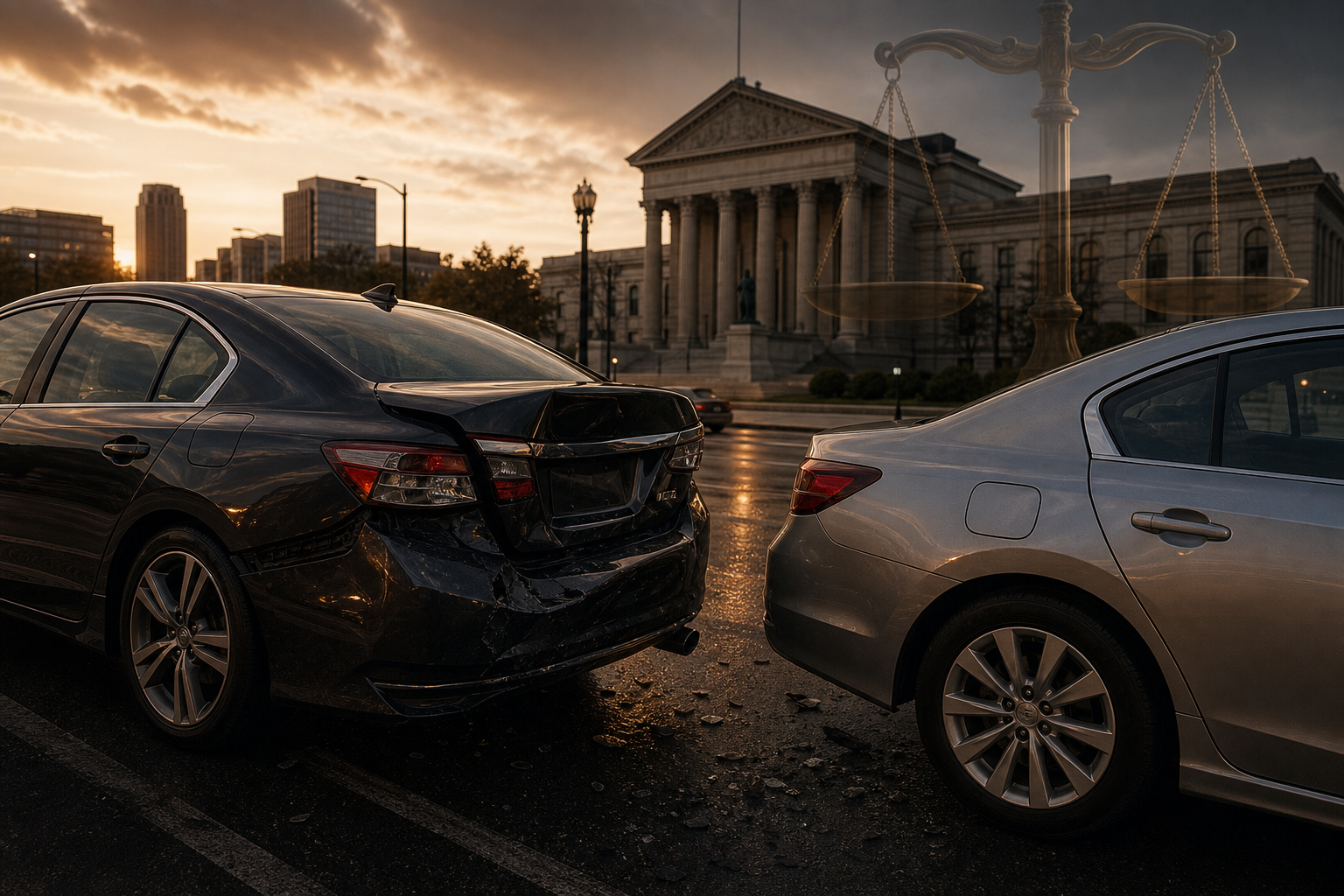
Rear-End Collision Accidents in Las Vegas: Fault, Injuries & Your Legal Rights
In This Article
Quick Summary: Rear-end collisions are the most common type of traffic accident in Las Vegas and throughout Clark County. In most cases, the trailing driver is presumed at fault. Victims may suffer whiplash, herniated discs, traumatic brain injuries, and other serious conditions — even in seemingly minor crashes. Nevada law allows injured victims to seek compensation for medical bills, lost wages, pain and suffering, and more. If you were hit from behind, call (702) 435-3333 for a free consultation with attorney Thomas Boley.
What Is a Rear-End Collision?
A rear-end collision occurs when one vehicle strikes the back of another. These crashes happen at intersections, on freeways like I-15 and US-95, in construction zones along the Las Vegas Beltway, and in heavy stop-and-go traffic on Las Vegas Boulevard. Whether the impact happens at 5 mph in a parking lot or at highway speeds near the Spaghetti Bowl interchange, rear-end collisions can cause significant injuries that may not appear immediately.
Free case review
Injured or Facing Charges in Las Vegas?
Thomas Boley offers free consultations — no fees unless we win your case.
In our 18+ years representing accident victims in Las Vegas, our team has seen countless cases where clients dismissed a rear-end crash as 'just a fender bender' — only to discover days or weeks later that they had sustained serious spinal injuries, concussions, or soft tissue damage requiring months of treatment.
How Common Are Rear-End Accidents in Las Vegas?
According to the National Highway Traffic Safety Administration (NHTSA), rear-end collisions account for approximately 29% of all traffic crashes nationwide — making them the single most common crash type. In Clark County, the combination of tourist traffic on the Strip, congested commuter routes through Henderson and Summerlin, and frequent construction projects creates conditions that are ripe for rear-end accidents.
High-risk areas for rear-end collisions in the Las Vegas metropolitan area include:
- I-15 corridor — especially during rush hours between Tropicana Avenue and Sahara Avenue
- US-95 (Summerlin Parkway) — heavy commuter traffic from Summerlin to downtown Las Vegas
- Las Vegas Boulevard (The Strip) — frequent stop-and-go traffic with distracted tourists
- Flamingo Road and Eastern Avenue — major intersection with heavy cross-traffic
- Henderson expressways — rapid development has increased traffic density near Green Valley and Anthem
- North Las Vegas intersections — growing population areas with inadequate signal timing
Who Is at Fault in a Rear-End Collision in Nevada?
In Nevada, the rear driver is presumed to be at fault in most rear-end collisions. This presumption is based on the legal principle that every driver must maintain a safe following distance and be prepared to stop when traffic slows or stops ahead. Under NRS 484B.127, drivers must not follow another vehicle more closely than is reasonable and prudent given the speed, traffic, and road conditions.
However, the presumption of fault is rebuttable. The trailing driver may not be entirely at fault — or may share fault — in situations including:
- Sudden, unexpected stops — The lead driver brakes abruptly for no legitimate traffic reason (brake-checking)
- Malfunctioning brake lights — The front vehicle's brake lights were not working, giving no warning
- Merging or lane-change collisions — The lead vehicle cut in front of the trailing driver immediately before the crash
- Multi-vehicle chain reactions — A third vehicle pushed the trailing car into the lead vehicle
- Hazardous road conditions — Debris, oil spills, or construction zone hazards contributed to the collision
Nevada follows a modified comparative negligence rule under NRS 41.141. This means that even if you are partially at fault for the accident, you can still recover damages — as long as your fault does not exceed 50%. Your compensation is reduced by your percentage of fault. For example, if you are found 20% at fault and your damages total $100,000, you would recover $80,000.
Common Causes of Rear-End Collisions in Las Vegas
Understanding why rear-end collisions happen helps establish fault and build a strong personal injury case. The most frequent causes include:
- Distracted driving — Texting, adjusting a GPS, or looking at the Las Vegas skyline instead of the road
- Tailgating — Following too closely, especially at high speeds on I-15 or US-95
- Speeding — Excessive speed reduces stopping distance and reaction time
- Impaired driving — Alcohol and drug use impair judgment and slow reflexes
- Fatigue — Drowsy driving is especially common among tourists and late-night workers along the Strip
- Poor weather conditions — Rain on Las Vegas roads creates unexpectedly slick surfaces because oil buildup rarely gets washed away
- Sudden traffic slowdowns — Common near casino entrances, Fremont Street, and construction zones
Common Injuries from Rear-End Collisions
Even low-speed rear-end collisions can cause serious injuries. The sudden force of impact pushes occupants forward and then snaps them back — a motion that is especially damaging to the neck, spine, and brain. In our experience handling these cases in Clark County courts, we frequently see the following injuries:
- Whiplash and cervical strain — The most common rear-end collision injury, caused by rapid back-and-forth neck movement. Symptoms may not appear for 24–72 hours after the crash.
- Herniated or bulging discs — The impact force can compress spinal discs, causing radiating pain, numbness, and weakness in the arms or legs.
- Traumatic brain injuries (TBI) — Even without direct head contact, the brain can strike the inside of the skull during a rear-end impact, causing concussions or more severe TBIs.
- Back and lumbar injuries — Lower back strains, fractures, and nerve compression are common, particularly in higher-speed crashes.
- Shoulder and chest injuries — Seatbelt loading injuries, rotator cuff tears, and sternum fractures from striking the steering wheel.
- Facial injuries — Contact with the steering wheel, dashboard, or deployed airbag can cause lacerations, dental damage, and jaw injuries.
- Psychological trauma — PTSD, anxiety, and driving phobias frequently develop after rear-end collisions, especially those involving significant impact.

Important: Always seek medical attention immediately after a rear-end collision — even if you feel fine. Many serious injuries, including whiplash and TBIs, have delayed onset symptoms. Medical documentation also creates a critical link between the accident and your injuries, which is essential for your personal injury claim.
Compensation You Can Recover After a Rear-End Collision
Nevada law entitles rear-end collision victims to seek both economic and non-economic damages. The specific compensation available depends on the severity of your injuries, the impact on your daily life, and the strength of the evidence in your case.
Economic damages include:
- Emergency room visits, hospital stays, and ambulance costs
- Ongoing medical treatment — physical therapy, chiropractic care, pain management
- Prescription medications and medical devices
- Lost wages from missed work during recovery
- Reduced earning capacity if injuries prevent returning to your previous occupation
- Vehicle repair or replacement costs
- Out-of-pocket expenses related to the accident
Non-economic damages include:
- Pain and suffering — both physical pain and emotional distress
- Loss of enjoyment of life
- Mental anguish, anxiety, and PTSD
- Loss of consortium (impact on spousal relationship)
- Scarring and disfigurement
In rare cases involving extreme recklessness — such as a driver who was texting at 80 mph on I-15 — Nevada courts may award punitive damages to punish the at-fault driver and deter similar behavior.
How Insurance Companies Handle Rear-End Collision Claims
Nevada is a fault-based insurance state, meaning the at-fault driver's insurance company is responsible for paying the victim's damages. However, insurance companies routinely try to minimize payouts by:
- Arguing your injuries were pre-existing and not caused by the accident
- Offering a lowball settlement before you understand the full extent of your injuries
- Requesting recorded statements designed to undermine your claim
- Disputing the severity of damage based on vehicle photos (the 'minor impact' defense)
- Delaying claim processing to pressure you into accepting less
Having an experienced Las Vegas personal injury attorney on your side levels the playing field. Attorney Thomas Boley has negotiated with every major insurance carrier operating in Nevada and understands their tactics — our team fights to ensure you receive the full compensation you deserve, not a fraction of it.
Steps to Take After a Rear-End Collision in Las Vegas
What you do in the hours and days after a rear-end collision can significantly impact your ability to recover compensation. Follow these steps to protect your rights:
- Call 911 — Report the accident and request medical assistance if anyone is injured. A police report creates an official record of the crash.
- Seek immediate medical attention — Go to the emergency room or urgent care, even if you feel fine. Document every symptom.
- Document the scene — Take photos of vehicle damage, the road, traffic signals, skid marks, weather conditions, and any visible injuries.
- Exchange information — Get the other driver's name, insurance details, license plate number, and contact information.
- Gather witness information — If bystanders saw the accident, collect their names and phone numbers.
- Do not admit fault — Avoid saying 'I'm sorry' or 'I didn't see you.' Anything you say can be used against you.
- Notify your insurance company — Report the accident promptly, but do not give a recorded statement without legal advice.
- Contact a personal injury attorney — Call (702) 435-3333 before signing anything or accepting any settlement offer.
Nevada Statute of Limitations for Rear-End Collision Claims
Under NRS 11.190, Nevada imposes a two-year statute of limitations on personal injury claims arising from car accidents, including rear-end collisions. This means you must file your lawsuit within two years of the date of the accident — or you lose your right to seek compensation entirely.
There are limited exceptions that may extend this deadline, including cases involving minors, delayed discovery of injuries, or government entity defendants (which have shorter notice requirements). Given these complexities, it is critical to consult with an attorney as soon as possible after your accident to ensure no deadlines are missed.
Whiplash and Cervical Strain
Whiplash is the signature injury of rear-end collisions. The rapid back-and-forth motion of the neck stretches and tears the muscles, tendons, and ligaments in the cervical spine. Symptoms include neck pain and stiffness, headaches originating at the base of the skull, shoulder and upper back pain, dizziness, and in some cases numbness or tingling radiating into the arms. Whiplash symptoms often do not appear until 24 to 72 hours after the collision, which is why many rear-end collision victims make the mistake of declining medical treatment at the scene and later have difficulty connecting their symptoms to the crash.
Herniated and Bulging Discs
The force of a rear-end impact can compress, bulge, or rupture the intervertebral discs in the cervical and lumbar spine. A herniated disc occurs when the soft inner core of the disc pushes through the tougher outer layer and presses on a nearby nerve root, causing radiating pain, numbness, and weakness in the arms or legs. Disc injuries often require epidural steroid injections, prolonged physical therapy, and in severe cases, surgical intervention such as a discectomy or spinal fusion. These injuries are particularly concerning in rear-end collisions because they can take weeks to fully manifest on imaging.
Traumatic Brain Injuries and Concussions
Even without a direct blow to the head, the sudden acceleration and deceleration of a rear-end collision can cause the brain to strike the inside of the skull, producing a concussion or mild traumatic brain injury. Symptoms include confusion, memory problems, difficulty concentrating, mood changes, sleep disturbances, and sensitivity to light and noise. Moderate to severe rear-end collisions can also cause the driver's or passenger's head to strike the steering wheel, headrest, window, or deployed airbag, producing more serious brain injuries.
Back and Spinal Cord Injuries
High-speed rear-end collisions — the kind that frequently occur on the I-15 when a distracted driver fails to notice stopped traffic — can cause fractures to the vertebrae, damage to the spinal cord itself, and compression injuries that produce partial or complete paralysis. Even less severe crashes can cause lumbar sprains, sacroiliac joint dysfunction, and chronic lower back pain that lasts months or years. Victims who were already seated in a reclined position or who were not wearing a seatbelt are at elevated risk for these injuries.
Shoulder, Chest, and Seatbelt Injuries
The seatbelt that saves your life in a rear-end collision can also cause injuries of its own. The restraint system locks across your chest and pelvis during the impact, and the force can cause bruised or fractured ribs, sternum fractures, shoulder impingement or rotator cuff tears, and deep tissue bruising. Airbag deployment in more forceful rear-end collisions can cause facial burns, wrist fractures, and chest contusions. These injuries are real, compensable, and often dismissed by insurance adjusters as "minor."
Psychological Injuries: PTSD, Anxiety, and Driving Phobia
Not all rear-end collision injuries are physical. Many victims develop post-traumatic stress disorder, generalized anxiety, or a specific driving phobia after being rear-ended — especially if the collision was violent, involved a child in the car, or occurred on a highway at high speed. Psychological injuries are compensable in Nevada, and they can be among the most debilitating consequences of a crash. If you find yourself unable to drive on the freeway, experiencing flashbacks, or avoiding the intersection where the collision occurred, those are real damages that belong in your claim.
The Low-Impact Rear-End Collision Problem
One of the most frustrating aspects of rear-end collision claims in Las Vegas is the insurance industry's "low-impact" argument. If the rear damage to your vehicle looks minor — a dented bumper, scuffed paint, or a bumper that absorbed the impact without visible deformation — the adjuster will argue that there was not enough force to cause real injuries. This argument has been debunked by decades of biomechanical research. Studies published in peer-reviewed journals have demonstrated that whiplash injuries can occur at impact speeds as low as 5 to 10 miles per hour, and that modern bumper designs are engineered to absorb energy and minimize vehicle damage, not to minimize occupant injury.
In other words, the better modern bumpers work at preventing vehicle damage, the less reliable vehicle damage is as a predictor of occupant injury. Despite this, insurance companies continue to use the low-impact argument because it works against unrepresented claimants who do not know the science. An experienced auto accident attorney can counter this tactic with expert testimony, biomechanical analysis, and the medical evidence linking your specific injuries to the collision forces involved.
Chain-Reaction Rear-End Collisions
Chain-reaction accidents — where three or more vehicles are involved in a series of rear-end impacts — are common on Las Vegas freeways, particularly during rush hour on the I-15 and US-95. These multi-vehicle collisions create complicated liability questions because multiple drivers may share fault. Generally, the last vehicle in the chain bears the greatest liability, since their failure to stop set the sequence in motion. However, each driver in the chain can potentially bear some fault if they were also following too closely.
Chain-reaction collisions are also medically complex because victims may sustain injuries from multiple impacts — an initial rear-end hit and then a secondary collision when they are pushed into the vehicle ahead. This means two separate trauma events to the cervical spine, increasing the severity of whiplash and disc injuries. Sorting out liability and damages in these cases requires careful accident reconstruction and a thorough medical record.
Rear-End Collisions Involving Commercial Vehicles and Trucks
Being rear-ended by a semi-truck, delivery van, or commercial vehicle in Las Vegas is a substantially different situation than being hit by a passenger car. The weight differential means the impact forces are dramatically higher, the injuries are typically more severe, and the liability picture is more complex. Commercial vehicle drivers are subject to federal hours-of-service regulations, and a fatigued truck driver who rear-ends you may have been in violation of FMCSA rules. The trucking company may also bear liability for negligent hiring, inadequate maintenance, or pressuring drivers to exceed safe driving hours. Our guide on truck accident claims in Las Vegas covers the additional complexities of these cases.
Frequently Asked Questions About Rear-End Collisions in Las Vegas
Is the rear driver always at fault in a rear-end collision in Nevada?
Not always, but in most cases, yes. Nevada law creates a presumption that the trailing driver failed to maintain a safe following distance. However, this presumption can be overcome with evidence showing the lead driver contributed to the crash — such as brake-checking, non-functioning brake lights, or an unsafe lane change.
How much is a rear-end collision case worth in Las Vegas?
The value depends on the severity of your injuries, medical costs, lost income, and the impact on your quality of life. Minor whiplash cases may settle for $10,000–$25,000, while cases involving herniated discs, surgery, or traumatic brain injuries can be worth $100,000 or more. Every case is unique — contact our office for a free case evaluation.
Should I accept the insurance company's first settlement offer?
Almost never. Initial settlement offers are typically far below the true value of your claim. Insurance adjusters make offers before you know the full extent of your injuries or future medical needs. An experienced attorney can evaluate whether an offer is fair and negotiate for substantially more.
What if I was partially at fault for the rear-end collision?
You can still recover compensation under Nevada's comparative negligence law (NRS 41.141), as long as your fault does not exceed 50%. Your award is reduced by your percentage of fault.
How long do I have to file a rear-end collision claim in Nevada?
You have two years from the date of the accident to file a personal injury lawsuit under NRS 11.190. Missing this deadline can permanently bar your claim, so it is important to consult an attorney promptly.
Contact a Las Vegas Rear-End Collision Attorney Today
If you or a loved one has been injured in a rear-end collision in Las Vegas, Henderson, Summerlin, North Las Vegas, or anywhere in Clark County, you deserve an attorney who will fight for the full compensation you are owed. Attorney Thomas Boley has spent over 18 years helping accident victims navigate the legal process, deal with insurance companies, and secure the resources they need to recover.
Call (702) 435-3333 today for a free, confidential consultation. We work on a contingency fee basis — you pay nothing unless we win your case. Our firm proudly serves clients throughout Las Vegas, Henderson, Summerlin, North Las Vegas, and all of Clark County.
About the Author
Thomas Boley is a Nevada licensed attorney specializing in personal injury law and criminal defense. Since 2008, Thomas has represented thousands of clients in Las Vegas and Clark County, recovering millions of dollars in compensation for injury victims. He is a member of the State Bar of Nevada, the Clark County Bar Association, and the Nevada Justice Association.
Need Legal Help? Contact Thomas Boley for a free consultation: (702) 435-3333