Nevada Drug Trafficking Charges: Mandatory Minimums, Defenses, and What to Do After Arrest in Las Vegas
In This Article
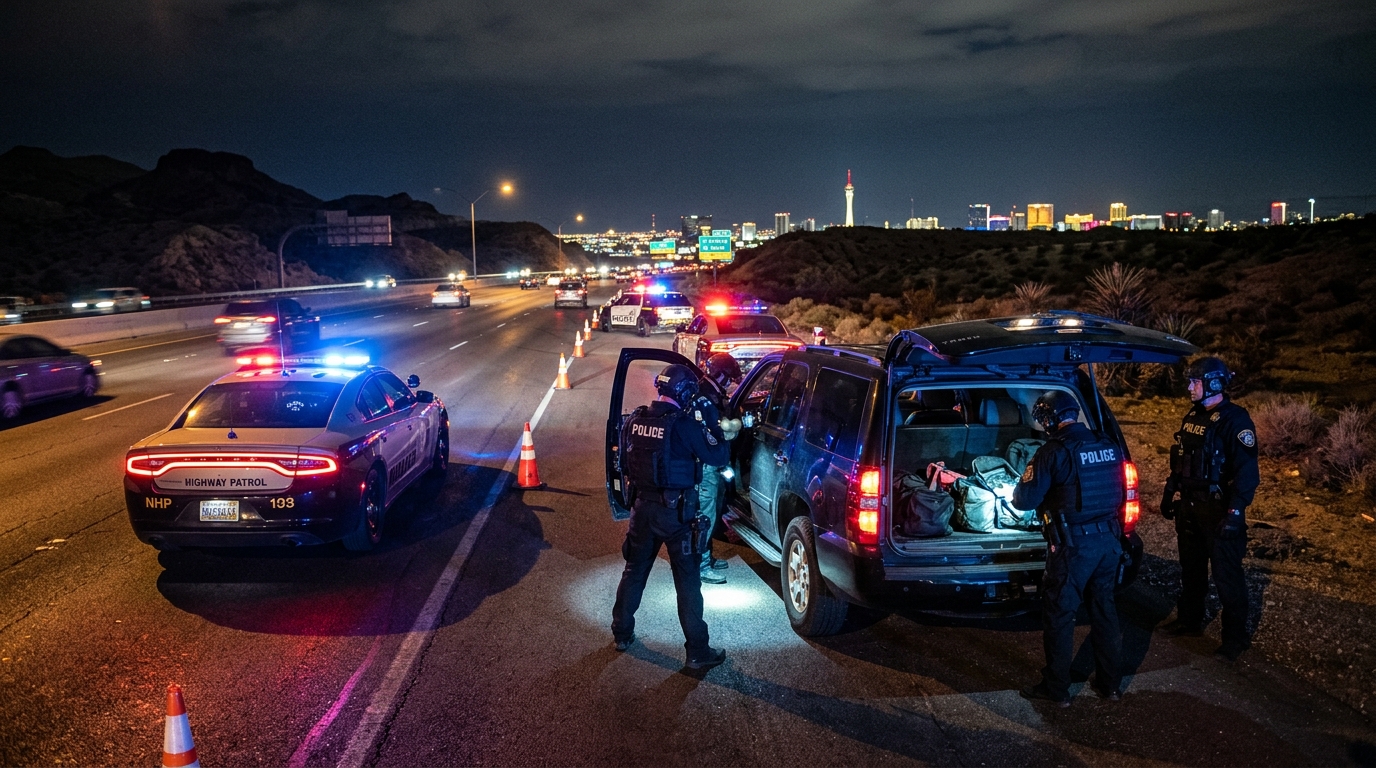
Nevada drug trafficking charges are among the most serious criminal offenses in the state — carrying mandatory minimum prison sentences that begin in years, not months, and reaching up to life imprisonment for the largest quantities. Unlike simple drug possession charges, trafficking is triggered by the quantity of a controlled substance — not by proof that you intended to sell. Las Vegas sits at a major drug corridor along I-15 between Los Angeles and the rest of the country, making it a high-enforcement zone for local police, the Metro Gang Unit, the DEA, and federal law enforcement. If you have been charged with drug trafficking in Clark County, you need an experienced criminal defense attorney immediately. The Law Offices of Thomas Boley defends trafficking cases throughout Clark County — call (702) 435-3333 now for a free consultation.
What Makes a Charge 'Drug Trafficking' in Nevada?
Nevada's drug trafficking statute (NRS 453.3385 – 453.339) is quantity-based. You do not need to be caught selling drugs, transporting drugs across state lines, or running an operation. Possession of a controlled substance above a statutory weight threshold is legally sufficient to trigger a trafficking charge. This means someone arrested with a large personal-use supply — perhaps a person with a serious addiction — can face mandatory trafficking penalties with no evidence of any actual sales. The prosecution does not need to prove intent to distribute. The quantity alone establishes the offense.
Free case review
Injured or Facing Charges in Las Vegas?
Thomas Boley offers free consultations — no fees unless we win your case.
You may also find nevada Record Sealing useful.
Nevada Drug Trafficking Penalties by Schedule and Quantity
Schedule I and II substances (cocaine, heroin, methamphetamine, fentanyl, MDMA/ecstasy):
• 4–14 grams: Category B felony — mandatory minimum 1 year, maximum 6 years in Nevada State Prison; fine up to $50,000
• 14–28 grams: Category B felony — mandatory minimum 2 years, maximum 15 years; fine up to $100,000
• 28 grams or more: Category A felony — mandatory minimum 10 years, maximum 25 years (or life with parole); fine up to $500,000
Note: These mandatory minimums cannot be suspended — a judge cannot impose probation or a lesser sentence below the floor.
Marijuana trafficking (NRS 453.3395):
• 50–100 lbs (or 1–5 kg concentrate): Category C felony — 1–5 years, fine up to $25,000
• 100–2,000 lbs (or 5–20 kg concentrate): Category B felony — 2–10 years, fine up to $50,000
• 2,000+ lbs (or 20+ kg concentrate): Category A felony — 5–20 years, fine up to $200,000
Note: Despite Nevada's recreational marijuana legalization, commercial trafficking outside licensed channels remains a serious felony.
Fentanyl — special enhanced penalties: Nevada has enacted enhanced penalties for fentanyl trafficking given the opioid crisis. Prosecutors treat fentanyl cases aggressively, and quantities that trigger trafficking thresholds are relatively small given fentanyl's potency. Counterfeit pills containing fentanyl ("fentanyl pills") are common in Las Vegas enforcement actions.
Federal Drug Trafficking Charges in Las Vegas
Because Las Vegas is a major transportation hub (Harry Reid International Airport, I-15, US-95), drug trafficking cases often involve federal law enforcement — DEA, FBI, Homeland Security Investigations (HSI). Federal drug trafficking charges under 21 U.S.C. § 841 carry their own mandatory minimum sentences: for example, 5 grams of methamphetamine triggers a 5-year federal mandatory minimum; 50 grams triggers 10 years. Federal convictions must typically be served at 85% of the sentence with no parole. If your case involves crossing state lines, use of the mail or wire, or a federal agent, you may face prosecution in federal court rather than Nevada state court — a critical distinction requiring specialized defense experience.

Key Defense Strategies in Nevada Drug Trafficking Cases
Unlawful search and seizure (Fourth Amendment): The majority of drug trafficking cases involve evidence discovered during vehicle stops, home searches, or airport searches. If police lacked reasonable suspicion for a stop, lacked probable cause for a search, or obtained a search warrant without sufficient supporting facts, the drugs and any other evidence discovered may be suppressed. Without the drugs, there is no trafficking case. This is the most powerful defense in trafficking prosecutions.
Chain of custody and lab analysis challenges: The prosecution must prove the substance is what they claim it is and weigh it accurately. Laboratory errors, contamination, improper storage, and documentation failures in the chain of custody can render the evidence inadmissible or reduce the provable quantity below a trafficking threshold.
Constructive possession challenges: In cases involving drugs found in a shared vehicle, home, or storage unit, the prosecution must prove you had dominion and control over the drugs — not merely that you were present near them. If multiple people had access to the location where drugs were found, "constructive possession" is genuinely contested.
Weight / purity challenges: Nevada trafficking thresholds are based on gross weight including cutting agents and packaging in some circumstances — but an independent expert analysis of purity and net weight can sometimes bring quantities below the threshold triggering higher mandatory minimums.
Entrapment: In undercover DEA and Metro operations, law enforcement may induce a defendant to traffic drugs they would not otherwise have handled. A genuine entrapment defense requires showing government inducement and absence of predisposition.
Substantial assistance / cooperation: In federal cases especially, providing substantial assistance to prosecutors in investigating other offenders can result in a motion for downward departure below the mandatory minimum — sometimes the only route to a non-mandatory sentence in a strong-evidence federal case.
Trafficking vs. Possession: Why the Distinction Matters
Many defendants do not understand that possessing drugs above a weight threshold is legally identical to "trafficking" under Nevada law — even without a single witness to a sale, no text messages about deals, and no drug paraphernalia associated with distribution. A person arrested at Harry Reid International with a quantity of cocaine in their luggage will face trafficking charges based purely on weight. Conversely, being caught with small quantities used in an actual sale may result in only possession charges. The quantity-based approach means the defense focus in trafficking cases is often entirely different from possession cases — attacking the legality of the search, the accuracy of the weight measurement, and the chain of custody rather than intent-based arguments.
Record Sealing and Long-Term Consequences of a Trafficking Conviction
A Nevada drug trafficking conviction has consequences that last far beyond the prison sentence: Record sealing: Category A felony convictions (the most serious trafficking offenses) cannot be sealed until 10 years after case closure (NRS 179.245). Category B and C felonies have 5-year waiting periods. Federal consequences: A felony drug conviction triggers a lifetime ban on federal financial aid for education (FAFSA), disqualification from many federal employment positions, and loss of the right to possess firearms. Immigration consequences: A drug trafficking conviction is an "aggravated felony" under federal immigration law — triggering mandatory deportation for non-citizens with virtually no discretionary relief. Professional licenses: Healthcare workers, real estate agents, contractors, and others with state professional licenses must typically self-report and may face suspension or revocation.
Frequently Asked Questions
Q: Can I be charged with trafficking if I didn't sell anything?
A: Yes. Nevada's trafficking statute (NRS 453.3385) is triggered by possession above a weight threshold — not by proof of any sale, transport, or distribution. Possessing more than 4 grams of cocaine, for example, is legally trafficking regardless of intent.
Q: What is the difference between state and federal drug trafficking charges?
A: State charges are prosecuted under NRS 453.3385 in Nevada state court (Clark County District Court). Federal charges are prosecuted under 21 U.S.C. § 841 in U.S. District Court, District of Nevada. Federal cases carry their own (often higher) mandatory minimums, must be served at 85%, and have no parole. Whether your case goes state or federal depends on which agency made the arrest, whether federal agents were involved, and prosecutorial discretion.
Q: Can mandatory minimum sentences be reduced or avoided?
A: In state court, Nevada mandatory minimums cannot be suspended by the judge — they are true floors. However, a skilled attorney can seek charge reduction through negotiation (e.g., to simple possession if weight is challenged successfully), pursue suppression of evidence, or — in federal cases — pursue substantial assistance departures. These are the primary routes to avoiding the mandatory minimum.
Q: Is marijuana still illegal to traffic in Nevada even though it's legal recreationally?
A: Yes. While adults may possess up to 1 oz of marijuana recreationally, commercial trafficking outside the licensed dispensary system remains a serious felony under NRS 453.3395. Large-quantity marijuana trafficking still carries 1–20 years depending on weight.
Q: What should I do immediately after a drug trafficking arrest?
A: Invoke your right to remain silent and your right to an attorney immediately — do not speak to police, explain where the drugs came from, or identify others involved without an attorney present. Contact our office at (702) 435-3333 as soon as possible. Evidence preservation and early investigation by your defense team is critical in trafficking cases.
For more information, visit our Las Vegas criminal defense attorney | schedule a free consultation.
About the Author
Thomas Boley is a Nevada licensed attorney specializing in personal injury law and criminal defense. Since 2008, Thomas has represented thousands of clients in Las Vegas and Clark County, recovering millions of dollars in compensation for injury victims. He is a member of the State Bar of Nevada, the Clark County Bar Association, and the Nevada Justice Association.
Need Legal Help? Contact Thomas Boley for a free consultation: (702) 435-3333