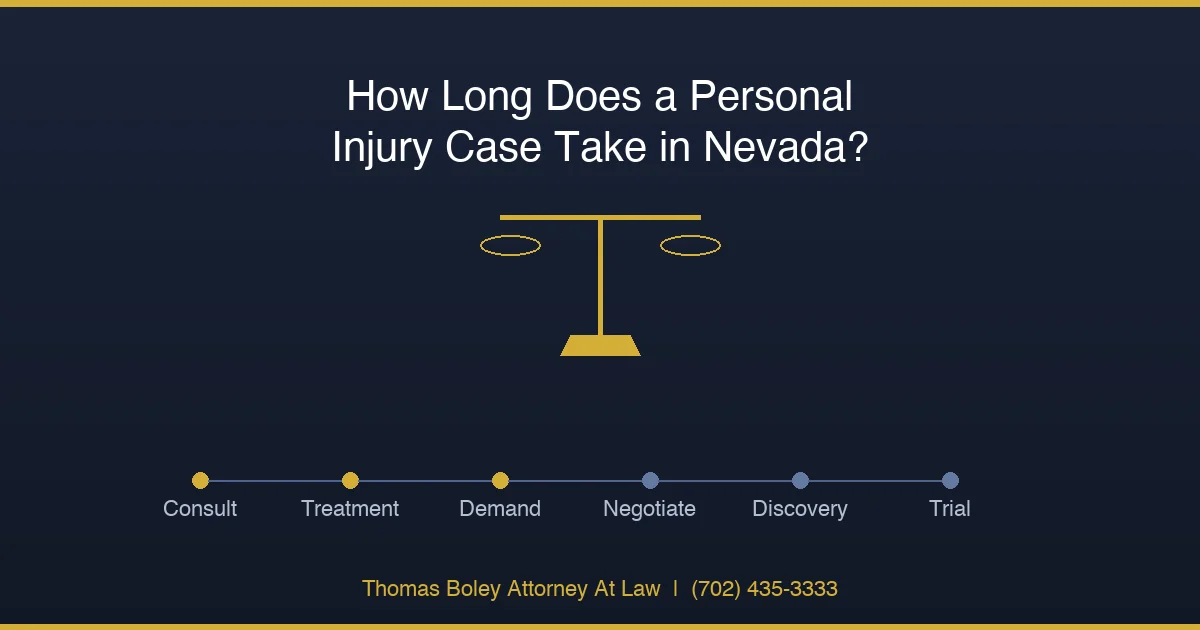
How Long Does a Personal Injury Case Take in Nevada?
In This Article
One of the first questions accident victims ask after being injured in Las Vegas is: how long will my personal injury case take? There is no single answer that applies to every case, because the timeline depends on the severity of your injuries, the complexity of liability, the willingness of the insurance company to negotiate fairly, and whether your case goes to trial in Clark County District Court. What we can do is walk you through each phase of a Nevada personal injury case so you understand what to expect, what causes delays, and how an experienced attorney keeps your case moving toward the best possible outcome.
The Short Answer: 6 Months to 3 Years
Most personal injury cases in Nevada resolve within six months to three years. Straightforward soft-tissue injury claims with clear liability — such as a rear-end collision on I-15 where the other driver received a citation — may settle in three to six months through pre-litigation negotiation. Complex cases involving catastrophic injuries, disputed liability, multiple defendants, or litigation in Clark County District Court can take one to three years or longer. Cases that proceed to a jury trial typically take 18 months to three years from the date of the accident.
Free case review
Injured or Facing Charges in Las Vegas?
Thomas Boley offers free consultations — no fees unless we win your case.
Phase 1: Initial Consultation and Case Evaluation
The timeline begins the moment you contact an attorney. During the initial consultation — which at our firm is free and confidential — your attorney reviews the facts of your accident, evaluates liability, and assesses the potential value of your claim. If you have a viable case, representation typically begins the same day. Your attorney immediately sends a letter of representation to the at-fault party's insurance company, notifying them that all communication must go through your attorney from that point forward. This stops the insurer from contacting you directly and protects you from the tactics insurance companies use to reduce or deny claims.
Timeline: Day 1 to Week 1.
Phase 2: Medical Treatment and Maximum Medical Improvement
This is typically the longest phase of a personal injury case — and the most important. You should not settle your claim until you have reached maximum medical improvement (MMI), the point at which your treating physicians determine that your condition has stabilized and no further significant improvement is expected. Settling before MMI is one of the most common and costly mistakes injury victims make, because you cannot accurately value a case when the full extent of the injuries is still unknown.
For minor soft-tissue injuries like whiplash from a fender-bender on Tropicana Avenue, MMI may come in four to eight weeks. For moderate injuries — herniated discs, torn ligaments, fractures requiring surgery — MMI may take six months to a year. For catastrophic injuries like traumatic brain injuries or spinal cord injuries, reaching MMI can take a year or longer, and some injuries result in permanent disability that requires lifetime medical care planning.
Timeline: 1 month to 18+ months, depending on injury severity.
Phase 3: Investigation and Evidence Gathering
While you focus on treatment, your attorney is building the strongest possible case. This phase runs concurrently with your medical treatment and includes gathering police and accident reports, collecting medical records and billing statements from every provider, obtaining traffic camera footage, dashcam video, and surveillance recordings, interviewing witnesses, retaining accident reconstruction experts if liability is disputed, documenting lost wages and calculating lost earning capacity, and compiling evidence of pain, suffering, and diminished quality of life.
- Obtaining the complete police accident report and all supplemental reports
- Collecting all medical records, imaging studies, surgical reports, and billing statements
- Securing traffic camera footage, dashcam recordings, and business surveillance video before it is overwritten
- Interviewing eyewitnesses and documenting their accounts
- Retaining accident reconstruction experts when liability is contested
- Documenting lost wages with employer records and calculating future lost earning capacity with vocational experts
- Compiling a personal injury journal documenting daily pain levels, physical limitations, and emotional impact
In Las Vegas, evidence preservation is time-sensitive. Traffic camera footage from NDOT and the Regional Transportation Commission is routinely overwritten. Business surveillance systems along the Strip, in Henderson shopping centers, and at Summerlin commercial properties cycle footage regularly. Your attorney must act quickly to preserve this evidence before it disappears.
Timeline: Runs parallel with Phase 2 — typically 2 to 12 months.
Phase 4: The Demand Letter and Pre-Litigation Negotiation
Once you reach MMI and your attorney has assembled the full picture of your damages, the next step is sending a formal demand letter to the insurance company. This document presents the complete case: a detailed account of the accident, evidence establishing liability, a comprehensive summary of your injuries and medical treatment, an itemized accounting of all economic damages (medical bills, lost wages, future medical costs, lost earning capacity), and a calculation of non-economic damages (pain and suffering, emotional distress, loss of enjoyment of life).
The demand letter includes a specific dollar amount — the total compensation your attorney believes your case is worth based on the evidence, Nevada case law, and experience with similar cases in Clark County. The insurance company then has a period — typically 30 days — to respond with an offer, a counteroffer, or a denial.
Most cases go through several rounds of negotiation after the initial demand. Your attorney and the insurance adjuster exchange offers and counteroffers, each supported by evidence and legal argument. Many cases settle during this phase, which avoids the time and expense of litigation. However, if the insurer refuses to offer fair compensation, your attorney must be prepared to file a lawsuit.
Timeline: 1 to 3 months for demand and initial negotiation rounds.
Phase 5: Filing a Lawsuit in Clark County
If pre-litigation negotiations fail to produce a fair settlement, your attorney files a personal injury lawsuit in Clark County District Court (or the appropriate Nevada court). Filing a lawsuit does not mean your case will go to trial — the vast majority of filed cases still settle before trial. But filing creates litigation pressure that changes the insurance company's calculus. The insurer now faces the costs of defense attorneys, depositions, expert witnesses, and the risk of a jury verdict that could exceed the settlement demand.
Under Nevada law, you generally have two years from the date of injury to file a personal injury lawsuit, as established by NRS 11.190. Missing this deadline — the statute of limitations — permanently bars your claim. An experienced attorney files well in advance of the deadline, preserving your rights and maximizing negotiation leverage.
Timeline: Filing takes 1 to 2 weeks once the decision is made.
Phase 6: Discovery and Depositions
After a lawsuit is filed, both sides enter the discovery phase — the formal exchange of evidence and information. Discovery includes written interrogatories (questions each side must answer under oath), requests for production of documents (medical records, insurance policies, correspondence), requests for admissions (asking the other side to admit or deny specific facts), and depositions (sworn testimony taken outside of court, recorded by a court reporter).
Depositions are often the most impactful part of discovery. Your attorney will depose the defendant, the insurance adjuster, treating physicians, and expert witnesses. The defense will depose you and your medical providers. Depositions frequently reveal new information and shift settlement dynamics. Discovery in Clark County District Court typically runs four to eight months, though complex cases with multiple defendants — such as trucking accident cases involving the driver, carrier, and manufacturer — can take longer.
Timeline: 4 to 12 months.
Phase 7: Mediation and Settlement Conference
Clark County District Court often requires parties to attempt mediation or participate in a settlement conference before trial. Mediation involves a neutral third-party mediator who facilitates negotiation between you and the insurance company. The mediator does not make a binding decision — they help both sides evaluate the strengths and weaknesses of their positions and work toward a resolution.
A significant number of litigated personal injury cases settle at or after mediation. Both sides have now completed discovery, taken depositions, and have a realistic picture of the evidence. The approaching trial date creates pressure to resolve the case. If mediation succeeds, the case is resolved without the uncertainty and expense of trial.
Timeline: 1 day for mediation session, but scheduling typically occurs 2 to 4 months before the trial date.
Phase 8: Trial
If settlement negotiations and mediation do not produce a fair result, your case goes to trial before a jury in Clark County District Court. Personal injury trials in Las Vegas typically last three to seven days, depending on complexity. Your attorney presents your case through opening statements, witness testimony, expert testimony, documentary evidence, and closing arguments. The jury then deliberates and returns a verdict.
Going to trial is not a failure of negotiation — it is sometimes the only way to obtain fair compensation, particularly when the insurance company has undervalued your claim or denied liability entirely. Nevada juries have returned substantial verdicts for injury victims, and the credible threat of trial is what gives your attorney leverage throughout the negotiation process.
Timeline: Trial itself is 3 to 7 days. Reaching the trial date is typically 12 to 24 months after filing.
Factors That Affect How Long Your Case Takes
Every personal injury case in Nevada is different. The following factors have the most significant impact on your case timeline.
- Injury severity: Minor injuries resolve faster because MMI comes sooner and damages are lower. Catastrophic injuries like TBI, spinal cord damage, and amputations take longer because treatment is extensive and damages are substantial.
- Disputed liability: When fault is clear (rear-end collision, DUI crash), cases move faster. When liability is contested — as in comparative negligence disputes — additional investigation and litigation are often needed.
- Number of defendants: Cases involving multiple at-fault parties (trucking companies, property owners, government entities) require coordinated discovery and separate negotiations with each insurer.
- Insurance company behavior: Some insurers negotiate in good faith and resolve claims efficiently. Others delay, deny, and force litigation as a business strategy.
- Medical treatment duration: Your case cannot be accurately valued — and should not be settled — until you reach maximum medical improvement.
- Court scheduling: Clark County District Court docket availability affects trial dates. Complex cases and judicial reassignments can add time.
- Pre-existing conditions: If you have pre-existing medical conditions, the insurer will dispute how much of your current condition is attributable to the accident, requiring additional medical evidence.
Why Rushing Your Case Costs You Money
Insurance companies know that injured people are under financial pressure. Medical bills are piling up, paychecks have stopped, and daily life is disrupted. The insurer's strategy is to use that pressure against you by offering a quick settlement for a fraction of what your case is actually worth. Accepting an early settlement before you reach MMI and before your attorney has built the full damages picture is one of the most common mistakes that destroy personal injury claims.
Once you accept a settlement and sign a release, you cannot go back for more money — even if your injuries turn out to be far more serious than you initially thought. A herniated disc that seemed manageable at week four may require surgery at month six. A concussion that appeared minor may develop into post-concussion syndrome with lasting cognitive effects. Patience during the medical treatment phase directly translates into higher compensation.
Nevada's Statute of Limitations: The Hard Deadline
While patience during treatment is important, there is an absolute deadline you cannot miss. Under NRS 11.190, you generally have two years from the date of injury to file a personal injury lawsuit in Nevada. If you miss this deadline, your claim is permanently barred regardless of how strong the evidence is or how serious your injuries are.
There are narrow exceptions. Claims against government entities under NRS 41.036 require a notice of claim within two years, and the lawsuit must be filed within that same period. Medical malpractice claims have different deadlines. The discovery rule may extend the deadline in cases where the injury was not immediately apparent. But relying on exceptions is risky — the safest approach is to contact an attorney as soon as possible after your accident.
Typical Timelines by Case Type in Las Vegas
While every case is unique, the following ranges reflect what we typically see in our Las Vegas personal injury practice.
- Minor car accident (soft tissue, clear liability): 3 to 6 months to settlement
- Moderate car accident (fractures, herniated discs, surgery): 8 to 18 months
- Motorcycle accident with serious injuries: 12 to 24 months
- Truck accident with multiple defendants: 18 to 36 months
- Slip and fall with disputed liability: 6 to 18 months
- Catastrophic injury (TBI, spinal cord, amputation): 18 to 36+ months
- Wrongful death: 12 to 30 months
- Cases that go to trial in Clark County District Court: 18 to 36 months from filing
What Happens After You Settle or Win at Trial?
After a settlement is reached or a jury returns a verdict in your favor, there are still a few steps before you receive your compensation. Your attorney must resolve any outstanding medical liens — amounts owed to health insurance companies, Medicare, Medicaid, or medical providers who treated you on a lien basis. Your attorney negotiates these liens down whenever possible, which puts more money in your pocket. Once liens are resolved, your attorney deducts the contingency fee and case costs, and you receive the remaining balance.
For settlements, this process typically takes two to four weeks after the settlement agreement is signed. For trial verdicts, the losing party may file post-trial motions or an appeal, which can add months or longer. However, most verdicts result in payment without appeal.
How Working with an Attorney Affects the Timeline
Hiring an experienced personal injury attorney does not necessarily make your case take longer — in many cases, it makes the process more efficient. An attorney handles all communication with the insurance company, preventing delays caused by misinformation or unanswered requests. An attorney knows which evidence to gather and when, avoiding gaps that slow negotiations. An attorney files suit at the strategically optimal time, creating pressure that moves the insurer toward fair settlement.
At the same time, a good attorney will not rush your case to a premature settlement. The goal is the best outcome, not the fastest. Working with Thomas Boley on a contingency fee basis means you pay nothing upfront and nothing out of pocket — the fee comes from the recovery. This eliminates financial barriers and ensures your attorney's incentive is aligned with maximizing your compensation.
Frequently Asked Questions About Personal Injury Case Timelines in Nevada
Q: Can I get money before my case settles?
A: In some cases, yes. Medical providers may treat you on a lien basis, meaning they are paid from your settlement. Some attorneys can also help arrange medical funding. Your attorney can discuss options to manage expenses while your case is pending.
Q: Does filing a lawsuit mean I have to go to trial?
A: No. The majority of personal injury lawsuits filed in Clark County settle before trial. Filing a lawsuit creates leverage and opens the discovery process, which often leads to better settlement offers.
Q: What if the insurance company is stalling my claim?
A: Deliberate delay is a common insurance tactic. Your attorney can file a lawsuit to force the issue, and in cases of extreme bad faith, Nevada law allows additional damages against the insurer. Read more about insurance company delay tactics.
Q: How long do I have to file a personal injury claim in Nevada?
A: Under NRS 11.190, you generally have two years from the date of injury. Exceptions exist for government entities and cases involving delayed discovery of the injury. Do not wait — contact an attorney as soon as possible to preserve evidence and protect your rights.
Q: Will my case take longer if the other driver was uninsured?
A: Potentially. Uninsured motorist claims are filed against your own insurance company under your UM/UIM policy. While your own insurer should process the claim in good faith, disputes over damages can still lead to litigation.
Contact Thomas Boley for a Free Consultation
If you have been injured in an accident in Las Vegas, Henderson, North Las Vegas, Summerlin, Spring Valley, Paradise, Enterprise, Sunrise Manor, Winchester, Whitney, or anywhere in Clark County, the clock is running on your case. Every day that passes is a day that evidence can be lost, witnesses can forget details, and the statute of limitations moves closer. At Thomas Boley Attorney At Law, we have spent more than 18 years guiding personal injury victims through every phase of the claims process — from the first consultation to final settlement or jury verdict. We handle personal injury cases on a contingency fee basis — you pay nothing unless we recover compensation for you. Call (702) 435-3333 today for a free, confidential consultation. We will review your case, explain your legal options, and give you an honest assessment of what your claim is worth and how long the process is likely to take. This article is for informational purposes only and does not constitute legal advice. Every case is unique. Contact Thomas Boley Attorney At Law for a free consultation specific to your situation.
About the Author
Thomas Boley is a Nevada licensed attorney specializing in personal injury law and criminal defense. Since 2008, Thomas has represented thousands of clients in Las Vegas and Clark County, recovering millions of dollars in compensation for injury victims. He is a member of the State Bar of Nevada, the Clark County Bar Association, and the Nevada Justice Association.
Need Legal Help? Contact Thomas Boley for a free consultation: (702) 435-3333