Credit Card Fraud Charges in Las Vegas: Penalties & Defenses
In This Article
A hotel valet card that comes back "declined" twice before it finally goes through, a Metro detective calling about a gas pump skimmer with your name attached to it, or a casino cage transaction flagged because the card had already been reported stolen the week before — any of these can turn into credit card fraud charges in Las Vegas by the end of the day. Nevada treats the fraudulent use of someone else's card, or your own card after you know it has been revoked, as a serious offense from the very first incident, and Clark County prosecutors move quickly when a hotel, casino, or bank is the one filing the complaint. At Thomas Boley Attorney At Law, we defend clients facing credit card and debit card fraud charges throughout Las Vegas, Henderson, Summerlin, North Las Vegas, and the rest of Clark County.
- Nevada's core credit and debit card fraud statute, NRS 205.760, punishes fraudulent card use under a value-based framework: a gross misdemeanor under $650, a Category D felony between $650 and $3,500, and a Category C felony above $3,500.
- A conviction can mean up to 364 days in jail and a $2,000 fine at the misdemeanor level, or 1 to 5 years in Nevada State Prison and a $10,000 fine at the felony level, plus restitution to the cardholder and card issuer.
- Possessing two or more incomplete cards, or any machinery or device built to produce counterfeit cards — including a skimmer — is charged separately under NRS 205.790 as its own Category D felony, even if no card was ever successfully used.
- Skimming operations that cross state lines or target cardholders from multiple states, common in a tourism economy like Las Vegas, frequently draw federal charges under 18 U.S.C. § 1029, which can carry up to 15 years for device-making equipment alone.
- Charges often start with a hotel, casino, valet company, or bank flagging a transaction, not with a police stop, meaning the accused frequently learns about the investigation only after evidence has already been gathered.
- Common defenses include lack of intent to defraud, valid authorization from the cardholder, mistaken identity, and challenging whether the value threshold for the charged felony level was actually met.
Credit Card Fraud Charges in Las Vegas Under Nevada Law
Free case review
Injured or Facing Charges in Las Vegas?
Thomas Boley offers free consultations — no fees unless we win your case.
Nevada's credit and debit card fraud law is codified at NRS 205.760, and it covers using a card you know is stolen, forged, or counterfeit; using a card issued to someone else without their consent; and using your own card after you know it has been revoked, canceled, or reported lost. Unlike some fraud statutes that impose one flat penalty no matter the amount involved, NRS 205.760 borrows Nevada's value-based theft framework — the dollar amount obtained through the fraudulent charge determines whether the case is a misdemeanor or a felony, and how serious a felony it becomes. We cover the statute in more detail, including its exact penalty tiers, in our Nevada Criminal Laws glossary entry on NRS 205.760, but the short version is this: Nevada does not treat a fraudulent charge as a minor paperwork problem, and it prosecutes accordingly.
What Counts as Fraudulent Use Under NRS 205.760
The statute reaches far beyond a stranger physically swiping a stolen card. Entering a stolen card number into an online checkout page, using a company card for a personal purchase without authorization, or continuing to use a card you know your bank has already frozen can all support a charge. Family situations create some of the most contested cases we see: a spouse, adult child, or roommate who uses a card that was left out or previously shared can find themselves accused of fraud once a relationship sours, even though the cardholder originally allowed the access. Whether the accused person actually had authorization — and whether that authorization was ever withdrawn — is frequently the central factual dispute at trial. These cases are also easy to confuse with identity theft, and it matters which one actually happened: if someone else obtained your card number and used it without your knowledge, you are the victim of identity theft, not the person who should be facing an NRS 205.760 charge, and proving that distinction quickly protects both your credit and your liberty.
Skimming Devices and NRS 205.790: When Possession Alone Is a Felony
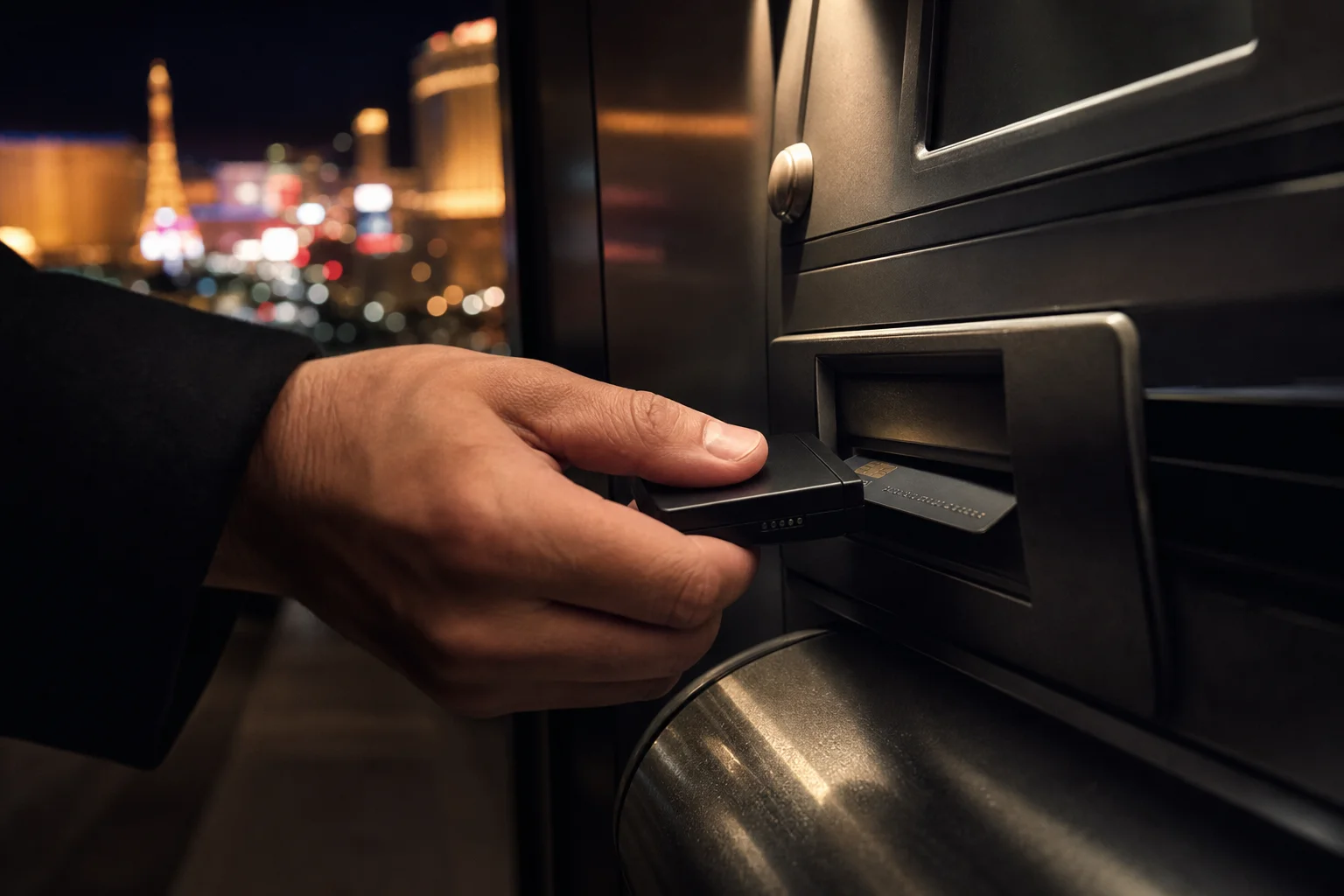
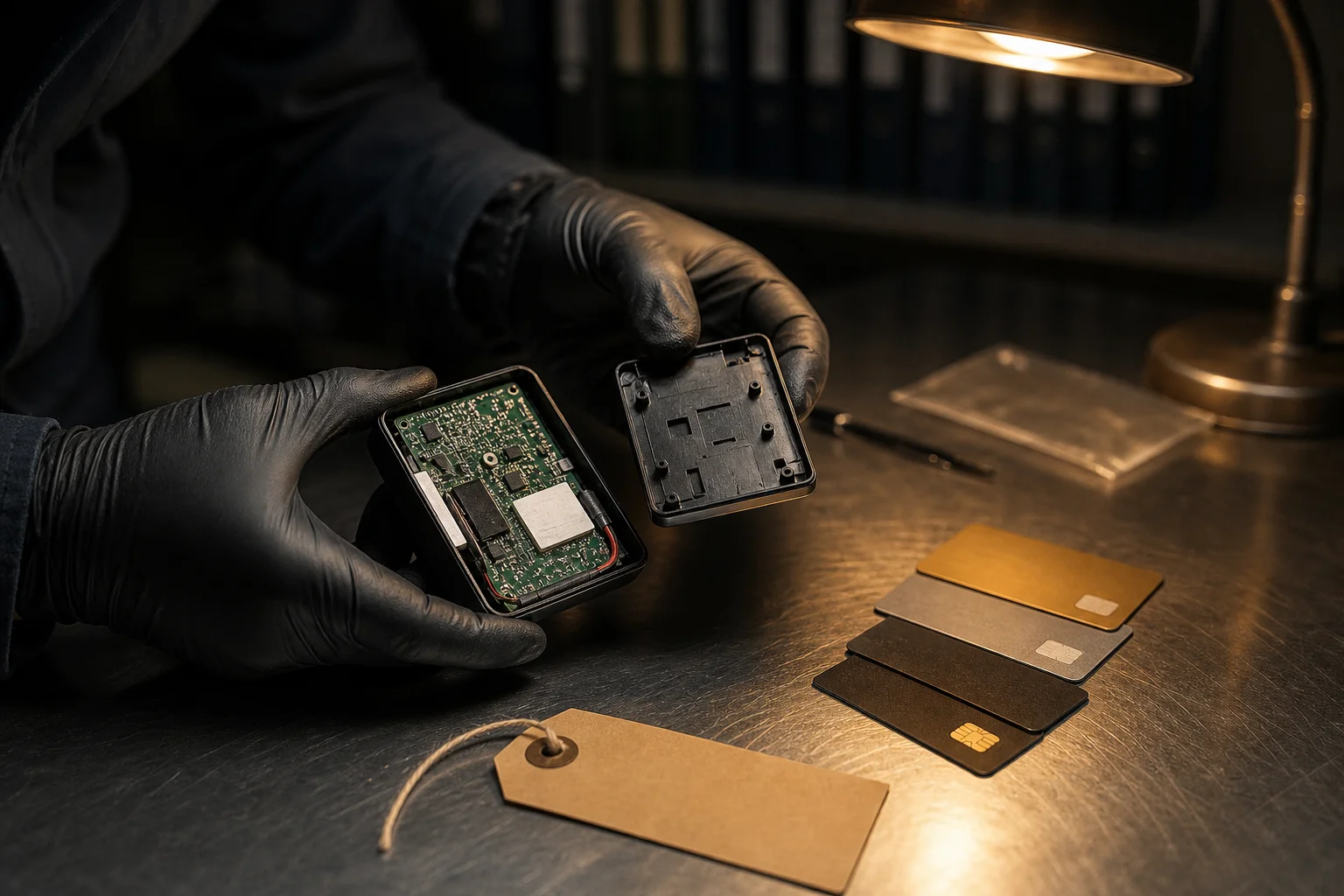
Card skimming — hiding a small device inside a card reader that copies the magnetic stripe data as a card is swiped — is prosecuted separately from ordinary fraudulent use. NRS 205.790 makes it a Category D felony to possess two or more incomplete credit or debit cards, or any machinery, plate, or device built to produce counterfeit cards, and this charge does not require proof that a single fraudulent purchase was ever completed. In a tourism-driven economy where millions of out-of-town cardholders swipe at gas pumps, valet stands, ATMs, and hotel point-of-sale terminals every month, Las Vegas is a recurring target for skimming rings, and Metro's financial crimes unit and the casinos' own loss-prevention teams actively look for it. Simply being found with a skimmer, a card reader, or a stack of blank cards carrying magnetic stripe data can be enough to support this charge — you do not have to have used a single one of them.
Penalties for a Credit Card Fraud Conviction in Las Vegas
A conviction under NRS 205.760 is sentenced according to the value obtained through the fraud. Fraudulent charges under $650 are a gross misdemeanor, punishable by up to 364 days in the Clark County Detention Center and a fine of up to $2,000. Charges between $650 and $3,500 are a Category D felony, carrying 1 to 4 years in Nevada State Prison and a fine of up to $5,000. Anything over $3,500 is a Category C felony, punishable by 1 to 5 years in prison and a fine of up to $10,000. At every level, a judge can also order restitution to the cardholder and the card issuer, on top of any jail or prison sentence and fine. A separate NRS 205.790 conviction for possessing skimming equipment or incomplete cards carries its own Category D felony exposure — 1 to 4 years and up to $5,000 — and prosecutors frequently charge both statutes together when a skimmer is recovered alongside cards that were actually used.
How These Cases Start in a Casino and Tourism Economy
Most of the credit card fraud investigations we see in Las Vegas do not start with a traffic stop. A hotel's night audit flags a room charge that does not match the guest on file. A valet company's daily reconciliation turns up a card that was declined for fraud at the front desk but somehow cleared at the valet stand an hour later. A casino cage employee notices a marker payment or chip purchase on a card that customer service confirms was reported stolen days earlier. A bank's fraud department, reviewing a cluster of suspicious transactions from cardholders in different states who all visited the same Strip-area gas station or ATM in the same week, forwards the pattern to Metro's financial crimes detail or directly to the U.S. Secret Service. Because Las Vegas draws such a high volume of out-of-town cardholders, financial institutions and federal investigators treat the city as a recurring hotspot for organized skimming activity, and that scrutiny means an investigation can already be well underway — with surveillance footage, transaction logs, and bank records already gathered — before the accused person ever learns a case exists.
When Credit Card Fraud Becomes a Federal Case
Not every credit card fraud case charged in Las Vegas stays in Nevada state court. When a skimming or card-cloning scheme reaches across state lines, involves cardholders from multiple states, or ties into an organized ring the Secret Service has already been tracking, federal prosecutors can bring charges under 18 U.S.C. § 1029, the federal access device fraud statute. A basic federal access device fraud conviction can carry up to 10 years in federal prison; if the case involves device-making equipment — the same kind of skimmer or card encoder charged under NRS 205.790 at the state level — federal exposure jumps to up to 15 years, and a defendant with a prior conviction can face up to 20 years. Federal fines can reach $250,000, on top of restitution. Federal and state prosecutors sometimes coordinate on the same skimming ring and decide afterward which cases stay local and which move to federal court, so a defendant's exposure can shift significantly based on that charging decision alone — another reason early legal representation matters before that decision gets made.
Defending Against Credit Card or Debit Card Fraud Charges
An accusation is not a conviction, and credit card fraud cases often have more nuance than the initial police report suggests. If the cardholder actually authorized the transaction — even informally, such as a family member handing over a card for a specific purchase — that authorization can be a complete defense. The prosecution must also prove intent to defraud, not just that a card was used; a card that was declined by mistake, used past its expiration date without the holder realizing it, or picked up after being left behind can lack the willful intent the statute requires. Mistaken identity is a real issue in skimming and cloned-card cases, where surveillance footage is grainy, a shared hotel key or valet ticket connects several people to the same transaction, or a cloned card was used by someone who was never actually near the original device. And because these investigations often begin with a bank or loss-prevention review rather than a warrant, we routinely examine whether the eventual search of a phone, a hotel room, or a vehicle that turned up a skimmer or blank cards was properly authorized. Evidence obtained through an unlawful search can be suppressed, and in a case built almost entirely around physical evidence, that alone can end the prosecution's case. We handle these evidentiary disputes as part of our broader Las Vegas theft and property crimes defense practice, since the same investigative missteps that undermine a theft case just as often undermine a card fraud case.
- Do not discard, wipe, or reset any phone, card, or device connected to the accusation — that alone can support a separate evidence-tampering charge.
- Do not agree to a recorded statement with a loss-prevention investigator, bank fraud department, or detective before speaking with an attorney.
- Gather any documentation showing authorization for the transaction, such as texts, a shared account agreement, or a receipt showing you made the purchase yourself.
- Write down where you were and who you were with when the disputed charge occurred, while the details are still fresh.
- Call a Las Vegas criminal defense attorney immediately if a skimmer, blank cards, or a card reader was found in your possession.
- Can I be charged with credit card fraud for using a family member's card? Yes, if you did not have their authorization for that specific use. If the cardholder gave you permission, that is a complete defense — but the prosecution may still charge you if the authorization is disputed after the fact.
- Is online credit card fraud treated the same as using a stolen physical card? Yes. Entering a stolen card number into an online checkout is prosecuted under the same NRS 205.760 framework as swiping a physical card, and it can also trigger separate wire fraud exposure under federal law.
- Can I be charged just for possessing a skimmer, even if I never used it? Yes. NRS 205.790 makes possession of two or more incomplete cards or any device built to produce counterfeit cards a Category D felony on its own, regardless of whether a fraudulent purchase was ever completed.
- Will my case stay in Nevada state court or become a federal case? It depends on the scope of the alleged scheme. Cases involving multiple states, an organized ring, or Secret Service involvement can be charged federally under 18 U.S.C. § 1029, which generally carries harsher penalties than the equivalent state charge.
- What is the difference between credit card fraud and identity theft in Nevada? Identity theft involves obtaining someone else's personal or financial information; credit card fraud involves using a card fraudulently. The two charges often overlap in the same case, and which one actually fits your situation can significantly affect your defense.
Speak With a Las Vegas Credit Card Fraud Defense Attorney
A credit card or debit card fraud accusation can move from a bank's fraud department to a felony charge faster than most people expect, especially when a hotel, casino, or valet company is the one that first flagged the transaction. Thomas Boley has represented clients throughout Clark County for more than 18 years and moves quickly to secure transaction records, surveillance footage, and device evidence before it disappears.
Call (702) 435-3333 for a free consultation, or contact Thomas Boley online to discuss a credit card or debit card fraud case in Las Vegas, Henderson, Summerlin, North Las Vegas, or elsewhere in Clark County. Bring any paperwork you have received, details about who else had access to the card or account, and a timeline of your whereabouts when the disputed charge occurred. Our guide to Fraud and White-Collar Crime Charges in Las Vegas explains how these cases can overlap with broader financial crime investigations. This article is informational only and is not legal advice. Every case is unique.
About the Author
Thomas Boley is a Nevada licensed attorney specializing in personal injury law and criminal defense. Since 2008, Thomas has represented thousands of clients in Las Vegas and Clark County, recovering millions of dollars in compensation for injury victims. He is a member of the State Bar of Nevada, the Clark County Bar Association, and the Nevada Justice Association.
Need Legal Help? Contact Thomas Boley for a free consultation: (702) 435-3333