Counterfeit Goods Charges in Las Vegas: NRS 205.210
In This Article
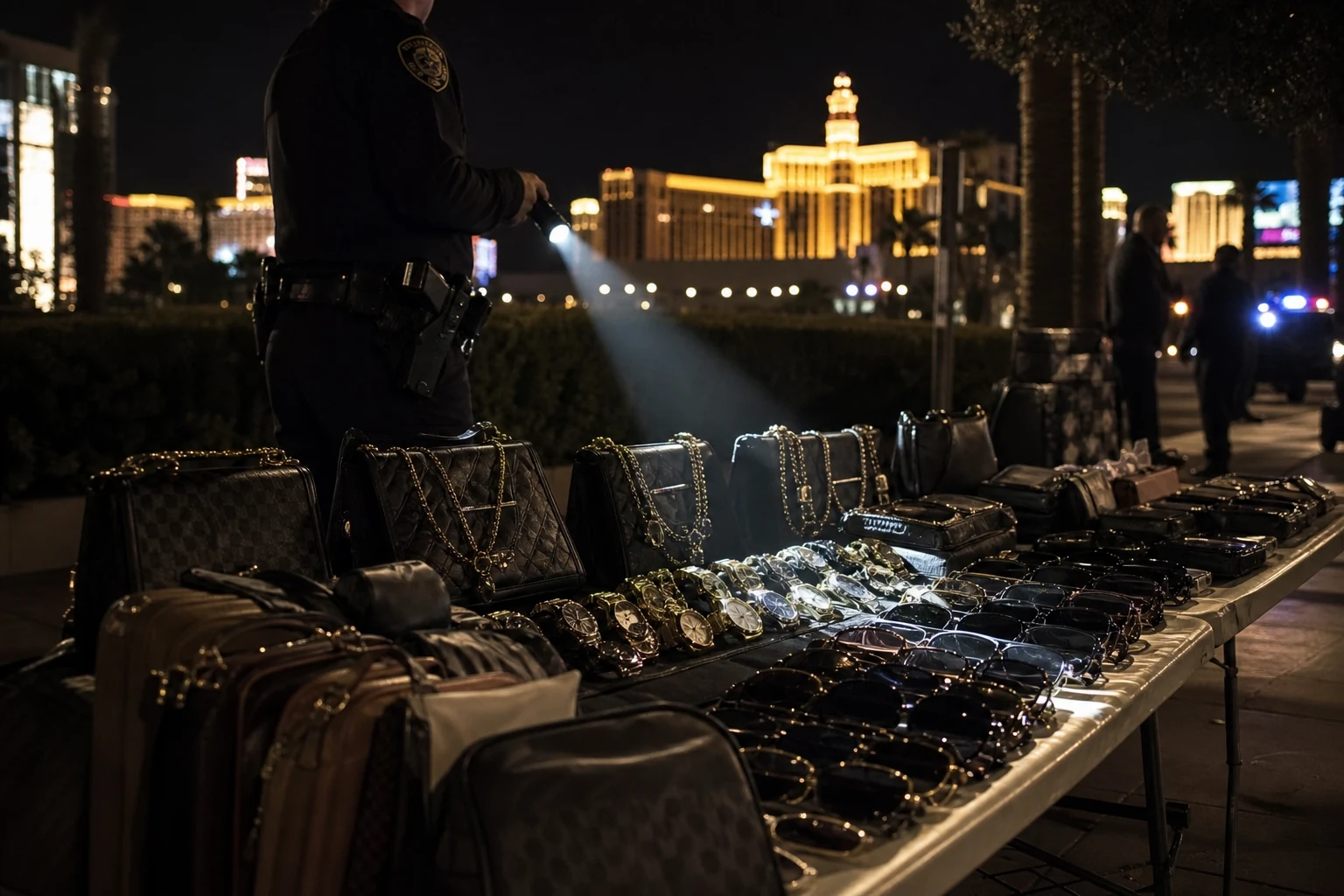
Folding tables of handbags, watches, and sunglasses appear along the Strip and the Fremont Street corridor almost every weekend, and so do the officers who shut them down. Counterfeit goods charges in Las Vegas are not limited to the vendor running the table either; a tourist buying a stack of "replica" items to resell back home, a swap-meet dealer, or a shop owner stocking a back room with unlicensed merchandise can all face the same Nevada statute. At Thomas Boley Attorney At Law, we defend clients accused of selling, displaying, or possessing counterfeit-trademarked goods throughout Clark County, and this guide explains how NRS 205.210 works, when the charge becomes a felony, and how a state arrest on the Strip can turn into a federal case.
- NRS 205.210 makes it unlawful to knowingly sell, display, or advertise goods bearing a false or counterfeit trademark.
- A first offense is generally a misdemeanor, but the charge becomes a category E felony with a prior conviction or when the counterfeit goods are worth $1,000 but less than $10,000 at retail.
- A second prior conviction raises the charge to a category D felony under NRS 205.210.
- NRS 205.205 separately criminalizes actually counterfeiting a trademark or design, as a misdemeanor.
- Large-scale counterfeit goods operations can also draw federal charges under 18 U.S.C. § 2320, often investigated by Homeland Security Investigations.
- How the retail value of the goods is calculated, and whether the seller knew the goods were counterfeit, are frequently the most contested issues in these cases.
Counterfeit Goods Charges in Las Vegas: How Nevada Defines the Crime
Free case review
Injured or Facing Charges in Las Vegas?
Thomas Boley offers free consultations — no fees unless we win your case.
Nevada addresses fake designer merchandise through two related statutes in Chapter 205 of the Nevada Revised Statutes. NRS 205.205 makes it a misdemeanor to manufacture, reproduce, or counterfeit a trademark, trade name, or design without authorization. NRS 205.210, the statute behind most counterfeit goods charges in Las Vegas, targets the sale side: it is unlawful to knowingly sell, offer for sale, display, or advertise any goods or services bearing a false or counterfeit trademark or imitation of a genuine trademark. The word "knowingly" matters, because the prosecution has to prove the seller was aware the trademark was false or counterfeit, not merely that the goods turned out to be fake. A vendor who genuinely believed a supplier's goods were licensed overstock, and who can show that, has a materially different case than someone who sourced obvious knockoffs and sanded off a factory marking.
Who Investigates Counterfeit Goods Sales in Las Vegas
The Las Vegas Metropolitan Police Department runs routine enforcement against sidewalk vendors on the Strip and Fremont Street, often in response to complaints from licensed retailers, hotel security, or brand representatives who monitor the resort corridor. A typical case starts small: an officer approaches a table, and either visibly fake branding or a vendor's own admission establishes the "knowingly" element on the spot. Larger operations draw more coordinated attention. A warehouse, storage unit, or shipment of counterfeit goods can bring in Homeland Security Investigations, U.S. Customs and Border Protection, or a brand's private investigators working alongside local police, especially around major conventions, title fights, and other events that draw tens of thousands of visitors likely to buy souvenirs on the street.
Misdemeanor vs. Felony Penalties Under NRS 205.210
A first NRS 205.210 violation is typically charged as a misdemeanor, carrying up to six months in jail and a fine of up to $1,000. The charge escalates to a category E felony if the person has one prior conviction under the statute, or if the counterfeit goods involved have a retail value of at least $1,000 but less than $10,000. Category E felonies in Nevada usually carry probation eligibility with a suspended prison sentence on a first felony, though that depends on the judge and the full record. A second or later prior conviction raises the charge to a category D felony, punishable by one to four years in prison and up to a $5,000 fine. Retail value is calculated using what the genuine, branded version of the item would sell for, not what the vendor actually charged for the counterfeit, which can push a modest street-corner haul into felony territory faster than a defendant expects. Our guide on grand larceny charges in Las Vegas covers a similar value-threshold structure that applies to Nevada theft offenses generally.

When a State Case Becomes a Federal Trademark Counterfeiting Charge
A Las Vegas arrest for selling fake handbags or watches can stay entirely in state court, but larger operations frequently attract federal interest. 18 U.S.C. § 2320 criminalizes intentionally trafficking in counterfeit goods or services, and it carries far more severe penalties than the Nevada misdemeanor-to-felony structure, including years in federal prison for a first offense when the quantity or value is significant. Federal involvement tends to follow quantity, interstate or international shipping, and whether a brand's own investigators have already built a case before police ever get involved. A defendant who was charged locally after a single sidewalk table rarely sees federal charges, but someone connected to a storage unit full of imported counterfeit merchandise, or a shipment seized at a Nevada port of entry, is in a meaningfully different legal posture. Our article on receiving stolen property charges in Las Vegas walks through a related scenario where the source and scale of goods change how a case is charged.
Common Defenses to a Counterfeit Goods Charge
- Lack of knowledge: NRS 205.210 requires the state to prove the seller knew the trademark was false or counterfeit, which is not always obvious from unbranded or generically labeled merchandise.
- Disputed retail valuation: challenging how the state calculated the genuine-brand value of the seized goods can move a case back under the felony threshold.
- Chain of custody: questioning how seized merchandise was tagged, stored, and tracked between the arrest and any court proceeding.
- Fourth Amendment issues: whether officers had a lawful basis to search a vendor's table, bag, vehicle, or storage unit before any counterfeit evidence was found.
- Entrapment or improper inducement, in cases built around an undercover purchase by an officer or a brand investigator.
- Ownership and control: whether the defendant actually controlled the goods in question, particularly at a shared swap-meet booth or a multi-vendor table.
What to Do If You're Arrested for Selling Counterfeit Goods
- Stay polite but limit what you say about where the merchandise came from or what you knew about it; those details are exactly what the "knowingly" element turns on.
- Do not sign anything waiving ownership of seized goods without first speaking to an attorney about what that waiver might mean for your case.
- Write down what you remember about the stop, including whether officers searched beyond the table itself and what they told you about the basis for the search.
- Keep any receipts, invoices, or supplier communications showing where the merchandise came from, since they can support a lack-of-knowledge defense.
- Ask whether the case is being handled by Las Vegas Metro, another local agency, or has been referred federally, since that affects which court and which penalties apply.
- Contact a criminal defense attorney before your first court date so the valuation, the evidence, and the basis for the stop can all be reviewed early.
- Is selling fake designer bags on the Strip a felony in Las Vegas? Not automatically. A first offense under NRS 205.210 is typically a misdemeanor; it becomes a category E felony with a prior conviction or when the counterfeit goods' retail value reaches $1,000.
- What does "knowingly" mean in a counterfeit goods case? The prosecution must show the seller was aware the trademark on the goods was false or counterfeit, not simply that the goods later turned out to be fake.
- Can I be charged federally for selling counterfeit items in Las Vegas? It is possible under 18 U.S.C. § 2320, but federal charges typically follow larger operations, significant quantities, or interstate or international shipping, not a single small sidewalk sale.
- How is the value of counterfeit goods calculated for charging purposes? Nevada generally values seized counterfeit goods based on what the genuine, branded item would sell for, not what the counterfeit version was priced at, which can push the value over a felony threshold.
- What happens to the seized merchandise? Seized goods are typically held as evidence and may be forfeited, which is separate from any criminal penalty tied to a conviction.
- Should I talk to police about where I got the merchandise? It is best to speak with an attorney first, since details about sourcing and knowledge are often central to how the case is charged and defended.
Speak With a Las Vegas Criminal Defense Attorney
Thomas Boley has represented clients throughout Clark County on criminal matters for more than 18 years, including counterfeit goods and theft-related charges tied to Strip and Fremont Street enforcement. Because the difference between a misdemeanor and a felony counterfeit goods charge often comes down to a contested valuation or what the state can actually prove about your knowledge, early counsel matters. Call (702) 435-3333 for a free consultation, or contact Thomas Boley online to discuss a counterfeit goods charge anywhere in Las Vegas, Henderson, Summerlin, North Las Vegas, or elsewhere in Clark County. Our theft and property crimes defense practice handles cases like these regularly. This article is informational only and is not legal advice. Every case is unique.
About the Author
Thomas Boley is a Nevada licensed attorney specializing in personal injury law and criminal defense. Since 2008, Thomas has represented thousands of clients in Las Vegas and Clark County, recovering millions of dollars in compensation for injury victims. He is a member of the State Bar of Nevada, the Clark County Bar Association, and the Nevada Justice Association.
Need Legal Help? Contact Thomas Boley for a free consultation: (702) 435-3333