
Broken Bone and Fracture Injury Claims in Las Vegas: Your Legal Guide
In This Article
Broken bone injury claims in Las Vegas arise from car accidents, slip and fall incidents, construction site hazards, and other preventable events across Clark County every day. A fracture can sideline you from work for months, require surgery and physical therapy, and leave you with permanent limitations that change how you live. Nevada law entitles accident victims to full compensation for these injuries when another party’s negligence caused the harm. If you or a family member suffered a broken bone in a Las Vegas accident, understanding your legal options early can make the difference between a lowball insurance settlement and the recovery you actually deserve. A Las Vegas personal injury attorney can evaluate your fracture case at no cost — call (702) 435-3333 today.
- Broken bones from car crashes, falls, and workplace accidents are among the most common serious injuries in Las Vegas personal injury cases.
- Fracture victims can recover medical expenses, lost wages, pain and suffering, and future care costs under Nevada law.
- Nevada’s statute of limitations gives you 2 years from the date of injury to file a personal injury lawsuit (NRS 11.190).
- Even if you were partially at fault, Nevada’s comparative negligence rule may still allow compensation if your fault is under 50 percent.
- Call (702) 435-3333 for a free consultation — early legal representation protects your claim and your evidence.
How Broken Bone Injuries Happen in Las Vegas Accidents
Free case review
Injured or Facing Charges in Las Vegas?
Thomas Boley offers free consultations — no fees unless we win your case.
Las Vegas’s congested roadways, active construction zones, and high-traffic commercial properties create conditions where fracture injuries occur with alarming regularity. The force required to break a bone is significant, and when that force comes from someone else’s negligent or reckless behavior, the injured person has every right to pursue a legal claim. Common causes of broken bone injuries across the Las Vegas Valley include:
- Car accidents: Rear-end collisions, T-bone crashes at intersections, and high-speed freeway wrecks along I-15, US-95, and the Las Vegas Beltway frequently cause fractures to the arms, legs, ribs, pelvis, and spine. Read more about what to do after a car accident in Las Vegas.
- Motorcycle accidents: Riders have virtually no structural protection. Broken femurs, tibias, wrists, and clavicles are extremely common in motorcycle crashes. See our guide on motorcycle accident injuries.
- Truck accidents: The sheer mass of commercial vehicles means collisions with passenger cars often produce catastrophic fractures, including pelvic and spinal fractures. Learn about truck accident claims.
- Slip and fall incidents: Wet floors, uneven surfaces, broken stairs, and poorly maintained parking lots at casinos, shopping centers, and apartment complexes cause hip fractures, wrist fractures, and spinal compression fractures — especially in older adults. Read about slip and fall liability in Nevada.
- Construction accidents: Falls from scaffolding, equipment failures, and struck-by incidents routinely produce compound and comminuted fractures in Las Vegas construction workers. See construction accident injuries in Las Vegas.
- Pedestrian accidents: A pedestrian struck by a vehicle traveling even 20 miles per hour can suffer multiple fractures to the lower extremities, pelvis, and upper body.
- Sports and recreational accidents: While many sports injuries are assumed risks, negligent maintenance of facilities, defective equipment, or reckless behavior by others can give rise to a valid fracture claim.
Types of Fractures and Their Medical Impact
Not all broken bones are the same. The type, location, and severity of a fracture directly affect treatment cost, recovery time, and the value of your legal claim. Medical professionals classify fractures into several categories, and understanding these distinctions helps explain why some fracture cases are worth significantly more than others.
- Simple (closed) fracture: The bone breaks cleanly without piercing the skin. These fractures typically require casting or splinting and heal within six to eight weeks, though pain and stiffness can persist longer.
- Compound (open) fracture: The broken bone penetrates the skin, creating a wound that introduces serious infection risk. Open fractures almost always require emergency surgery, IV antibiotics, and extended wound care.
- Comminuted fracture: The bone shatters into three or more fragments. Common in high-energy impacts like car and truck accidents. These fractures often require surgical repair with plates, screws, or rods — and multiple follow-up surgeries.
- Compression fracture: Vertebrae in the spine collapse under force. Frequently seen in slip and fall cases involving older adults and in rear-end auto collisions. Compression fractures can cause chronic pain, reduced height, and spinal deformity.
- Stress fracture: Small cracks caused by repetitive force. While less common in acute accident claims, they can develop after trauma alters a victim’s gait or weight distribution.
- Displaced fracture: The bone fragments shift out of alignment and require surgical reduction (repositioning) before they can heal properly. Hardware implantation is often necessary.
- Growth plate fracture: Found in children and adolescents. These fractures can disrupt bone development and cause long-term growth abnormalities if not treated correctly — making pediatric fracture claims particularly significant.
Beyond the initial break, fracture victims face the risk of complications that can extend treatment and increase damages: delayed union or nonunion (the bone fails to heal properly), compartment syndrome (dangerous pressure buildup in the muscles surrounding a fracture), osteomyelitis (bone infection, particularly in open fractures), post-traumatic arthritis in the affected joint, chronic regional pain syndrome (CRPS), and hardware failure requiring revision surgery.
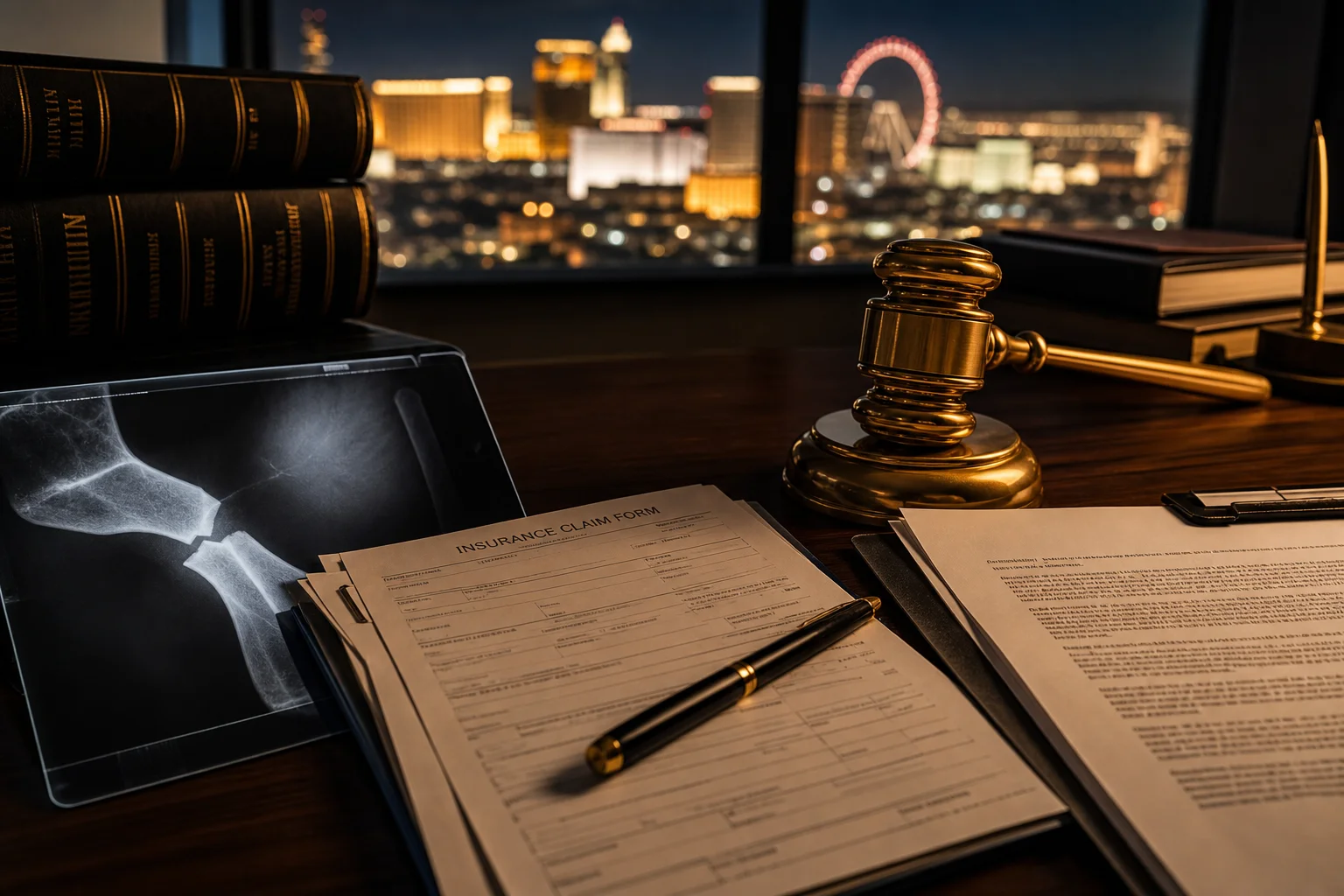
Broken Bone Injury Claims Las Vegas: What Compensation Is Available
Nevada law allows fracture injury victims to recover the full range of compensatory damages. The value of a broken bone injury claim depends on the severity of the fracture, the treatment required, how long the injury affects your ability to work and live normally, and whether the injury causes permanent impairment. Categories of compensation in a Las Vegas broken bone case include:
- Medical expenses: Emergency room visits, ambulance transport, diagnostic imaging (X-rays, CT scans, MRIs), orthopedic surgery, hardware implantation, hospital stays, prescription medications, physical therapy, occupational therapy, and follow-up appointments. Both past and future medical costs are recoverable.
- Lost wages: Income lost during your recovery period, including salary, hourly wages, bonuses, commissions, and self-employment income. Proper documentation through pay stubs, tax returns, and employer verification is essential.
- Loss of earning capacity: If a fracture causes permanent limitations that reduce your ability to perform your job or earn at your prior level, you may recover compensation for diminished future earnings. Vocational experts and economists can quantify this loss.
- Pain and suffering: Physical pain from the fracture itself, surgical recovery, physical therapy, and any chronic pain that persists after maximum medical improvement. Nevada does not cap general damages in personal injury cases (unlike medical malpractice).
- Emotional distress: Anxiety, depression, PTSD, sleep disruption, and the psychological impact of a serious injury and extended recovery.
- Loss of enjoyment of life: When a fracture prevents you from participating in activities you previously enjoyed — exercise, hobbies, travel, or playing with your children.
- Loss of consortium: Available to the spouse of a seriously injured victim for the impact on the marital relationship.
- Scarring and disfigurement: Surgical scars, visible deformity from a displaced fracture, or limb-length discrepancy.
For a detailed breakdown of damage categories, see our guide on tort elements in a Nevada car accident case.
Proving Negligence in a Fracture Injury Case
To recover compensation for a broken bone in Nevada, you must establish that another party’s negligence caused your injury. This requires proving four legal elements: duty of care, breach of that duty, causation, and damages. In practical terms, this means showing that the at-fault party owed you a responsibility to act safely (all drivers owe this duty to others on the road; property owners owe it to visitors), that they failed to meet that responsibility (running a red light, leaving a spill unattended, ignoring OSHA safety requirements), that their failure directly caused the accident that broke your bone, and that you suffered real, documented losses as a result.
Evidence that strengthens a fracture injury claim includes police accident reports, surveillance and traffic camera footage, witness statements, medical records documenting the fracture diagnosis and treatment, accident reconstruction expert analysis, photographs of the accident scene and your injuries, and employer records showing lost work time. An experienced attorney knows how to gather and preserve this evidence before it disappears — which is why consulting a lawyer soon after a fracture injury matters so much.
Nevada follows a modified comparative negligence rule. Under NRS 41.130, you can still recover damages even if you were partially at fault — as long as your fault does not reach 50 percent. Your compensation is reduced by your percentage of fault. For example, if your damages total $150,000 and you are found 20 percent at fault, you would recover $120,000. Learn more about Nevada’s comparative negligence rules.
Nevada’s Statute of Limitations for Broken Bone Claims
Under NRS 11.190, Nevada gives personal injury victims two years from the date of the accident to file a lawsuit. If you miss this deadline, your claim is permanently barred regardless of how severe your fracture was or how clear the other party’s fault may be. While two years may sound like plenty of time, evidence degrades quickly — surveillance footage is overwritten, witnesses move or forget details, and medical records become harder to obtain. Insurance companies also benefit from delay because they know injured people become more desperate for money as bills pile up.
Certain circumstances can affect the statute of limitations timeline. If the injured person is a minor, the clock generally does not begin until their eighteenth birthday. If the at-fault party is a government entity (a city bus, a poorly maintained public sidewalk), Nevada’s government claims process requires you to file an administrative claim within a much shorter window — often as little as two years under NRS 41.036, with specific procedural requirements that must be followed exactly. Consulting an attorney promptly ensures you meet every applicable deadline.
Steps to Take After Suffering a Fracture in an Accident
The actions you take immediately after a fracture-causing accident can significantly affect the outcome of your claim. Follow these steps to protect both your health and your legal rights:
- Seek emergency medical treatment immediately. Call 911 or go to the nearest emergency room. A same-day medical record linking your fracture to the accident is the single most important piece of evidence in your case.
- Report the accident. For car accidents, call law enforcement and obtain a police report. For slip and fall incidents, report the incident to the property owner or manager and request a written incident report. For workplace injuries, notify your employer and file the required workers’ compensation report.
- Document everything. Photograph the accident scene, your injuries, any hazardous conditions that caused the fall or crash, vehicle damage, and any visible bruising or swelling at the fracture site. If there are witnesses, get their names and contact information.
- Follow all medical advice. Attend every follow-up appointment, complete prescribed physical therapy, and do not skip doses of prescribed medication. Gaps in treatment give insurance adjusters ammunition to argue that your injury was not serious.
- Do not give a recorded statement to the at-fault party’s insurance company without first consulting an attorney. Adjusters are trained to elicit statements that minimize your claim.
- Keep a recovery journal. Document your daily pain levels, mobility limitations, activities you can no longer perform, sleep disruption, emotional effects, and how the injury affects your work and family life.
- Contact a Las Vegas personal injury attorney. Early legal representation ensures evidence is preserved, medical treatment is properly documented for litigation, and insurance companies cannot take advantage of you during a vulnerable time. Contact Thomas Boley online or call (702) 435-3333.
Frequently Asked Questions About Broken Bone Injury Claims
Q: How much is a broken bone injury case worth in Las Vegas?
A: The value depends on the type and location of the fracture, whether surgery was required, the length of your recovery, your lost income, and the impact on your quality of life. A simple wrist fracture treated with a cast has a different value than a comminuted femur fracture requiring multiple surgeries and permanent hardware. We evaluate each case individually based on documented medical evidence and losses — call us at (702) 435-3333 for a free case evaluation.
Q: Can I file a broken bone claim if I was partially at fault for the accident?
A: Yes. Nevada’s modified comparative negligence law (NRS 41.130) allows you to recover compensation as long as your fault is less than 50 percent. Your award is reduced by your percentage of fault. For example, if you are 15 percent at fault and your damages are $200,000, you would recover $170,000.
Q: What if the insurance company says my fracture was a pre-existing condition?
A: Nevada follows the “eggshell plaintiff” doctrine — a defendant takes the victim as they find them. If the accident aggravated, worsened, or accelerated a pre-existing bone condition (such as osteoporosis), you are entitled to full compensation for the worsening. The key is establishing your baseline condition before the accident and documenting the new or worsened injury through medical records and imaging.
Q: How long does it take to settle a broken bone injury claim in Nevada?
A: Most fracture cases settle between six months and two years after the injury, depending on the complexity of the fracture, the length of medical treatment, and whether liability is disputed. It is critical not to settle before reaching maximum medical improvement (MMI) — the point at which your doctors determine your condition has stabilized — because settling too early may leave future medical costs and permanent impairment uncompensated.
Q: Do I need a lawyer for a broken bone from a car accident, or can I handle it myself?
A: You are legally permitted to handle your own claim, but insurance companies have teams of adjusters and attorneys working to minimize payouts. Fracture cases involving surgery, extended treatment, lost wages, or disputed liability almost always benefit from experienced legal representation. A personal injury attorney handles all insurer communications, gathers and preserves evidence, retains medical and vocational experts, and negotiates from a position of knowledge about what your claim is actually worth. Our consultations are free.
Call Thomas Boley for Broken Bone Injury Claims in Las Vegas
A broken bone changes your life in an instant — weeks or months of pain, lost income, mounting medical bills, and the uncertainty of whether you will fully recover. You should not have to bear those costs alone when someone else’s negligence caused your injury. At the Law Offices of Thomas Boley, we represent fracture injury victims throughout Las Vegas, Henderson, North Las Vegas, Summerlin, Spring Valley, and all of Clark County. We handle your case on a contingency fee basis, which means you pay nothing unless we recover compensation for you.
Call (702) 435-3333 for a free consultation, or contact Thomas Boley online to get started. We are available to discuss your broken bone injury claim and help you understand your legal options under Nevada law. You may also find our guides on whiplash and soft tissue injury claims and what to do after a car accident in Las Vegas helpful. This article is informational only and is not legal advice. Every case is unique.
About the Author
Thomas Boley is a Nevada licensed attorney specializing in personal injury law and criminal defense. Since 2008, Thomas has represented thousands of clients in Las Vegas and Clark County, recovering millions of dollars in compensation for injury victims. He is a member of the State Bar of Nevada, the Clark County Bar Association, and the Nevada Justice Association.
Need Legal Help? Contact Thomas Boley for a free consultation: (702) 435-3333